[Stones and Stories] A Society Numb to Pain
![[Stones and Stories] A Society Numb to Pain](http://www.asiae.co.kr/news/img_view.htm?img=2026042110442634135_1776735866.jpg)
A narrow alleyway, so tight that two people walking side by side could touch the walls with their fingertips. Wooden gates that creak every time they open stand face to face in a row. Several households would share a single gate. Whether the house was owned or rented, four or five family members would crowd into just one or two rooms—a humble nest they called home.
The bathroom, which was a shared space, had a dim lightbulb precariously hanging from the ceiling. With only a single water tap placed in a corner of the yard, people would wash their faces and do laundry there. The saying that neighbors knew how many spoons each household owned was no exaggeration. There were no secrets in that place; everyone even knew whose child had been scolded by the teacher. When someone cooked a savory pot of doenjang jjigae, the aroma would drift into the next room, making mouths water. If someone made kimchi pancakes, it was only natural to share them with the neighbors.
If a child from next door came home with a scraped knee, neighbors would apply the so-called “red medicine” (povidone-iodine) from the first-aid kit, gently blowing on the wound, even if the child wasn’t their own. Sometimes the neighbors would sulk or quarrel over trivial things, but just a bowl of Makgeolli exchanged between them would quickly restore warmth to their relationship. This was life in a Seoul neighborhood in the 1970s, where even from a young age, people naturally learned that life was not so lonely after all.
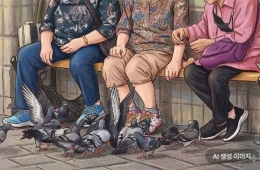
Back then, the alley was a training ground for social life. On a wooden platform, patched here and there with old linoleum, daily games of Janggi and Baduk were played with great excitement. When cool watermelon and hot boiled potatoes were brought out, bystanders and kibitzers would join in, turning it all into a small festival.
Half a century has passed, and where memories of the alley have vanished, massive concrete apartment buildings have risen. The space between apartment doors—no wider than those old alleyways—is now filled only with silence. It is difficult to know what people do for a living or how they are these days, and most make no effort to find out.
While privacy is guaranteed, it is hard to find any warmth between neighbors. Even when passing each other in the elevator, people turn their heads and stare intently at their smartphones, finding even a slight nod awkward. The firmly closed front doors rarely open. Within these layers of concrete barriers, children seldom get the chance to practice social living.
In today's world, people feel more familiar with those on the other side of online communities and social networking services (SNS) than with neighbors who offer warmth. In the flood of provocative language, the values of consideration and respect have nowhere to stand. Some even charge themselves with pleasure by expressing hostility toward the world and others. Even if one hurls harsh words at invisible targets, anonymity allows them to escape responsibility. In a world where hate and ridicule have become playthings, the sad echo continues to erode the foundations of our communities.
We live in the same era as those who visit the graves of former presidents to take photos symbolizing hatred, laughing among themselves. What does cursing the world change? After a fleeting laugh, only a long-lasting emptiness follows. It is lamentable to see this foolish struggle, passing down a society where the sense of pain has been dulled.
Hot Picks Today
!["Big Gains for Holders... Up 566% and Still More to Go" Target Price Raised, But Here’s Why Caution Remains [Weekend Money]](https://cwcontent.asiae.co.kr/asiaresize/93/2025090513580721483_1757048288.jpg) "Big Gains for Holders... Up 566% and Still More to Go" Target Price Raised, But Here’s Why Caution Remains [Weekend Money]
"Big Gains for Holders... Up 566% and Still More to Go" Target Price Raised, But Here’s Why Caution Remains [Weekend Money]
- "Data Centers Ignite ESS Order Rally Expectations for This Company [Weekend Money]"
- "Achieving 1 Billion Won Through Stocks" Office Worker Remains Optimistic Despite Mandatory Paid Leave and Halved Salary
- [The View]There Are Different Types of 'Bait'
- "Best Homeroom Teacher"... Hong Kong Education Sector in Shock Over Spread of "Princess Carry" Photos
Sometimes, I miss the days when pain was contagious. A world where people lived as if others’ pain were their own, sharing a bite of kimchi pancakes and blossoming with laughter together. Will we ever again experience a world where the warmth of empathy is alive and breathing?
© The Asia Business Daily(www.asiae.co.kr). All rights reserved.