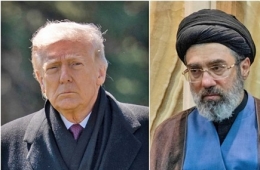
'On the Verge of Peace'... U.S. and Iran Face Off Over Hormuz and Nuclear Issues
Iranian Hardliners Intensify Pressure Over Control of the Strait and Other Issues
Final negotiations for a peace agreement between the United States and Iran are facing last-minute difficulties. Both sides continue to maintain a hardline stance, upholding their respective 'red lines' over control of the Strait of Hormuz and the handling of highly enriched uranium (HEU).
According to the White House on May 27 (local time), U.S. President Donald Trump said during a Cabinet meeting, "Iran very much wants to make a deal," but added, "So far, they have not reached a level that satisfies us."
He continued, "Either that (the deal) happens, or we just need to finish things ourselves," adding, "Maybe we will have to go back and end it, or maybe there is no need to do that for now."

However, the U.S. government has left the door open for negotiations. Secretary Rubio, who attended the meeting, stated, "There has been some progress and there is interest," adding, "We will see in the next few hours or days if further progress is possible." He emphasized that "diplomacy is always the first option," prioritizing a solution through negotiation.
The main issues are control over the Strait of Hormuz and Iran's nuclear program. President Trump said regarding control of the Strait of Hormuz, "No one will control it," and added, "It is international waters." He continued, "The strait will be open to all nations, and the United States will be watching over it."
This is in direct opposition to Iran’s demand for control over the strait as a condition for a peace agreement. According to the Financial Times (FT), hardline conservatives from the Paydari faction in Iran are pressuring the negotiation team, defining the exclusive control over the Strait of Hormuz, the imposition of shipping tolls, and the prohibition of ships linked to Israel as their 'red line.'
The gap between the two sides on the nuclear program also remains unresolved. In a brief phone interview with PBS, President Trump was asked whether Iran could receive sanctions relief in exchange for giving up highly enriched uranium (HEU); he replied, "No. Absolutely not. Sanctions relief is not on the table."
In the Cabinet meeting, President Trump also said, "We are not talking about sanctions relief or giving money," and added, "We will return the money only when they act properly."
The backlash from hardliners within Iran is another variable in the negotiations. According to the FT, hardliner lawmakers have publicly criticized the negotiation team for making excessive concessions to the United States beyond the authority of Iran's new leader Mojtaba Khamenei. They are demanding a complete lifting of U.S. sanctions, guarantees that sanctions will not be reimposed in the future, and even compensation for war damages.
Hot Picks Today
 "Buying in China Is a Rip-off" "Saved 550,000 Won on Van Cleef Necklace in Korea"... Surge of Foreign Luxury Shoppers
- 'An Hourly Wage of 1 Million Won'... 40,000 Applicants Flock to Unique Lotte World Part-Time Job Promising Fun
- BTS and BLACKPINK Fill Wembley and Tokyo Dome, but in Korea They Struggle for Stadium Slots Amid Turf Concerns [K-pop’s Home Lacks a Performance Dome]
- "Worse Than the War That Killed 3 Million"... Why Japan's Crisis Is So Dire
- "183 Pyeong with Swimming Pool, Cabanas, and Two Gardens: Three-Story 'Super Penthouse' Tempts Wealthy Investors [Real Estate AtoZ]"
Meanwhile, on the morning of May 27, Iran’s state broadcaster reported that it had obtained a draft memorandum of understanding (MOU) for the peace agreement being discussed between the United States and Iran, which allegedly included the lifting of the U.S. maritime blockade and normalization of the Strait of Hormuz. However, the White House immediately denied this, calling it a "complete fabrication."
© The Asia Business Daily(www.asiae.co.kr). All rights reserved.