"Pinpointing Only Fraud Rings"… Target-Centric Network Analysis Technology Developed [Reading Science]
Exploring Only 'Meaningful Groups' Without Access to Complete Data
Potential Applications in Customer Analysis, Fraud Detection, and New Drug Development
A domestic research team has developed an analytical technology that efficiently identifies only those groups that are strongly connected to a specific target within complex network data. This technology is expected to be utilized in various fields, such as analyzing small groups of enthusiastic customers, tracking suspicious accounts for fraud, and developing new drugs based on protein network analysis.
On May 28, UNIST (Ulsan National Institute of Science and Technology) announced that the research team led by Professor Kim Junghoon from the Department of Computer Science has developed a new community analysis algorithm. This algorithm explores only significant groups of a specified size, while ensuring that the user-designated target is always included.

Comparison of Community Exploration Performance Based on Real Network Data. The research team's algorithm identified actual groups with higher accuracy than existing methods in real network data such as the Karate Club and Dolphin social networks. It also effectively found groups with dense internal connections and clear separation from external nodes in large-scale networks like Amazon and YouTube. The example below shows community results explored around the target user, where a higher number of blue nodes and fewer red nodes indicate higher group identification accuracy. Provided by the research team
View original imageCommunity exploration is a technology that identifies groups with strong internal connections within large-scale network data. It is used in social networking service (SNS) recommendation systems, detection of abnormal financial transactions, and analysis of biological networks. Existing technologies often require access to the entire network, making them difficult to use in environments with privacy restrictions or massive data volumes. There was also the issue of weakly connected targets being grouped together.
The research team developed a method that allows users to identify only “actually meaningful groups” around their specified target, without needing to access the entire network.
The algorithm starts from a specific node and explores surrounding candidates one by one, expanding the group. During this process, it calculates how much the overall connectivity improves when a new candidate is added, and it is designed so that the score does not easily increase as the group size becomes unnecessarily large.
In addition, instead of simply looking at individual connections, the algorithm also analyzes small clusters of nearby connections, enabling it to capture relationships that may not stand out individually but reinforce group characteristics when considered together.
"Fraud Detection and Niche Customer Analysis"… Real-World AI Analytical Technology
Performance improvements were also confirmed in experiments using real network data. According to the research team, the F1 score improved by up to 1.39 times and the ARI score by up to 5.95 times compared to the best existing methods. This means the algorithm can more accurately identify the target group while including fewer weakly connected entities.

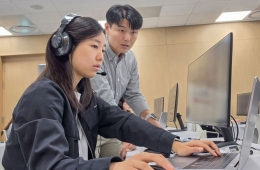
Research team photo. Professor Kim Junghun (left) and researcher Kim Dahi. Courtesy of UNIST
View original imageThe research team expects this technology to be highly useful in real industrial environments. For example, in marketing, it can be used to precisely extract small groups of loyal customers; in finance, it can be applied to detect groups connected to suspicious accounts; and in biology, it can provide clues for new drug development by analyzing protein interaction networks.
Professor Kim Junghoon explained, “In real-world network analysis, it is often difficult to access all data at once, and the required group size is usually predetermined. This technology focuses on quickly identifying only meaningful relationships around the target of interest.” He added, “It can be applied to various fields such as recommendation services, detection of abnormal transactions, and protein network analysis.”
Hot Picks Today
 "Please Pay Me at Least 3 Million Won a Month": More Than Half of Young People Today Prioritize "Working Conditions" Over Company Size
- Selling Like Crazy Every Year... 30-Year-Old Hetbahn Takes on a New Challenge: Tastes Better Than "Mom's Home Cooking" [On-Site Report]
- "Americans Would Be Amazed If They Came": Wide-Eyed at a Sight They've Never Seen Before... Foreigners Also Fall for K-Baseball [K-Holic]
- "Hey, Lady, Teach Your Kids to Behave!" ... 300,000 Won in Cash and a Bodily Injury Claim Demanded Over Child's Door Ding
- Beachgoer Finds 'Plastic' That Turns Out to Be Perfume Ingredient Worth More Than Twice as Much as Gold
This research was conducted with UNIST researcher Kim Dahi as the first author and supported by the National Research Foundation of Korea. The results will be presented at the 2026 ACM SIGMOD International Conference on Management of Data, one of the most prestigious conferences in the field of databases.
© The Asia Business Daily. All rights reserved. Unauthorized AI training and use prohibited.