[Reporter’s Notebook] No "One Team" in Samsung’s Labor-Management Agreement
Internal Discord Persists Over "Memory-Centric Agreement"
Behind Samsung's "Super Gap" Lies a Structure of Symbiosis
The Company Must Consider Synergy and Integration Across Divisions
![[Reporter’s Notebook] No "One Team" in Samsung’s Labor-Management Agreement](http://www.asiae.co.kr/news/img_view.htm?img=2026052716390178600_1779867540.jpg)
The wage negotiation agreement between Samsung Electronics labor and management has been approved, marking the beginning of the end for a prolonged conflict. It is fortunate that the crisis of an unprecedented general strike was averted and that labor-management clashes did not escalate to the extreme. However, this incident has left a more fundamental question within Samsung: Is Samsung still a "one team"?
What ultimately resolved the conflict during this round of negotiations was a 600 million won performance bonus focused on the memory division. It was a bold decision that quelled the dissatisfaction of memory employees who had been demanding compensation at the level of competitors. However, in that process, the Foundry and System LSI divisions, which have continued to struggle with profitability, were effectively treated as organizations without achievements, and the finished goods divisions such as TV and home appliances also received relatively smaller rewards, leading to continued complaints that the agreement favored certain groups. Of course, a performance-based approach is a natural principle for any company. It is undeniable that the memory business supported Samsung's performance last year. The problem is that the secret to Samsung's current position cannot be attributed solely to "performance distribution."
In the past, Samsung's competitiveness stemmed from a philosophy of "maintaining a super gap." It was a collective goal to raise technology and productivity to a level no one else could match. In this process, Samsung enhanced synergy through inter-division collaboration and support. When the semiconductor business faltered, the mobile division held firm, and in order to grow system semiconductors, the company proactively installed its own chips in smartphones. The once-booming finished goods businesses such as TVs and home appliances also played the role of stable customers for Samsung's semiconductors, growing together. The reason why Samsung Electronics, once a memory-focused company, was able to grow into a fully integrated device manufacturer (IDM) was also due to the symbiotic relationship between memory and non-memory segments.
Even today, Samsung's memory competitiveness is not solely the result of the memory division's efforts. The company has highlighted its status as the "world’s only IDM company" while announcing the world's first mass production of next-generation High Bandwidth Memory (HBM) 4. HBM, too, is the result of combined capabilities in packaging, design, and foundry collaboration. Especially as the era of artificial intelligence (AI) semiconductors demands increasingly advanced technologies, the boundaries between memory and non-memory are blurring. While aggressive investment in memory talent is necessary, there must also be simultaneous consideration of new growth engines that will come "after memory."
Hot Picks Today
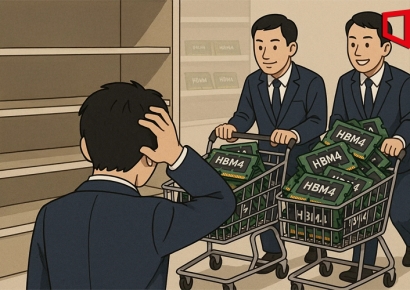 "What Will Retail Investors Do With No Ammo Left?... Samsung Electronics and SK Hynix See Another Rosy Outlook"
- "Switching from Stocks to Savings?"... Up to 19.4% Annual Interest Rate Offered from June 22
- [Exclusive] Bought for 16.6 Billion Won from Kang Hodong, Sold to Noh Hongchul for 15.2 Billion Won: Even Hotspots Become Loss Sales... Gangnam Small Buildings Face 'Tearful Discounts' [Real Estate AtoZ]
- "My Stocks Alone Crashing in a Bull Market? Turns Out... 82% Are in the Same Boat"
- Trump Urged "Buy Quickly"...Stock Soared 39% Overnight
The competitiveness of an industry comes from a robust ecosystem. Taiwan's rise as a semiconductor powerhouse was also built on a structure where fabless companies like MediaTek grew alongside TSMC. In an era where the competitiveness of an entire industry cannot be sustained by the achievements of a single business, what Samsung needs now is to go beyond a simple debate over compensation and contemplate how its memory, non-memory, and finished goods businesses can once again form a symbiotic structure. Rather than evaluating and ranking each business division solely by performance and results, it is time to pursue strategies that consider synergy and integration across divisions.
© The Asia Business Daily(www.asiae.co.kr). All rights reserved.