Early Summer Triggers Vegetable Price Surge... Green Onion Wholesale Prices Soar 213% in One Month
Change in Harvest Season Leads to Supply Shortages for Some Vegetables
Wholesale Prices of Green Onions, Lettuce, and Oi-gochu on the Rise
Food Prices Unstable Following Livestock Products
Large Supermarkets Secure Supplies in Advance, Seek
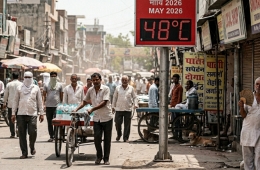
With hot and humid summer weather, with daytime highs approaching 30 degrees Celsius, arriving earlier than usual in 2026, the previously stabilizing vegetable prices have started to rise again. The change in the harvesting season has led to a shortage of supply in production regions, fueling the price increases. Amid continued high prices for livestock products and eggs, major retailers such as large supermarkets are seeking to ease the burden on consumers by sourcing alternative production areas and securing supplies in advance to help stabilize prices.

Green onions are displayed at a large supermarket in Seoul. Photo by Jinhyung Kang
View original imageAccording to the Korea Agro-Fisheries & Food Trade Corporation (aT) agricultural and fisheries market price information service 'KAMIS' on May 27, the vegetable that saw the largest wholesale price increase as of May 26 was green onions, with prices per kilogram rising 107.1% year-on-year to 2,462 won. Compared to late April, prices surged 213.6% in just one month. An industry official explained, "From early to mid-May, production switches to fresh green onions from regions such as Jeonju, Wanju, Gimcheon, and Pocheon, but due to large temperature fluctuations in March, when the crops needed to mature, there was a shortage of high-quality produce. As a result, shipment volumes have decreased and auction prices are rising."
Lettuce, representing leafy vegetables, is also seeing higher prices. The wholesale price for 4 kilograms of green lettuce has reached 24,024 won, up 62.5% compared to the same period last year and 103.8% higher than in late April. Even compared to the three-year average for late May, excluding the lowest and highest prices of the past five years, it is 86.9% more expensive. Prices for cucumber peppers have also risen, with wholesale rates at 48,997 won—up 54.4% year-on-year and 27.7% higher than the average for late May. The industry analyzes that the temporary drop in shipments during the transition from spring to summer, combined with farmers switching to crops with relatively higher prices, has reduced supply and contributed to the price increases.

In addition, popular items such as napa cabbage, onions, and perilla leaves are also seeing wholesale prices rise by around 10% compared to the same period last year. Because it typically takes about a week for changes in wholesale prices to be reflected in retail stores, consumer prices for these vegetables could soon rise further. Already, the retail price for green onions is 2,827 won per kilogram, marking a 32.7% increase year-on-year. The government has been preparing for stable supply and demand for key vegetables in and after June—when heavy rain and heat waves are concentrated—by stockpiling items such as napa cabbage, radishes, and onions, which saw increased shipments during last winter and spring. Nonetheless, price instability has begun earlier than expected.
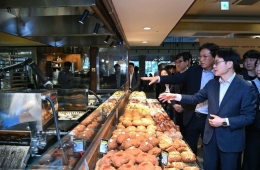
Large supermarkets are also closely monitoring price volatility in key vegetables and are seeking countermeasures. In the case of green onions, Emart is securing supplies in advance if unfavorable weather such as rain is expected, and storing them short-term at its own fresh food logistics center to maintain quality and price. For lettuce, the company is focusing on securing stable supplies mainly from major farm regions such as Icheon and Nonsan.
Hot Picks Today
 There Was a Real "Money-Making Machine" Soaring 538%... A Large-Cap Stock Outperformed Samsung and SK hynix
- "Just Two Glasses a Day Significantly Lower Blood Pressure... This Juice Controls Hypertension in Older Adults in Just Two Weeks"
- Bank of Korea: "If Semiconductor Export Volume Rises Over 20%, Growth Above 3% Possible"
- Women Enter Men's Restroom Due to Long Lines for Women's Restroom... "Wouldn't It Be Sexual Harassment If Men Did That?" Sparks Controversy
- Busan's Signature Dish Named "World's Most Dangerous" by CNN: The Truth Behind the Korean Cuisine

Lotte Mart is also responding by offering 'Tomorrow Farm Lettuce and Perilla Leaves' grown in smart farm facilities, maintaining consistent quality and enabling stable supply. A Lotte Mart official stated, "For green onions, we are monitoring crop conditions and shipment status in key production regions such as Cheorwon and Pyeongchang in Gangwon Province in real time, and we are also identifying alternative production areas such as Jeonju and Wanju in North Jeolla Province and Osong in North Chungcheong Province to secure stable supplies."
© The Asia Business Daily(www.asiae.co.kr). All rights reserved.