AI Now Fries Soboro Bread Too... Manufacturing AI Permeates Seongsimdang
Seongsimdang Automates Fried Soboro Production with AI and Robotics
AI Learns Dough Injection, Bread Flipping, and Defect Detection
"AI That Detected Semiconductor Defects Now Identifies Soboro Quality" ... Accelerating AI Transformation in Everyday Industries
Now, even Seongsimdang's Fried Soboro bread is being made by AI. The process of adding dough, flipping bread, and determining the frying condition is now being learned and performed by AI and robots. There is a growing assessment that manufacturing AI is starting to penetrate not only advanced factories in the semiconductor and automotive sectors, but also food production sites closely linked to everyday life.
On May 27, Minister of Trade, Industry and Energy Kim Jeonggwan visited the Seongsimdang location at Lotte Department Store in Daejeon to inspect the AI factory demonstration and hosted a roundtable on "Expanding AI in Manufacturing Sites Experienced by the Public."
Rosso, the operator of Seongsimdang, is applying an AI-based automation system to the Fried Soboro production process in collaboration with AI company Roilabs and robotics company Intertech. The AI analyzes the temperature and humidity of the frying environment and the condition of the product in real time, while the robot performs dough injection and bread flipping. The goal is to fully automate the process up to the final packaging by automatically determining the size of the bread, whether it has been flipped, and even over-fried conditions. The Ministry of Trade, Industry and Energy estimates that this could increase productivity by 20%.
Until now, much of Seongsimdang's Fried Soboro production has relied heavily on manual labor. In particular, the repetitive task of flipping bread in front of hot oil and checking its condition was highly labor-intensive. This project is significant in that it automates a process that previously depended on the senses of skilled bakers, using AI to learn based on data.

Minister Kim stated, "We have confirmed that the vision AI model for detecting defects in semiconductor substrates is technologically similar to the model for detecting defects in Soboro bread," adding, "We will boldly apply M.AX not just to advanced industries and core manufacturing sectors, but across the entire economy."
Minister Kim also emphasized, "The AI that determines frying results is technologically similar to vision AI models that detect things like steel plate cracks or semiconductor substrate defects," and stressed, "M.AX has proven itself as a powerful policy that can be applied broadly, including to small businesses and the service sector."
The Seongsimdang team also expressed optimism about the introduction of AI. Lim Youngjin, CEO of Seongsimdang, said, "We hope to reduce the hardship faced by employees who had to endure extremely hot conditions while making Fried Soboro," and added, "We are positively considering upgrading the newly introduced AI models and robots further and expanding them to other branches."
Roilabs, which supplied the AI solution, noted that this project provided a new industrial reference. It confirmed that manufacturing AI, which has previously focused on semiconductors and factory automation, can also be expanded into the food and F&B sectors.
This case is part of the "AI Factory Project for Public Experience," a component of the Ministry of Trade, Industry and Energy's ongoing Manufacturing AI Transformation (M.AX) initiative. M.AX is a policy aimed at boosting productivity by applying AI across the entire manufacturing sector, and until now, it has mainly focused on core manufacturing industries such as semiconductors, steel, automotive, and shipbuilding. However, recently, the scope of AI application has expanded to include lifestyle-centric industries such as food, logistics, and service sectors.
Since launching the M.AX Alliance in September last year, the Ministry has been expanding cooperation between the manufacturing and AI industries and research institutions. The Ministry explained, "The core battlefield of global AI competition is shifting from virtual spaces to real-world manufacturing sites," and added, "Securing high-quality manufacturing data is the key to competitiveness in manufacturing AI."
In particular, the Ministry sees it as a strength that Korea's manufacturing sector possesses a diverse industry portfolio and comprehensive on-site data. Utilizing production data from each industry to train AI models can lead to the optimization of manufacturing processes, quality improvement, and productivity gains. So far, the Ministry has deployed 102 AI factories and plans to add another 100 this year.

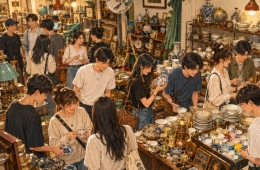
At Seongsimdang, a representative landmark of Daejeon, customers are choosing bread. Photo by Huh Younghan
View original imageThe Seongsimdang project is cited as an example of how this manufacturing AI strategy can extend beyond large corporate factories to small businesses and the service sector. In fact, the public experience projects unveiled on the same day included numerous cases from the food and logistics sectors.
Hoegok Brewery in Andong is applying AI and robotics to the fermenter stirring process, which previously depended on the skills of master brewers. The system learns the tacit knowledge of experts—such as assessing the state of the fermenter, timing, and intensity of stirring—and transfers it to the robot to ensure consistent quality. Jangchungdong Wang Jokbal Bossam has introduced an AI-based system for selecting substandard meat and precise packaging, and the Army Smart Logistics Center is conducting a demonstration project for supply sorting and packaging robots.
Hot Picks Today
!["Please Teach Us the Technology"—Korea Once Sought Help from Japan... Now Threatens the Origin Country After 65 Years [Advance of K-Ramen]①](https://cwcontent.asiae.co.kr/asiaresize/93/2024110818333992902_1731058419.jpg) "Please Teach Us the Technology"—Korea Once Sought Help from Japan... Now Threatens the Origin Country After 65 Years [Advance of K-Ramen]①
"Please Teach Us the Technology"—Korea Once Sought Help from Japan... Now Threatens the Origin Country After 65 Years [Advance of K-Ramen]①
- [Breaking] Former North Gyeongsang Provincial Councilor Sentenced to 1 Year in Prison for Requesting Nomination from Geonjin Beopsa
- "Peaceful Swim Turns Nightmare"... US Woman Gets 38 Stitches After Sudden Otter Attack in Lake
- "I Thought I Could Live Off the Rent From a 4 Billion Won Building"…Haein Lee Admits to Hundreds of Thousands in Monthly Losses
- Ignored "Don't Build Homes Here" Warning... Surge of Cancer Cases in Wealthy California Town
Going forward, the Ministry plans to expand the scope of AI demonstrations not only to manufacturing plants but also to lifestyle-oriented facilities such as food, cosmetics, and hotels. The Ministry intends to continuously expand "public experience projects" so that people can directly feel the effects of AI transformation in their daily lives.
© The Asia Business Daily. All rights reserved. Unauthorized AI training and use prohibited.