South Korea's Net External Financial Assets Post Second Largest Decline on Record as Stock Prices Surge
Bank of Korea Releases Preliminary Q1 International Investment Position
Net External Financial Assets Drop by $132.1 Billion... Second Largest Decline on Record
"Booming Domestic Stock Market" Drives Foreign Equity Investment Up by $122.1 Billion
Net external financial assets (external financial assets minus external financial liabilities), which indicate South Korea's external payment capacity, recorded the second largest quarterly decrease on record in the first quarter of this year. This is the result of a sharp rise in domestic stock prices, which fueled a surge in foreign investment in Korean securities, causing external financial liabilities to increase more than external financial assets.

Net external financial assets at $753.6 billion, cumulative decrease of $283.6 billion over two quarters
According to the "Preliminary International Investment Position for Q1 2026" released by the Bank of Korea on the 27th, as of the end of the first quarter, South Korea's net external financial assets stood at $753.6 billion, down $132.1 billion from the previous quarter's $885.7 billion. This marks the second consecutive quarterly decrease, and the second largest drop on record, following the $151.5 billion decline in the fourth quarter of last year.
This was because external financial liabilities, representing foreign investment in Korea, increased much more than external financial assets, which represent Koreans' investment abroad. External financial assets rose by $15.0 billion from the previous quarter, mainly due to increased direct investment by residents. External financial liabilities soared by $147.1 billion from the previous quarter, primarily owing to a surge in non-residents’ investment in securities.
External financial assets rise just $15.0 billion due to global market correction and higher interest rates
At the end of the first quarter, South Korea's external financial assets stood at $2.8826 trillion, an increase of $15.0 billion from the previous quarter, marking a new all-time high. However, despite the continued growth in direct investment, the increase was limited to $15.0 billion as a correction in global equity markets and rising interest rates led to a decline in the valuation of securities, resulting in a drop in securities investment.
The largest contribution to the increase came from residents’ direct investment, which rose by $15.4 billion to $851.7 billion, mainly due to continued equity investment in the U.S. In contrast, securities investment decreased by $15.1 billion to $1.2381 trillion, marking the first decline since the $2.4 billion decrease in the fourth quarter of 2024. In detail, equity securities declined by $9.3 billion to $966.9 billion due to a decrease in valuation stemming from the global market correction. Debt securities also fell by $5.8 billion to $271.2 billion as higher global interest rates reduced bond valuations.
Other investment (at $317.4 billion) rose by $3.4 billion, driven by an increase in trade credit on the back of strong exports. Reserve assets (at $423.7 billion) decreased by $4.4 billion, reflecting a decline in the dollar-converted value of non-dollar foreign currency assets due to the strong U.S. dollar and stabilization measures such as foreign exchange swaps by the National Pension Service.

On the 26th, the status board in the Hana Bank dealing room in Jung-gu, Seoul, displayed the KOSPI and other indices. On that day, the KOSPI closed at 8047.51, up 199.80 points (2.55%) from the previous trading day. Photo by Yonhap News.
View original imagePossibility of continued decline in Q2... Interpreting it as a crisis signal is excessive
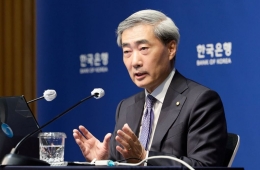
A further decrease in net external financial assets is likely in the second quarter of this year. This is because the domestic stock market remains bullish, with the KOSPI index surpassing 8,000. Moon Sangyun, Head of the Overseas Investment Statistics Team at Economic Statistics Department 1 of the Bank of Korea, stated, "So far, the continued and accumulated current account surplus has resulted in foreign currency inflows, which have been channeled into overseas investments. As a result, net external financial assets have consistently increased, surpassing $1 trillion, mainly due to the expansion of overseas investment." He added, "However, since the second half of last year, a continued current account surplus signals strong performance by export companies. This has led to a revaluation of domestic companies, especially semiconductor firms, pushing up domestic stock prices and thus driving an increase in external financial liabilities." He pointed out that it remains to be seen whether the recent trend of declining net external financial assets will continue amid the ongoing rise in domestic stock prices.
However, he dismissed concerns that the decline in net external financial assets could trigger a crisis in South Korea's external payment capacity as unfounded. Moon noted, "The upward trend in external financial assets is expected to continue," and explained, "Whether net external financial assets increase or decrease will depend on whether external financial liabilities continue to rise as rapidly as they have recently, even as external financial assets grow." He also emphasized, "This is a situation where price factors—which are financial variables—are changing, rather than a fundamental change in transaction factors. Since price factors can fluctuate rapidly, we need to keep monitoring the situation." He added that, as the rise in domestic stock prices is backed by solid corporate performance, this should also be viewed as a positive factor.
Increase in external financial liabilities ranks fourth highest on record due to domestic stock surge
At the end of the first quarter, external financial liabilities stood at $2.129 trillion, up $147.1 billion from the previous quarter. Despite foreigners selling Korean stocks, the significant rise in stock prices led to a substantial increase in equity securities. The magnitude of the increase ranks as the fourth largest on record after $240.3 billion in Q4 2020, $236.5 billion in Q4 last year, and $217.7 billion in Q2 last year.
Foreign securities investment rose by $108.3 billion to $1.4729 trillion. In particular, equity securities surged by $122.1 billion to $1.0325 trillion amid the bullish domestic stock market. In contrast, debt securities fell by $13.8 billion to $440.4 billion as rising government bond yields and a weaker won reduced bond valuations. Direct investment decreased by $1.3 billion to $320.7 billion. Other investment (at $263.4 billion) increased by $15.3 billion, mainly due to an uptick in cash and deposits.
The ratio of short-term external debt to reserve assets, an indicator of external debt soundness, rose by 1.4 percentage points to 43.3% from 41.9% at the end of the previous quarter. The proportion of short-term external debt in total external debt, which indicates external payment capacity, also edged up by 0.4 percentage points to 23.7% from 23.3% over the same period. Regarding this, Moon stated, "Considering that the increase in short-term external debt was mainly due to a rise in confirmed liabilities related to foreigners’ sales of Korean stocks, rather than new borrowing, both external payment capacity and external debt soundness remain robust."
Hot Picks Today
 "Just Two Glasses a Day Dramatically Lowered Blood Pressure... The Juice That Controlled Seniors’ Blood Pressure in Two Weeks"
- Galaxy S26 Now "Free" Just Two Months After Release... Fierce Subsidy Battle Among Three Major Carriers
- There Was a Real "Money-Making Machine" Soaring 538%... A Large-Cap Stock Outperformed Samsung and SK hynix
- "Daughter Consults ChatGPT After Fight with Father, Leading to Manager’s Resignation... AI Crisis Response Sparks Debate in Japan"
- "My Most Respected Father"... Pharmacist YouTuber Yakbbu Loses Father in Seosomun Overpass Accident
Most of the increase in short-term external debt was attributable to a rise in non-residents’ won-denominated deposits and unpaid liabilities resulting from foreign sales of Korean stocks. Foreigners selling Korean stocks leads to a decrease in equity-type liabilities, while increases in won-denominated deposits and unpaid liabilities result in a rise in confirmed temporary liabilities. Notably, the proportion of short-term external debt is still much lower than in the past, and given the high level of net short-term external assets, which has risen to $469.4 billion, the likelihood of a foreign currency liquidity shortage caused by a sudden outflow of short-term funds is assessed to be low.
© The Asia Business Daily(www.asiae.co.kr). All rights reserved.