Will the Oil Price Shock Hit the Dinner Table? Inflation Eyes 3% for the First Time in Two Years

Amid the protracted Middle East conflict, the combined shock of high oil prices and a strong U.S. dollar is significantly raising the likelihood that the consumer price inflation rate will surpass the 3% range this month. The sharp surge in global oil prices appears to be spilling over into service and processed food prices. In addition, the base effect from last year’s drop in agricultural prices and the simultaneous rise in food raw material costs are intensifying inflationary pressures.
Producer Prices Soar... Supply Chain-Driven Inflation Accelerates

On the 3rd, citizens were shopping at a large supermarket in downtown Seoul. According to the consumer price trend for July announced by the Statistics Korea on the same day, the prices of agricultural, livestock, and fishery products rose by 9.7% compared to a year ago. In particular, eggs surged by 57.0%, marking the highest increase in four years since July 2017 (64.8%). Photo by Moon Honam munonam@
View original imageAccording to relevant ministries on May 28, the Ministry of Economy and Finance, the Bank of Korea, and other price authorities are not ruling out the possibility that this month’s consumer price inflation rate could expand from the upper 2% range to the low 3% range. Rising fuel prices are spilling over into food and service costs, increasing the overall inflation burden. In fact, producer prices—which reflect costs incurred by factories and businesses before goods reach consumers—have already surged significantly. When production costs rise, consumer prices for goods often follow over time.
According to the Bank of Korea, producer prices in April rose by 2.5% from the previous month. This is the largest month-on-month increase in about 28 years since February 1998, during the foreign exchange crisis. Compared to the same month last year, producer prices jumped 6.9%, marking the highest level in three and a half years. Prices for coal and petroleum products soared 31.9% in just one month, a direct result of rising global oil prices driving up domestic production costs. Such increases at the production stage are highly likely to filter through to consumer prices over time. As companies’ cost burdens grow, this can lead to higher prices for processed foods, dining out, and services. In April, the domestic supply price index rose 5.2% from the previous month, with raw material prices surging by 28.5%.

Oil, Agricultural, Livestock, and Fishery Products: The Boomerang of the 'Base Effect'
The problem is that even the price trends of agricultural, livestock, and fishery products—which have helped contain inflation so far—are increasingly likely to reverse. In April, prices for these products fell by 0.5% year-on-year due to increased supply, partially offsetting overall inflation. However, since agricultural prices dropped sharply in May last year, the inflation rate is likely to be calculated higher this year even if prices remain at the same level, due to the 'base effect.'
In addition, the upward trend in international food raw material prices is another risk factor. According to the Food and Agriculture Organization (FAO), last month’s global food price index reached 130.7 points, up 1.6% from the previous month. In particular, the edible oil price index surged 5.9% to 193.9 points, the highest since July 2022. This was driven by simultaneous increases in the prices of palm, soybean, and sunflower oils.
The global rise in edible oil prices is not just a matter of oil itself. It is highly likely to lead to higher production costs for processed foods such as ramen, snacks, bread, and fried chicken. With global oil prices rising, logistics and packaging costs are also climbing, which could affect food prices more broadly. Within the government, there is concern that the lagged impact of higher international raw material prices may start to be fully reflected in consumer prices starting this month. Yoo Sangdae, Deputy Governor of the Bank of Korea, expressed concern, saying, "In May, with oil prices remaining high and the base effect from agricultural, livestock, and fishery products, the rate of price increases is likely to accelerate."

On April 30, Deputy Prime Minister and Minister of Economy and Finance Koo Yoon-chul is speaking at the Emergency Economic Meeting, Economic Relations Ministers' Meeting, and Foreign Economic Ministers' Meeting held at the Government Seoul Office in Jongno-gu, Seoul. 2026.4.30 Photo by Jo Yongjun
View original imageRising Costs of Raw Materials Due to Russian Strength
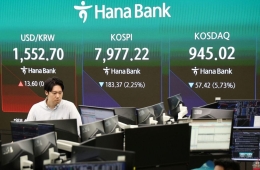
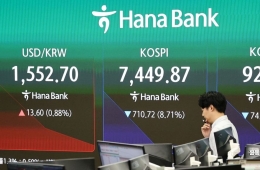
The won-dollar exchange rate surpassing 1,500 won is another destabilizing factor fueling inflation. A rising exchange rate is particularly burdensome for countries like South Korea that are highly dependent on imports. Korea imports large amounts of crude oil, grains, feed, and various raw materials, with most transactions settled in U.S. dollars. For example, if the exchange rate is 1,400 won per dollar, buying $100 worth of crude oil costs 140,000 won, but if the rate rises to 1,500 won, the cost increases to 150,000 won. Thus, costs rise solely due to exchange rates, even if oil prices themselves do not increase. According to the Seoul foreign exchange market, the won-dollar exchange rate hovered around 1,450 won early this month, but began to climb rapidly in mid-May, reaching an intraday high of 1,517.2 won on May 22.
Hot Picks Today
 Ballot Box Found in Trash... Peru Holds Runoff Amid 'Ballot Shortage Crisis'
- [Exclusive] "Why Is Only My Stock Not Rising?" The Reason Revealed... Suspicions of 'Stock Price Suppression' Mocking Government Policy [Wealth Succession] Intops②
- "Exactly the Same Early Voting Results in Songdo 1-dong and 2-dong?"... Uproar Over Ballot Counting
- $28 for a Beer: "Is This for Real?"... U.S. Stadium Prices Make Headlines Ahead of World Cup
- "Click! Gotta Post on SNS"... 'Small Luxury' for 20s and 30s Cools Down Amid High Inflation
From the perspective of businesses, this means facing the dual burden of higher oil prices and a stronger dollar at the same time. Ultimately, these cost pressures are spreading to the petrochemical, logistics, and food industries, and over time are highly likely to translate into higher consumer prices for gasoline, processed foods, and dining out. Recently, there have even been reports of increased short-term foreign exchange trading for investment purposes in response to the rising exchange rate. This signals more companies and investors are buying dollars in anticipation of further appreciation. In response to growing inflationary pressures, price authorities have stepped up their efforts. The Ministry of Economy and Finance has recently expanded discount support for agricultural, livestock, and fishery products, released government stockpiles of fishery products, and announced measures to increase livestock imports. Kang Sungjin, professor of economics at Korea University, said, "While government price stabilization measures are helping to ease short-term upward pressure, if the impact of rising global oil prices is fully reflected with a time lag, the consumer price inflation rate could approach 3%."

According to the "March Consumer Price Trends" announced by the Ministry of Data and Statistics on the 2nd, the consumer price index last month was 118.80 (2020=100), showing a 2.2% increase compared to one year ago. Among these, livestock product prices rose by 6.2% year-on-year, and dining out prices also increased by nearly 3%. On the other hand, most agricultural product items maintained lower prices than the same period last year, resulting in a 5.6% decrease. Pork is displayed at a mart in downtown Seoul on this day. Photo by Yonhap News Agency
View original image© The Asia Business Daily(www.asiae.co.kr). All rights reserved.
!["Money Pit: Unstoppable Price Gouging at Golf Courses [Green Fee Price Shock]"](https://cwcontent.asiae.co.kr/asiaresize/307/2026060809323390802_1780878752.png)

!["Don't Get Excited, Crushes Are Exhausting Too: The 'Crush Recession' Among Gen Z [World is Z Gold]"](https://cwcontent.asiae.co.kr/asiaresize/307/2026060508335888548_1780616038.png)