"Junction Formed with a Single Laser Shot"... Enhanced Performance of 2D Semiconductor Photodetectors [Reading Science]
Direct Formation of Energy Barriers Inside SnS₂ Without Complex Stacking or Transfer Processes
Potential Applications in Flexible Sensors, Image Sensors, and Integrated Optoelectronic Devices
Daegu Gyeongbuk Institute of Science and Technology (DGIST) has developed a technology that enables the formation of a junction structure inside a two-dimensional semiconductor to enhance light-to-electricity conversion efficiency using a single laser irradiation. This breakthrough enables the fabrication of high-performance photodetectors without complex stacking or transfer processes, and is expected to be utilized in the development of next-generation flexible sensors and image sensors.
DGIST announced that the research team led by Professor Hyukjun Kwon of the Department of Electrical Engineering and Computer Science has developed a process technology to fabricate a high-performance photodetector by directly irradiating tin disulfide (SnS₂), a two-dimensional semiconductor material, with a laser.

Schematic diagram of laser-induced oxygen engineering-based tin disulfide (SnS2) homojunction formation. When laser irradiation is applied to certain areas of SnS2, oxygen is introduced, creating an energy barrier between the treated and untreated regions. This structure rapidly separates light-generated charges, enhancing the photocurrent performance. Provided by the research team.
View original imagePhotodetectors are core devices that convert light into electrical signals and are widely used in image sensors, optical communications, Internet of Things (IoT) devices, and flexible electronics. In particular, two-dimensional semiconductors are attracting attention as next-generation optoelectronic materials due to their atomically thin layers and high flexibility.
However, conventional two-dimensional semiconductor-based photodetectors typically form junctions by stacking or transferring different materials layer by layer. This process is complex and prone to interfacial contamination or defects.
Junction Formation with a Single Laser Pulse... "High Performance Achieved Without Stacking"
The research team proposed a method of forming a junction by irradiating only part of a single SnS₂ flake with a 532nm continuous-wave laser. In the irradiated area, part of the sulfur (S) component is removed and oxygen is incorporated, causing part of the surface to transform into a tin oxide (SnOx) structure. Simultaneously, the thickness decreases and the chemical composition changes, naturally creating an energy barrier between the treated and untreated areas.

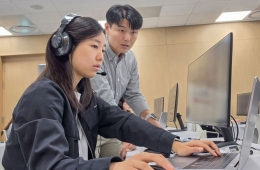
Professor Hyukjun Kwon, Department of Electrical Engineering and Computer Science at DGIST (left), and Ji Eun Lee, integrated master's and doctoral student (first author). Provided by DGIST
View original imageUsing atomic force microscopy (AFM), X-ray photoelectron spectroscopy (XPS), and high-resolution transmission electron microscopy (HR-TEM), the research team confirmed the introduction of oxygen, formation of Sn-O bonds, and local structural rearrangement after laser treatment. They also verified that a work function difference of about 0.7 eV arises between the laser-treated and untreated regions, resulting in the formation of a built-in electric field.
This built-in electric field rapidly separates photo-generated electrons and holes, suppresses their recombination, and enhances the photocurrent response.
The photodetector fabricated by the research team showed a significantly improved response speed to light compared to conventional devices and exhibited high sensitivity capable of detecting even faint light. In particular, its high efficiency in converting light into electrical signals demonstrates its potential for application to next-generation image sensors and flexible optoelectronic devices.
The research team emphasized the significance of directly creating a functional junction using only a laser, without the need for separate high-temperature, high-vacuum processes or wet chemical treatments. Notably, as a non-contact process that allows selective processing at desired locations without a mask, it is expected to be scalable to large-area image sensors and highly integrated optoelectronic platforms.
Professor Hyukjun Kwon stated, "This research demonstrates that an optimal environment for converting light to electricity can be created directly inside a two-dimensional semiconductor using only a laser, without complicated manufacturing processes. It is expected to become a practical process technology that can be extended to various industries, including high-performance photodetectors and transparent and flexible optical sensors."
Hot Picks Today
![Selling Like Crazy Every Year... 30-Year-Old Hetbahn Takes on a New Challenge: Tastes Better Than "Mom's Home Cooking" [On-Site Report]](https://cwcontent.asiae.co.kr/asiaresize/93/2026102216175071025_1792653470.jpg) Selling Like Crazy Every Year... 30-Year-Old Hetbahn Takes on a New Challenge: Tastes Better Than "Mom's Home Cooking" [On-Site Report]
Selling Like Crazy Every Year... 30-Year-Old Hetbahn Takes on a New Challenge: Tastes Better Than "Mom's Home Cooking" [On-Site Report]
- "Please Pay Me at Least 3 Million Won a Month": More Than Half of Young People Today Prioritize "Working Conditions" Over Company Size
- A 12-Year-Old Girl Went to the Hospital After Her Blood Pressure Hit 225 and Was Stunned: "What Is This Coral Reef-Like Thing in Her Aorta?"
- "Hey, Lady, Teach Your Kids to Behave!" ... 300,000 Won in Cash and a Bodily Injury Claim Demanded Over Child's Door Ding
- Beachgoer Finds 'Plastic' That Turns Out to Be Perfume Ingredient Worth More Than Twice as Much as Gold
This research was conducted with Ji-eun Lee, an integrated master's and doctoral student at DGIST, as the first author. The results were published in the May 2026 issue of the international journal Advanced Optical Materials in the field of optics. The study was supported by the Ministry of Science and ICT's Basic Science Research Program (Mid-career), the INNOCORE Program, and the Ministry of Education's University-Centered Research Institute Support Project.
© The Asia Business Daily. All rights reserved. Unauthorized AI training and use prohibited.