"Olive Young First, Then Pharmacies: The Revival of Myeongdong as a Global Showroom [K-Tourism Road]①"
Myeongdong's Consumer Landscape Transformed After COVID-19
A Hub for Foreign Tourists Seeking 'K-Lifestyle'
Leveraging as a Global Experiential Base
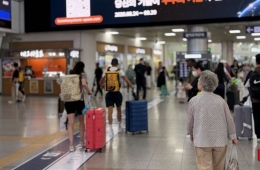
On the morning of May 26, the area in front of Exit 6 of Myeongdong Station in Jung-gu, Seoul, was bustling with foreign tourists pulling suitcases. The first place these tourists headed to was Olive Young. Tourists holding large shopping bags unfolded store maps at the entrance to check their routes. Among them were groups of Japanese tourists testing sun care products on their hands and comparing their textures, and American tourists using mobile translation apps to examine the ingredient lists of dermocosmetic (a compound word of dermatology and cosmetics) products. Yuki, a Japanese tourist in her 20s, said, "I came to Myeongdong because I wanted to test out products I saw on Japanese social media myself," adding, "In the past, I mainly bought sheet masks, but this time I plan to buy a lot of sunscreen and soothing skincare products."

The Myeongdong commercial district has been revitalized alongside the return of foreign tourists. Before the COVID-19 pandemic, Myeongdong was a hub for bulk purchases of cosmetics by Chinese tour groups. Recently, however, it has been transformed into an "experiential tourism district" where visitors enjoy not only K-beauty and fashion but also lifestyle goods and popular eateries.
"I Saw It on Social Media"…Foreign Tourists Flock to Olive Young
According to industry sources on May 29, the 'Olive Young Central Myeongdong Town,' which CJ Olive Young opened in Myeongdong, Seoul, on March 26, ranked among the top-performing Olive Young stores in terms of sales just one month after opening. Both total sales and foreign customer sales ranked second after 'Olive Young Myeongdong Town.'

The scene of 'Olive Young Central Myeongdong Town' located in Myeongdong, Seoul on the morning of the 26th. Photo by Hanjoo Han
View original imageThree out of Olive Young's top five stores by total sales are located in Myeongdong. Myeongdong stores outperformed districts popular with younger crowds, such as Seongsu and Hongdae. The industry interprets this as a sign that foreign tourist spending is once again concentrating in Myeongdong.
The success of Central Myeongdong Town is not just a new store effect. According to Olive Young, after the opening of Central Myeongdong Town, foreign customer sales at other Olive Young stores in the Myeongdong area (excluding the new store) increased by 11.5% compared to the previous month. The new store attracted more foreign customers, leading to a sales boost at surrounding Myeongdong locations as well.
!["Olive Young First, Then Pharmacies: The Revival of Myeongdong as a Global Showroom [K-Tourism Road]①"](http://www.asiae.co.kr/news/img_view.htm?img=2026052622491477142_1779803354.png)
"Pharmacies Are Shopping Stops Too"…Changing K-Beauty Consumption Patterns
The recovery of the Myeongdong district is backed by changing K-beauty consumption patterns. In the past, foreign tourists purchased value-for-money products like sheet masks and color cosmetics from road shops. Recently, however, demand has expanded to include dermocosmetics, sun care, small-sized color cosmetics, and premium brands.
These days, even pharmacies have become shopping stops for foreign tourists. Japanese and Chinese visitors compare and purchase skin ointments, sun care products, and vitamins, and some pharmacies have even installed signs in Chinese and Japanese. Lin, a tourist in her 30s from Taiwan, said, "I've heard a lot about the effectiveness of Korean pharmacy products," adding, "I buy cosmetics at Olive Young and then pick up functional products at the pharmacy as well."
In fact, according to Olive Young, K-derma products accounted for around 90% of skincare sales at Central Myeongdong Town. At other Olive Young stores in Myeongdong (excluding Central Myeongdong Town), sales in the derma category increased by 24.3% compared to the previous month.

Tourists passing by in front of a pharmacy located in Myeongdong, Seoul on the morning of the 26th. Photo by Han Yeju
View original image'K-Fashion Showroom' in Myeongdong
Fashion brands are also moving actively. Major K-fashion brands popular with younger consumers, such as Emis, Marithe Francois Girbaud, and Matin Kim, have opened large stores along Myeongdong's main street. Designer brands that were previously concentrated in Seongsu-dong are now flocking to Myeongdong to broaden their reach with foreign tourists. It is now common to see foreign tourists carrying Matin Kim and Emis shopping bags on the main street of Myeongdong.
LF Hazzys is also strengthening content targeting foreign tourists at its flagship store 'SpaceH Seoul' in Myeongdong, while Kolon Sports opened its flagship store 'Kolon Sports Seoul' in Myeongdong this January. New Balance Myeongdong, operated by E-Land World, has seen its sales rise for two consecutive years thanks to foreign tourist demand. The store’s sales in 2024 increased by 17% compared to the previous year, and in 2025, sales are expected to grow by 46% compared to 2024, continuing this upward trend.
'Musinsa Store Myeongdong,' which opened in January, has also become an essential shopping destination for tourists visiting Korea. Musinsa plans to open a new 'Musinsa Standard Myeongdong Jungang Branch,' a store selling its private label products, in September. Including the Musinsa Myeongdong store opened in 2024, a total of three Musinsa stores will operate in Myeongdong. Japanese SPA (Specialty Store Retailer of Private Label Apparel) brand Uniqlo, after withdrawing from Myeongdong due to COVID-19 and the 'No Japan' movement, has returned to open its largest store in Korea in Myeongdong after about five years.

Morning of the 26th, the 'Musinsa Store Myeongdong Branch' located in Myeongdong, Seoul. Photo by Han Yeju
View original imageMaking Keycaps and Buying Merchandise…Myeongdong Transforms into an Experiential Tourist Destination
Recently, Myeongdong has been transforming into an experiential tourism course targeting foreign tourists, with stores selling character merchandise, lifestyle goods, household items, and even sports brands.
At 'Mimi Line,' a lifestyle accessory store near Myeongdong Station, foreign tourists were seen assembling custom keycaps and keyrings to create their own merchandise. All around the store, people could be seen photographing their completed keycaps and uploading them to social media. Emily, a tourist from Australia, said, "Korean character designs are unique, so I'm making these as gifts for my friends," adding, "It's hard to find experiences like this in Japan or Europe."

On the morning of the 26th, foreign tourists are making keycaps at Mimi Line located in Myeongdong, Seoul. Photo by Han Yeju
View original image
Foreign tourists are shopping for accessories at Artbox located in Myeongdong, Seoul, on the 26th. Photo by Hyeju Han
View original imageArtbox has also emerged as a must-visit spot for foreign tourists. Many visitors purchase multiple character goods, stylish stationery, and lifestyle items. This demonstrates that the scope of K-consumption, once centered on cosmetics, is now expanding to accessories and lifestyle categories. Daiso Myeongdong also continues to draw foreign tourists, with the ability to purchase items ranging from travel-sized cosmetic containers to snacks and daily necessities in one stop cited as a key reason for its popularity.
Food has also become part of the tourist route. Even after lunchtime, long lines could be seen in front of Myeongdong Kyoja, a restaurant listed in the Michelin Guide. Cafes and dessert shops near Myeongdong Cathedral were also crowded with foreign tourists.
Changing Brand Strategies... "A Global Testbed"
Industry sources say that Myeongdong is being restructured into a new type of tourism shopping district. Before COVID-19, the core clientele in Myeongdong was primarily Chinese tour groups. These days, however, there is a higher proportion of independent tourists from Japan, China, Southeast Asia, and the Americas. They check product information on social media and online content before their trip, and compare products in person at the destination before making a purchase.
This is also changing the strategies of brands entering Myeongdong. Increasingly, stores are being used as experiential hubs to raise brand awareness among foreign tourists, rather than simply as points of sale.
Hot Picks Today
 "Twentysomethings Who Invested in Stocks All Lost"... John Lee Says, "Investing for Retirement? Put Your Money in This"
- "Why Give to Remarried but Not Unmarried? Youths Stirred by 1 Million Won Marriage Support Fund"
- 'August to September to the Fourth Quarter Again': Relocation Fears Persist as Financial Regulators Become Pawns in Political Calculations
- "As Soon as Yong Hyein Was Nominated... After a 195% Surge, This Stock Suddenly Plunged"
An industry official said, "The changes in Myeongdong are significant because offline retailers now have a space to boost brand recognition among foreign customers and assess potential for overseas expansion," adding, "Core stores in Myeongdong with a high proportion of foreign sales will serve less as simple retail outlets and more as global marketing hubs going forward."
© The Asia Business Daily. All rights reserved. Unauthorized AI training and use prohibited.