Seven Nations Vied for the AI Hub... Secured by Party Leader Lee Jae-myung's Directive
Fierce Competition for the AI Hub Amid Rival Bids
"Offering More Contributions"... Powerhouse Nations Engage in a Money Game
AI Strategy Initiated by Party Leader Lee’s Directive Two Years Ago
Ultimately Succeeded in Winning Over Senior Officials at International Organizations
"Don't even get me started. Other countries offered enormous contributions—far more than Korea did. So, we had to convince them with our competence and vision."
This was the response from a senior government official when asked how difficult it was for Korea to attract the Global AI (Artificial Intelligence) Hub. The competition was so fierce that seven countries bid astronomical amounts as contributions to host the AI Hub. Despite proposing a relatively small contribution and being at a disadvantage as a non-Western country, Korea succeeded in its bid thanks to the all-out efforts of the administration, the ruling party, and the presidential office, as well as a blueprint initiated by "Party Leader Lee Jae-myung" two years ago. There is growing anticipation within the Blue House and the government that Korea can even surpass the status of an "AI Big Three" nation.
'We'll give more money'... Fierce Competition for the AI Hub Amid Rival Bids

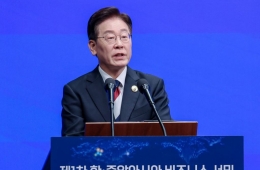
President Lee Jae-myung is applauding after watching a video on the basic plan for the development of nuclear-powered submarines at the 1st Future Defense Strategy Committee held in Jinhae-gu, Changwon-si, Gyeongnam on the 26th. May 26, 2026. Photo by Yonhap News
View original imageAccording to the Blue House, the government, and the Democratic Party of Korea on the 27th, a total of seven countries—including Korea, the United States, China, Japan, Switzerland, the United Arab Emirates (UAE), and India—competed to host the international organization's Global AI Hub. In the early stages, the odds were stacked against Korea, as other countries offered the international organization contributions far greater than what the Korean government proposed. The fact that international organization employees from the U.S. and Europe preferred to work in Western countries also worked against Korea.
Korea was able to secure the bid on this uneven playing field thanks to the administration's, the ruling party's, and the presidential office's meticulous strategy. The Global AI Hub, the international AI platform hosted by Korea, aims to foster global cooperation through AI and address worldwide issues on that basis. At the time, however, the United Nations was unable to pay proper attention to AI due to internal competition among its affiliated organizations and the suspension of funding from the United States. There were no AI experts within each organization, so they were unable to establish their own future plans.
The Korean delegation seized this opportunity. They proactively developed and presented an AI plan that the international organization had overlooked. Oh Hyun-joo, Third Deputy Director of the National Security Office and an expert in international organization negotiations, and Kim Woochang, AI Policy Secretary at the Presidential Office, provided strategic advice from the Blue House. The Ministry of Foreign Affairs facilitated meetings between the international organization and the Korean government through its network. Assemblyman Cha Jiho of the Democratic Party of Korea personally met with senior UN officials, with whom he had built relationships during his time as a professor at the University of Manchester in the UK and with Doctors Without Borders, to persuade them to support Korea's bid.

On January 21, Oh Hyunjoo, Third Deputy Director of the National Security Office, presided over the first public-private economic security working-level review meeting at the Korea Federation of SMEs in Yeouido, Seoul. January 21, 2026, Yonhap News Agency.
View original imageThe Korean delegation's AI plan was solidly structured in two stages: the first stage would see the UN build a joint AI platform with specialized personnel forming a single ecosystem; the second stage would have each UN agency applying AI to their respective projects. According to those familiar with the negotiations, the impact of the proposal was so significant that "senior White House officials, the UN Secretary-General, and the President of Switzerland all responded that it was innovative." Officials from the administration, the ruling party, and the presidential office explained that it was not just the financial support, but also the provision of a comprehensive AI plan that proved highly effective.
"Let's establish an AI strategy"... The 'Global Hub' Backed by Lee's Directive Two Years Ago
The robust AI plan was rooted in a directive from "Party Leader Lee Jae-myung." In 2024, when Lee was the ruling party leader, he instructed Assemblyman Cha to "develop an AI strategy." As a result, the Future Governance Committee was established within the ruling party in November of that year. Participants included Assemblyman Cha and Kim Woochang, then a fellow professor at KAIST, now the AI Policy Secretary. The two collaborated to draft a plan for an alliance of UN agencies. Assemblyman Cha, for his part, reportedly attended rallies for the impeachment of former President Yoon Suk Yeol during the day and developed AI strategies at night. The strategy they had been preparing since then came to fruition two years later on the international stage.
The launch of the Lee Jae-myung administration accelerated the AI Hub initiative. The direct catalyst was the Asia-Pacific Economic Cooperation (APEC) summit held in Gyeongju last November. The joint declaration at the time included a provision to establish the "Asia-Pacific AI Center" in Korea. This was the first time an international AI body would be established in the country. An APEC official who witnessed the situation explained, "It was not easy because some countries opposed it," and added, "It was thanks to Oh Hyun-joo's all-night efforts that the dramatic agreement to locate the AI center in Korea was reached."

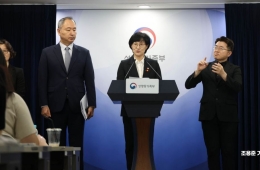
Kim Woochang, AI Policy Secretary at the Presidential Office, is reporting on the progress and future plans for the Global AI Hub at the Global AI Hub Attraction Committee held at the Government Seoul Office in Jongno-gu, Seoul, on March 24, 2026. Photo by Yonhap News.
View original imageFollowing this, the idea emerged within the Blue House that Korea could attract not only APEC's but also other international organizations' AI functions. The proposal came from Secretary Kim Woochang, who suggested consolidating all international organizations' AI functions in Korea. Consequently, a task force (TF) was formed under the leadership of Prime Minister Kim Minseok. Secretary Kim and Assemblyman Cha, who had prior collaboration experience, served as coordinators. When the prime minister, Assemblyman Cha, or the Ministry of Foreign Affairs held late-night meetings with international organizations, Secretary Kim would refine the strategy with the Blue House at dawn the following day.
The national policy direction and Korea's industrial ecosystem also contributed significantly to the successful bid. An official from Assemblyman Cha's office, who led the negotiations, explained, "Approaching AI as a basic social good that ensures universal well-being, rather than simply as a profit-driven technology, was perfectly aligned with the UN's philosophy." He added, "Korea was also highly evaluated for having the world's top technological ecosystem and financial capacity." Furthermore, "Korea was recognized as a country where data could be shared safely without being dependent on the U.S. or China," he noted.
Through these efforts, the government signed letters of intent (LOIs) with six UN-affiliated organizations last March, and on the 21st, Korea jointly announced a statement with nine international organizations and five multilateral development banks (MDBs). This left a strong impression on the international organizations, as negotiations with the UN usually take several years just to review the articles of agreement, but the AI Hub deal was concluded in only a few months. A senior UN official reportedly told Assemblyman Cha's team, "I've never seen the UN unite and sign an agreement at this speed before."
International Organizations Coming to Korea... "Ready to Surpass the AI Big Three"

The Blue House announced on the 18th that President Lee Jae-myung awarded a plaque of appreciation to Democratic Party lawmaker Cha Jiho for his contributions to AI basic social policies. The plaque, dated the 10th, was presented to Lawmaker Cha by the Blue House Political Secretary on the 13th on behalf of the president. April 18, 2026 Yonhap News Agency
View original imageThe task force formed by the administration, the ruling party, and the presidential office has begun final preparations with the aim of launching the AI Hub next year. The government is in the process of selecting a host city for the AI Hub and is negotiating with the UN on the size of the dispatched personnel and the proportion of Korean staff. Discussions are also underway to include the related expenses in next year's budget proposal.
Hot Picks Today
 "Additional 25% Mobile Bill Discount From Today" Causes Stir Online... The Truth Revealed
- "The Clothes My Dad Used to Wear"... Ralph Lauren, Beanpole, and Hazzys See Sales Surge as MZ Generation Embraces the Trend
- "So Many Inconsiderate People": Kicking and Struggling After Clothes Are Grabbed... Subway Line 2 Altercation Sparks Uproar
- "Please Take Off Your Shoes"—From Crawling onto the Bed to Changing Habits, Young Americans Lead the Shift
- "Famous Actress on KBS Is Perpetrator's Sister"... KBS Responds to 'Busan Fall Death' Family's Plea
Expectations are running high. Within the Blue House, there is growing confidence that securing the Global AI Hub means Korea is now ready to move beyond the "AI Big Three." Assemblyman Cha emphasized, "We will take the lead in AI transformation in tertiary service industries such as healthcare and education," and added, "If we design global standards with the UN agencies, it will create opportunities for Korean AI companies."
© The Asia Business Daily. All rights reserved. Unauthorized AI training and use prohibited.