"Small Business Closure Fears" vs "Losing Money by Working"... Labor and Management Clash at Minimum Wage Commission
Second Plenary Session Held on the 26th
Employers: "Differentiated Application by Industry Needed"
Workers: "Platform and Subcontracted Workers Must Be Included"
The plenary session of the Minimum Wage Commission to determine the minimum wage for next year resumed after a month-long hiatus. The employer side argued that although Korea's economic performance has improved due to a boom in semiconductor exports, small businesses significantly affected by the minimum wage continue to struggle. They stressed the need to set the minimum wage based on payment capacity. In contrast, the labor side demanded an increase in the minimum wage to a level that can prevent a decline in real wages, citing a sharp increase in workers' cost of living due to surging prices following the war in the Middle East.

Kwon Soonwon, Chair of the Minimum Wage Commission, is listening to the remarks of Lee Miseon, Vice Chair of the Korean Confederation of Trade Unions and worker representative, at the second plenary meeting of the Minimum Wage Commission held on the 26th at the Government Complex Sejong. Photo by Yonhap News Agency
View original imageThe Minimum Wage Commission held its second plenary session on the afternoon of the 26th at the Government Complex Sejong. Ryu Gijeong, Executive Director of the Korea Employers Federation and employer representative, stated in his opening remarks, "Although our economy recorded a solid performance in the first quarter due to increased exports, industries heavily affected by the minimum wage remain sluggish." He continued, "Production in the accommodation and food service sector, which is sensitive to domestic demand, fell by 1.3%, and as of the end of April, the outstanding balance of loans to individual business owners reached a record high of 460 trillion won." Ryu emphasized, "Given these circumstances, this year's minimum wage review must prioritize the payment capacity of small and medium-sized enterprises and small business owners." He also called for differentiated application by industry, saying, "At the very least, differentiated application should be implemented starting with industries that are most vulnerable and unable to bear the minimum wage burden."
Yang Okseok, employer representative and Head of Human Resources Policy at the Korea Federation of SMEs, said, "A convenience store owner I met at the field said they work 16 hours a day for an entire month, but take home only 2.5 million won," adding, "Since the best welfare is a job, this year's review must be an opportunity to consider how small business owners and the self-employed can avoid losing even their jobs."
On the other hand, the labor side highlighted the livelihood crisis faced by workers, which is hidden behind glamorous economic indicators such as the KOSPI surpassing 8,000. Ryu Giseop, Secretary-General of the Federation of Korean Trade Unions and employee representative, criticized the widening income gap in the labor market, mentioning the recent controversy over large company bonuses and the rise of the KOSPI. Ryu said, "The compensation gap that surpasses decades' worth of minimum wage workers' annual earnings in an instant is far too wide to be explained merely by 'luck,'" adding, "Amid rising inflationary pressures, most low-wage workers are struggling to make ends meet." He further emphasized, "We must present a clear effect of increasing the minimum wage to break the vicious cycle of deepening labor income polarization." He also argued that platform and subcontracted workers should be covered by the minimum wage, urging, "The scope of minimum wage protection should be as inclusive as the diversity of work arrangements."
Hot Picks Today
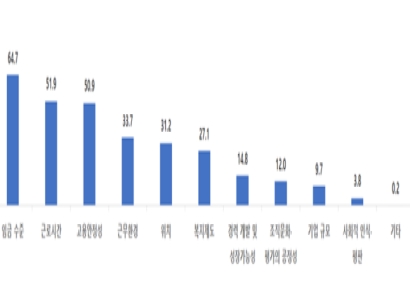 "Please Pay Me at Least 3 Million Won a Month": More Than Half of Young People Today Prioritize "Working Conditions" Over Company Size
- Selling Like Crazy Every Year... 30-Year-Old Hetbahn Takes on a New Challenge: Tastes Better Than "Mom's Home Cooking" [On-Site Report]
- "Americans Would Be Amazed If They Came": Wide-Eyed at a Sight They've Never Seen Before... Foreigners Also Fall for K-Baseball [K-Holic]
- President Lee Narrows Candidates for Next Justice Minister to Former Prosecutors Yang Bunam and Park Gyuntaek
- Beachgoer Finds 'Plastic' That Turns Out to Be Perfume Ingredient Worth More Than Twice as Much as Gold
Lee Miseon, Deputy Chair of the Korean Confederation of Trade Unions and employee representative, said, "Even though the minimum wage has surpassed 10,000 won, workers still have empty pockets and feel increasingly hopeless as they lose money the more they work." She continued, "We must seriously examine the harsh reality of how workers are managing to survive on less than 2 million won in net monthly income amid soaring prices." Lee strongly urged, "I hope this Minimum Wage Commission will serve as a venue to decide on a just increase that protects the survival of low-wage workers and ensures full coverage for all workers."
© The Asia Business Daily. All rights reserved. Unauthorized AI training and use prohibited.