"TIGER Samsung Electronics and SK hynix Leveraged ETFs Attract 329 Billion Won in Foreign Investment, Ensuring Ample Liquidity"
Application of Cash Creation and Redemption Method
Minimizing Bid-Ask Spread and Premium/Discount Rates
"The newly listed Samsung Electronics and SK hynix single-stock leveraged ETFs have attracted a record-breaking 329 billion won in foreign investment for TIGER ETFs."
Namgi Kim, Head of ETF Operations at Mirae Asset Global Investments, made this announcement during a press conference on single-stock leveraged ETFs held on the afternoon of May 26 at Mirae Asset Center One in Seoul. Kim stated, "When preparing the TIGER single-stock leveraged ETFs, our sole focus was on 'liquidity,'" and added, "Through the influx of foreign investors trading single-stock leveraged ETFs, we can demonstrate overwhelming liquidity."

On the 6th, at the 'TIGER ETF Press Conference' held at Mirae Asset Center One, Namki Kim, Head of ETF Operations at Mirae Asset Global Investments, is delivering the welcoming speech. Mirae Asset Global Investments
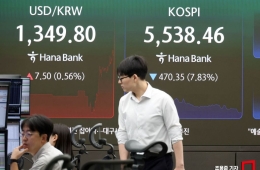
View original imageHe further explained that this could also contribute to the stabilization of the exchange rate. Kim said, "The purpose of introducing single-stock leveraged ETFs domestically also includes stabilizing the KRW-USD exchange rate," and explained, "To align with this purpose, we viewed overseas single-stock leveraged ETF operators—not domestic asset management firms—as our competitors, and by attracting foreign capital, we can make a significant contribution to stabilizing the KRW-USD exchange rate."
He noted that from the initial setup stage, a large number of foreign investors participated in the 'TIGER Samsung Electronics Single-Stock Leveraged ETF' and 'TIGER SK hynix Single-Stock Leveraged ETF,' which will be launched on the 27th, establishing a solid foundation of liquidity. The SK hynix leveraged ETF will be listed at a scale of 747 billion won, and the Samsung Electronics leveraged ETF at 592 billion won, with a total of 19 securities firms—including five APs and 14 LPs—participating as liquidity providers. The total management fee is set at an annual rate of 0.0901% (9.01 basis points), the lowest among similar products.
Additionally, Mirae Asset Global Investments highlighted the 'cash creation and redemption method' as the core differentiator of these products. This means that when LPs create or redeem ETFs through transactions with the asset management company, they use 'cash' instead of equity in-kind transfers. Jeonghwan Lee, Managing Director of ETF Operations at Mirae Asset Global Investments, stated, "If there is a gap between the spot and futures prices, TIGER single-stock leveraged ETFs can utilize the structural advantage of cash creation to conduct so-called 'arbitrage' by buying additional spot shares and selling futures," and added, "We plan to focus on conducting arbitrage to further enhance investor returns."
He emphasized that the cash creation and redemption method also allows for the reduction of bid-ask spreads and premium/discount rates. This product adopts a dual structure that separates management and liquidity provision. During the management stage, both spot and futures are utilized to maintain the advantage of 'dividend acquisition' inherent to spot leverage. In the liquidity provision stage, the APs and LPs are designed to hedge primarily through futures. Typically, when APs and LPs quote a spot-based product, transaction costs can be reflected in the quotes due to the need to consider the sale of spot shares upon redemption, and in this process, the 20 basis point (0.2 percentage point) transaction tax on spot trades may be reflected in the investor's trading price. In contrast, TIGER single-stock leveraged ETFs use the cash creation and redemption method, minimizing the burden of spot transaction taxes in the APs' and LPs' hedging processes, thereby improving investment accessibility.
However, Mirae Asset Global Investments cautioned that single-stock leveraged ETFs are fundamentally different from general ETFs, which are based on the principle of 'diversification,' and therefore investors should exercise caution. Kim stated, "Since there is no rebalancing or constituent replacement, investors must approach these products from a completely different perspective compared to general leveraged ETFs," and explained, "If a company goes bankrupt, the single-stock leveraged ETF will cease to exist, but a general thematic leveraged ETF will continue to exist as long as the overall industry does not collapse."
He also warned that due to the 'volatility decay effect,' even if the stock price falls and then returns to its original level, single-stock leveraged ETFs may still incur losses. They even released a simulation based on Samsung Electronics' stock price before and after the U.S.-Iran conflict. Lee said, "At the end of February, Samsung Electronics reached a historic high of 218,000 won, but after the war broke out, the stock moved sideways for about 57 days. Then, on April 20, it recovered to 219,000 won, returning to its previous high," adding, "If the Samsung Electronics leveraged ETF had been listed during this period, the simulation shows a return of -9.44%."
Lee advised, "Investors should use these products strictly for short-term investment purposes, and only allocate a portion of their portfolio when they have strong conviction about a company's outlook, so they can focus on making high-conviction investments."
Hot Picks Today
 "I Was Just Going Barefoot at Home"... "Absolutely Not": Why Doctors Warn Against It
- "What on Earth Is Happening to the Stock Market?" ... KOSPI and KOSDAQ Plunge 8%, Trading Halted (Comprehensive)
- "I Was Proud He Finished His Homework Quickly"... Dad Shocked After Checking Son's YouTube History
- Just 13.9 Seconds to Wash Hands After Using the Restroom... "So Many" Use Water Alone, No Soap
- "No Need to Hire a Model"... The 25-Year-Old Woman Who Entered Social Media with a Face That Cost Just 1,500 Won [AI Content: The Bright and Dark Sides] 1
Meanwhile, investors must complete the 'Single-Stock Leveraged/Inverse Listed Product Pre-Education' course at the Korea Institute of Financial Investment and register their completion number on HTS or MTS before they can invest in these products.
© The Asia Business Daily. All rights reserved. Unauthorized AI training and use prohibited.