Accelerating Localization of 'Lifeblood' Ultrapure Water for Semiconductors... 90% Core Equipment Targeted by 2030
The government has announced a plan to localize 90% of the core equipment for all processes of 'ultrapure water (Ultra Pure Water)' technology used in semiconductor and display manufacturing by 2030, aiming to enhance the stability of advanced industry supply chains.
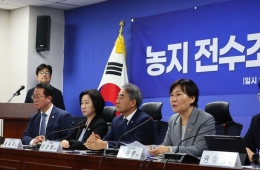
The Ministry of Climate, Energy and Environment stated on the 26th that it will hold a kick-off meeting for the 'Next-Generation Ultrapure Water Production, Supply, and Self-Reliant Manufacturing Process Technology Development Project (Phase 2)' on the 27th at the President Hotel in Jung-gu, Seoul, in collaboration with the Korea Environmental Industry & Technology Institute, Techcross Water & Energy, G&G Intec, and others.
Ultrapure water is industrial water used to clean wafers and equipment in the production processes of semiconductors, displays, and secondary batteries. Because even trace amounts of organic matter, particles, and ions must be removed, advanced water treatment technology is required.
The government explained that the need for localization is growing, as ultrapure water production technology is regarded as a core fundamental technology directly linked to semiconductor production stability. According to Global Water Intelligence (GWI), the global ultrapure water market is expected to grow from 46.5 trillion won last year to 58.9 trillion won by 2030.

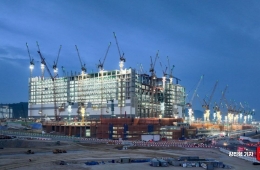
A researcher from the Korea Water Resources Corporation is inspecting the ultrapure water plant facility. Korea Water Resources Corporation
View original imagePreviously, since 2021, the government has promoted the 'High-Purity Industrial Water Production Localization Technology Development Project (Phase 1)' and succeeded in localizing core equipment such as ultraviolet (UV) oxidation devices, membrane degassing (MDG), and ion exchange resins. Ultrapure water produced with domestic technology was also supplied to the semiconductor wafer production process at SK Siltron's Gumi plant, verifying its applicability and reliability in the field.
This second phase project focuses on expanding the localization of core technologies and equipment across the entire ultrapure water production process, building on previous achievements. The scope of localization will be expanded to include ultrapure water supply piping materials, with the goal of increasing the localization rate for the entire process to over 90%. The government also plans to develop design technology for low-energy demonstration facilities for ultrapure water, aiming both to meet carbon regulations and to reduce operating costs.
To address instability in industrial water supplies caused by the climate crisis, the government will also pursue the development of technology that utilizes reclaimed wastewater as a raw water source for ultrapure water. By securing technology to remove trace contaminants, the goal is to establish a stable supply system for industrial water. Analytical technology for precise evaluation of ultrapure water quality will also be developed in parallel. Starting next year, the government plans to initiate the development of ultratrace (ppt, parts per trillion) analytical technology, aiming to secure not only ultrapure water production but also quality evaluation technology.
Hot Picks Today
![[Exclusive] "Nvidia Researchers to Work in Yangjae"... LG Electronics to Establish 'Joint Robotics Development Base'](https://cwcontent.asiae.co.kr/asiaresize/93/2026092110452736212_1789955126.jpg) [Exclusive] "Nvidia Researchers to Work in Yangjae"... LG Electronics to Establish 'Joint Robotics Development Base'
[Exclusive] "Nvidia Researchers to Work in Yangjae"... LG Electronics to Establish 'Joint Robotics Development Base'
- "Can't Afford a House Anyway"... Gen Z Cuts Dining and Salon Costs to Splurge on Airfare
- "I’ll Take This, Please"... Buying the Last Lottery Ticket Brings a Jackpot
- Posing as 'Identical Twin Brother' to Evade Arrest... 27,000 Fraud Suspects Caught
- "They Might Start Pitching Tents and Grilling Meat"... The 'Hammock Villain' Appears at Cheonggyecheon
Kim Jiyeong, Director of Water Utilization Policy at the Ministry of Climate, Energy and Environment, stated, "This second phase R&D project will serve as a turning point not only for the localization of equipment, but also for achieving technological self-reliance and establishing a sustainable supply system across the entire ultrapure water production process."
© The Asia Business Daily. All rights reserved. Unauthorized AI training and use prohibited.