"It's No Time to Celebrate Today's Gains"... Crash Warnings Loom After KOSPI Rebound
Semiconductor Stocks Surge Globally Amid AI Boom
CNBC Highlights Investment Caution and Pessimism
Korean Market Risks vs. Remaining Upside Potential
Amid the artificial intelligence (AI) boom, memory semiconductor companies such as Samsung Electronics and SK hynix are enjoying record-breaking prosperity. However, there have been warnings that the typical "boom and bust" cycle of the semiconductor industry may return.

On the 26th, the status board of the Korea Composite Stock Price Index (KOSPI) and others were displayed in the dealing room of Hana Bank in Jung-gu, Seoul. On that day, the KOSPI opened at 8,070.91, up 223.20 points (2.84%) from the previous trading day, and the KOSDAQ index started at 1,189.28, rising 28.15 points (2.42%). Yonhap News
View original imageAccording to Yonhap News on the 25th (local time), citing U.S. economic media outlet CNBC, "In recent years, the extraordinary returns of memory-related stocks have driven the upward trend in both the U.S. and Korean stock markets. However, market experts warn that it is risky to overlook the cyclical nature unique to the sector." Since the beginning of this year, the share prices of Samsung Electronics and SK hynix have soared by 114% and 186%, respectively, while Micron and SanDisk in the U.S. have each risen by 141% and 156%.
CNBC pointed out that the rally in share prices is underpinned by the belief that the memory industry has moved beyond its past cyclical characteristics. In fact, industry executives have consistently claimed that "AI has overturned the 'boom and bust' history of the memory industry, and a structural supply shortage could keep prices elevated for years." SK hynix told CNBC, "Customers such as hyperscalers are shifting toward preferring long-term contracts instead of the previous one-year contracts," adding, "The industry is undergoing structural change."
However, investment professionals remain cautious. John Conliffe, Head of Investments at asset management firm JM Finn, diagnosed, "Current share prices are relying on the optimistic assumption that high margins and strict supply control within the industry will persist for a long time." He added, "With the recent intensification of market concentration in the past weeks, the market has become vulnerable to corrections. In particular, if AI demand grows at a normal pace, production could increase significantly over the next three years, which might ease supply constraints."

SK hynix announced on the 23rd of last month that its consolidated operating profit for the first quarter of this year increased by 405.5% compared to the same period last year, reaching 3.76103 trillion KRW. Yonhap News
View original imageWilliam de Gale, portfolio manager at the asset management firm BlueBox and a noted pessimist, said in a CNBC interview, "The memory industry tends to experience massive fluctuations," and added, "In the long term, it is quite a terrible industry." He further noted, "Whenever claims arise that 'the memory cycle is over and it has become an industry that creates long-term value,' the business conditions have always ended up turning sharply downward." Andrew Lapping, Chief Investment Officer (CIO) at Ranmore Fund Management, commented on the possibility of structural change in the memory industry, saying, "A leopard doesn't change its spots easily."
There is also analysis suggesting that the overheating of memory stocks is increasing the risks across the Korean stock market. According to Manulife Investment, the combined weight of Samsung Electronics and SK hynix in the KOSPI reached an all-time high of 42.2% in May, meaning the fluctuations of these two stocks largely determine the entire index. Steve Brice, Global CIO of Standard Chartered, said on the 13th, "Optimism about the Korean stock market is approaching its peak," and advised investors to "realize gains from Korean stocks and diversify into a global portfolio."
Hot Picks Today
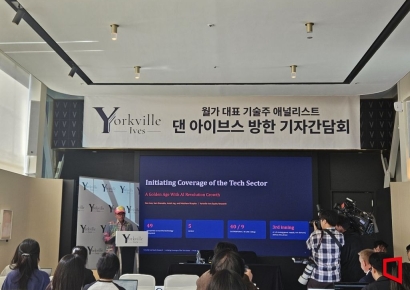 "Even New York Taxi Drivers Are Talking About the KOSPI; South Korean Market to Top 9,000 Again Within a Year"... 'Wall Street's Stock-Picking Ace' Names His Picks
- “Made 2 Billion Won in One Year in Prison,” PPP Lawmaker Retorts: “If You’re Jealous, Go There Yourself”
- Lee Hyeong-il makes international debut just a month after taking office...Heads to Thailand for G20 finance ministers' meeting
- “Washing Dishes and Folding Clothes 200 Times a Day”... China’s “Robot Trainers” Earn Up to 1.2 Million Won a Month
- "Shall We Grab a Drink?" KRW 30,000 a Round... Young Adults: "Prices Make My Hands Shake; I Can't Drink Out"
On the other hand, some investment banks continue to maintain a bullish outlook on the two companies. On the 15th, Nomura Securities in Japan raised its target price for SK hynix from 2.34 million won to 4 million won, and for Samsung Electronics from 340,000 won to 590,000 won. Both stocks, at the time, had approximately 118% to 120% further upside potential compared to their then-current prices. Nomura explained, "Over the next five years, as AI memory demand explodes while supply growth remains limited, the price-earnings ratios (PER) for both companies could be re-evaluated from around 6 times currently to approximately 20 times, in line with the level of Taiwan's TSMC."
© The Asia Business Daily. All rights reserved. Unauthorized AI training and use prohibited.