"Unfazed by Interest Rate Surge, Investors Tap Overdrafts to Avoid Missing Bull Market"
Fixed Mortgage Rates Hit 3-Year, 7-Month High
Upper End of Mortgage Loan Rates Already Exceeds 7% Per Annum
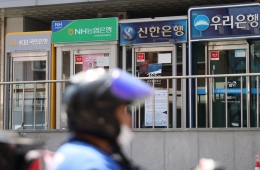
The lower end of fixed interest rates for home mortgage loans at major commercial banks has recently entered the 5% per annum range. This trend is attributed to rising market interest rates, driven by heightened concerns over inflation following the effects of the Middle East war. Financial industry experts are warning that, as the upward trend in interest rates is likely to continue for some time, individuals should exercise caution with strategies such as "Yeongkkeul" (purchasing a home by pooling every possible financial resource) or "Bittu" (investing with borrowed funds).
According to the financial sector on May 24, KB Kookmin Bank will raise the rates on its cyclical and hybrid (fixed) home mortgage loans this week by the same margin (0.10 percentage points) as the increase in the five-year bank bond yield, which serves as the benchmark. As a result, the lower end of the hybrid (fixed) mortgage loan interest rate will rise to 5.07% per annum. This is the first time in three years and seven months, since the end of October 2022, that the fixed-rate lower bound at KB Kookmin Bank has exceeded 5%. At that time, the Bank of Korea implemented two "big step" increases (raising the base rate by 0.50 percentage points each) to stabilize prices and exchange rates, and the base rate had reached 3.00% per annum.

The upper end of home mortgage loan interest rates has already surpassed 7% per annum. As of May 22, the hybrid mortgage loan interest rates at the top five banks (KB Kookmin, Shinhan, Hana, Woori, and NH Nonghyup) range from 4.53% to 7.13% per annum. Compared to the end of March, when uncertainties surrounding the Middle East war were high, both the upper and lower bounds have increased by 0.12 percentage points. This is due to the five-year bank bond yield, the indicator for fixed rates, rising from 4.12% to 4.24% during the same period.
Interest rates for unsecured credit loans are also rising rapidly. Currently, the interest rates for top-tier (grade 1) credit loans with a one-year maturity range from 4.10% to 5.74% per annum, with the lower end up by 0.25 percentage points and the upper end up by 0.21 percentage points compared to about two months ago. This is due to the one-year bank bond yield, the benchmark rate, increasing by 0.13 percentage points during the same period.
The variable interest rates for home mortgage loans (based on the new COFIX) have also increased, now ranging from 3.63% to 6.03% per annum, with both the upper and lower bounds up by 0.02 percentage points. This result stems from the main indicator, the COFIX (Cost of Funds Index), rising by 0.07 percentage points.
Hot Picks Today
 "Ppalli-Ppalli South Korea, This One Really Hurts Our Pride" Plunges from 1st to 22nd... Falls Behind Vietnam and Thailand
- Takes Off Belt, Assaults Employee... Cosmetics Company Executive in His 50s Causes Disturbance at Imported-Car Dealership
- "Shocking Quality": Chinese-Made Car Loses Both Rear Wheels on the Road
- KOSPI Rises More Than 2% on Semiconductor Rebound
- "I'll Give You 53.4 Billion Won to Keep Quiet"... Influencer Reveals Secret Deal; Musk Denies It
Despite rising interest rates, individual borrowing for investment purposes continues. As of May 21, the outstanding balance on personal overdraft accounts at the top five banks stood at 41.2822 trillion won, an increase of approximately 1.5 trillion won compared to the end of last month. A bank representative commented, "Individual investors continue to use credit loans and overdraft accounts to engage in investment activities."
© The Asia Business Daily. All rights reserved. Unauthorized AI training and use prohibited.