"If the AI Cycle Ends, Will KOSPI Plunge?...Why Investors Should Still Stay in Korea [KOSPI 10,000 Era]①"
Interview with Jonathan Pines, Head of Hermes Investment Asia
"Samsung Electronics and SK hynix remain undervalued at a PER of 6"
"KOSPI 10,000 is achievable with the AI cycle and corporate governance reform"
Just a year ago, reaching KOSPI 5,000 seemed like a distant dream for the Korean stock market. Now, the "10,000 era" is within reach. This is the result of the supercycle in semiconductors, the global boom in artificial intelligence (AI) investment, and government-led efforts to reform the capital markets. Amid growing concerns about a global correction in semiconductor stocks, The Asia Business Daily is publishing a five-part series examining the challenges of the "KOSPI 10,000 era" from the perspective of foreign investors and domestic experts. We will analyze the current status of the Korean stock market as seen by overseas investors, outlooks from domestic securities firms, and the remaining tasks ahead, exploring whether the Korean market can finally shed its "Korea discount" label and achieve a structural re-rating.
①[Interview] "Among all global AI-related stocks, Samsung Electronics and SK hynix are the cheapest"
②[Interview] "The key to the 10,000-point era is improving ROE"
③ "KOSPI could reach 10,000 this year," according to domestic securities firm research heads
④ "To encourage long-term investment, tax reform is ultimately needed...Capital gains tax needs to be reconsidered"
⑤ Will Korea be included in the MSCI Developed Markets Index?...Remaining upgrades for the Korean stock market
"Among all artificial intelligence (AI)-related stocks worldwide, Samsung Electronics and SK hynix are the cheapest."
Jonathan Pines, Head of Hermes Investment Asia, said in a recent interview with The Asia Business Daily in Yeouido, Seoul, "Even investors who worry that the AI boom could end still feel they need to remain in the market, and are looking for the cheapest global AI-related stocks. Those are Samsung Electronics and SK hynix," he explained.
Despite their recent sharp share price increases, he assessed that the valuations of these stocks remain significantly lower than those of global AI-related companies. He said, "Even after strong gains, Samsung Electronics and SK hynix are still trading at around six times price-to-earnings ratio (PER)," and added, "Compared to other global AI companies, which trade at multiples above 20, they are extremely inexpensive."

Jonathan Pines, Head of Hermes Investment Asia, who visited Korea, is interviewing with The Asia Business Daily in Yeouido. Photo by Seungwook Park
View original image"KOSPI 10,000 is possible...Next beneficiaries will be holding companies and low-PBR stocks"
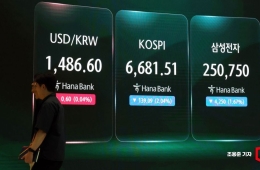
Pines also offered an optimistic outlook on the possibility of reaching the so-called "10,000 KOSPI" milestone. Just a year ago, the KOSPI was below 3,000 points; recently, it broke through the 8,000 mark. He said, "Of course it's possible. Why wouldn't KOSPI 10,000 be achievable?" He added, "If the parabolic AI cycle and improvements in corporate governance come together, reaching 10,000 is entirely possible."
He cited the improvement in the semiconductor industry and capital market reforms—such as amendments to the Commercial Act promoted by the Lee Jaemyung administration—as the drivers behind the KOSPI rally. He explained, "The memory semiconductor cycle is the main reason for the recent rally, but efforts to improve corporate governance are also providing a very positive backdrop for the Korean stock market." However, he also acknowledged the limits of a rally driven mainly by semiconductors. Pines said, "Many people worry that if the AI cycle ends, the KOSPI will fall with it, and that's correct," adding, "Relying on a single sector can make the market vulnerable." Nevertheless, he pointed out, "There are other sectors such as heavy industry, automobiles, insurance, and robotics. If corporate governance improvements strengthen the fundamentals of Korean equities, it will help cushion the declines when cyclical sectors like semiconductors turn down."
As for future investment opportunities in the Korean market, Pines singled out holding companies and undervalued stocks that stand to benefit the most from improvements in corporate governance. He stated, "The stocks that have risen the most so far can't really be considered the main beneficiaries of governance improvements," and continued, "The next opportunities will be in companies that stand to gain the most from governance reform." He further explained, "Low price-to-book ratio (PBR) stocks and holding companies trading at a steep discount are representative examples," and added, "Even though the market as a whole has risen, the stocks that will benefit most from governance improvements have not yet risen much. They will be the future engines of profit."
He also identified the discount on preferred shares in the Korean stock market as a key area of undervaluation. Pines said, "In other countries, the discount on non-voting preferred shares is only about 2%, but in Korea it can reach as high as 60%," calling it "a globally rare inefficiency."

Jonathan Pines, Head of Hermes Investment Asia, who visited Korea, is taking a photo after an interview with The Asia Business Daily in Yeouido. Photo by Seungwook Park
View original image"Skepticism on Korea is gone...Mandatory tender offers and enhanced disclosures are needed"
In the interview, Pines also praised the government for its capital market reforms, including Commercial Act amendments and the Value-up policy. He said, "The Korean government is clearly on the side of investors," and added, "At the end of 2023, various improvement recommendations were made regarding the Korean market, and many of those recommendations have already been implemented or are under review. Much of the skepticism that foreign investors used to have has now dissipated."
Hermes Investment, a global asset management firm, is an activist investor that is actively engaged in exercising shareholder rights and improving corporate governance. For example, it publicly opposed the merger between Samsung C&T and Cheil Industries, citing damage to shareholder value, and has long paid close attention to Korean companies' undervaluation and shareholder return policies.
Pines identified the root causes of the "Korea discount" as family-run governance structures, regulations favoring controlling shareholders, and high inheritance taxes. Still, he noted, "For a long time, governance issues kept Korea out of the spotlight for global investors, but the situation is changing. International demand for investment in Korea continues to grow."
As for future regulatory reforms, he suggested introducing a mandatory tender offer system and strengthening disclosures for undervalued companies. Pines argued, "A mandatory tender offer rule should be introduced so that minority shareholders can sell their shares at the same price as controlling shareholders during an acquisition." He also insisted, "Companies with price-to-book ratios (PBR) under 1, especially holding companies, should be required to disclose their sum-of-the-parts (SOTP) discounts and strategies to reduce them." He emphasized, "Whenever a holding company makes a value-up disclosure, it should state its SOTP discount and explain how it plans to reduce it," and added, "Companies with excessive cash relative to market capitalization or large non-core assets should also face additional disclosure requirements."
He also mentioned the need for inheritance tax reform. Pines said, "It's not about unconditionally lowering the inheritance tax, but about separating stock prices from taxation. If the SOTP method is used instead of current share prices to assess inherited value, it reduces the incentive for controlling shareholders to intentionally keep stock prices low."
Related Articles
![[KOSPI 10,000 Era]② Barings Asia Head: "It's Not Just About the Numbers... Market-Wide ROE Improvement Is Key"](https://cwcontent.asiae.co.kr/asiaresize/37/2026052108463771656_1779320798.jpg) [KOSPI 10,000 Era]② Barings Asia Head: "It's Not Just About the Numbers... Market-Wide ROE Improvement Is Key"
[KOSPI 10,000 Era]② Barings Asia Head: "It's Not Just About the Numbers... Market-Wide ROE Improvement Is Key"
- "KOSPI to Reach 10,000 This Year"…9 Out of 11 Securities Research Heads Are Optimistic [KOSPI 10,000 Era]③
- "Stock Prices Have Risen Significantly, So Taxes Should Be Paid on Gains"…Tasks Ahead for KOSPI 10,000 [KOSPI 10,000 Era] ④
- [KOSPI 10,000 Era] ⑤ Will South Korea Be Included in the MSCI Developed Markets Index... What Are the Remaining Upgrade Tasks for the Korean Stock Market?
Additionally, Pines said that among the current regulatory changes, foreign investors are most interested in the strengthened fiduciary duty requirements for corporate directors included in the amended Commercial Act. "Whether the fiduciary duty bill for directors will be effective ultimately depends on how judges interpret it," he said. "We are watching closely to see whether the codified law is actually enforced and whether companies are able to exploit loopholes."
© The Asia Business Daily. All rights reserved. Unauthorized AI training and use prohibited.