Trump Raises 'Project Freedom' Participation... Government to Carefully Review Its Position
Following the explosion incident involving a Korean vessel in the Strait of Hormuz, U.S. President Donald Trump mentioned participation in "Project Freedom." However, the South Korean government stated that it would prioritize a thorough investigation into the cause of the accident and proceed with caution.

The Ministry of National Defense said on May 5, "We will carefully review our position, taking into comprehensive consideration international law, the safety of international sea routes, the South Korea-U.S. alliance and security situation on the Korean Peninsula, and domestic legal procedures."
Previously, at around 8:40 p.m. (Korean time) the previous day, an explosion followed by a fire occurred on a Korean shipping company-operated vessel anchored near the United Arab Emirates (UAE) in the Strait of Hormuz. The vessel, named "HMM Namu," is registered in Panama and had six Korean crew members and eighteen foreign crew members on board. According to the Ministry of Foreign Affairs, all crew members were unharmed, the fire was completely extinguished, and there were no additional damages.
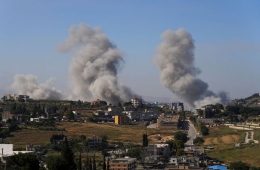
The explosion occurred on the same day that the U.S. military launched "Project Freedom," an operation to escort civilian vessels trapped in the Gulf region through the Strait of Hormuz using military aircraft and warships. The incident took place amid warnings from Iran that it would attack if the U.S. military attempted to approach or enter the Strait of Hormuz as part of Project Freedom, raising the possibility of an attack.
In response, President Trump posted on Truth Social on May 4 (local time), stating, "Iran attacked unrelated countries, including a Korean cargo ship," and added, "It seems like now is the time for Korea to join this operation." Given that President Trump has recently retaliated against European countries, including Germany, by raising tariffs and reducing U.S. troops stationed in Germany, this move appears to pressure South Korea for a military contribution. In March, he also directly expressed dissatisfaction with NATO, the United Kingdom, Australia, Japan, and South Korea for not joining deployment requests related to the Iran war.
However, the government maintains that a precise investigation into the cause of the incident, including whether it was an Iranian attack, must be conducted. The Ministry of National Defense stated that determining the cause of the vessel's accident is the top priority and that subsequent measures will be reviewed based on these findings. The Ministry of Foreign Affairs also said, "The exact cause of the accident may be identified during the process of towing the vessel and confirming the extent of the damage."
Due to this incident, it appears unlikely that forces such as the Cheonghae Unit, which is currently tasked with anti-piracy missions in the Gulf of Aden, will be deployed to the Strait of Hormuz. First, dispatching the Cheonghae Unit to the wartime situation in the Strait of Hormuz would require approval from the National Assembly. In addition, the Daegyo-Youngham, the Cheonghae Unit's main vessel, serves a different operational purpose than missions conducted within the Strait of Hormuz.
Hot Picks Today
![Samsung Electronics' "Special Dividend" Effect: Target Price for Samsung C&T Raised to 630,000 Won... Upward Revisions Continue [Weekend Money]](https://cwcontent.asiae.co.kr/asiaresize/93/2024072515415464772_1721889714.jpg) Samsung Electronics' "Special Dividend" Effect: Target Price for Samsung C&T Raised to 630,000 Won... Upward Revisions Continue [Weekend Money]
Samsung Electronics' "Special Dividend" Effect: Target Price for Samsung C&T Raised to 630,000 Won... Upward Revisions Continue [Weekend Money]
- "Is It Still a Good Time to Buy Samsung Electronics and SK hynix?"... Market Expert Says "Leadership Concentration Seen 30 Years Ago Too" [Weekend Money]
- "Just When You Thought 'Time to Travel Abroad'... Shocking News: Even with Hormuz Reopened, High Oil Prices Expected Next Year [Weekend Money]"
- "I Lost 700 Million Won Saved Over a Lifetime in Just One Year Through Stocks": YouTuber’s Confession
- Daejeon Cafe's "Myeolgong Latte" Faces Backlash Over Incorrect Taegeukgi in Promotion
Minister of National Defense Ahn Kyubaek previously stated, "The Daegyo-Youngham is equipped only for drone defense, not for ballistic missile defense, so additional reinforcement would be necessary." He also mentioned that, given the distance, it would take about three months, including preparation time, for the unit to arrive at the Strait of Hormuz from the Gulf of Aden.
© The Asia Business Daily(www.asiae.co.kr). All rights reserved.