The Three Major Shipbuilders Thrive on Energy Carrier Orders
Samsung Heavy Industries, Hanwha Ocean, and HD Korea Shipbuilding & Offshore Engineering
Secure 1.5 Trillion Won in Orders in a Single Day
AI-Driven Power Demand and Decarbonization Trends
Orders Concentrated on LNG and Ammonia Carriers
The focus of orders for Korea’s three major shipbuilders is shifting toward energy vessels such as LNG and ammonia carriers. As orders are increasingly concentrated on LNG and ammonia transport and supply facilities, there has been a clear reorganization of demand by vessel type.

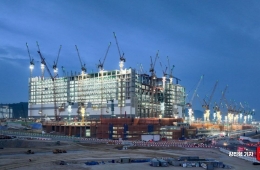
From the left in the photo, the ultra-large ammonia carrier built by Hanwha Ocean, and the FSRU built by Samsung Heavy Industries. Hanwha Ocean·Samsung Heavy Industries
View original imageAccording to the shipbuilding industry on May 6, Samsung Heavy Industries, Hanwha Ocean, and HD Korea Shipbuilding & Offshore Engineering, the three major Korean shipbuilders, each announced shipbuilding contracts worth a combined total of 1.5 trillion won on May 4.
Samsung Heavy Industries secured an order for one LNG-FSRU (Floating Storage and Regasification Unit) worth 484.8 billion won from a shipowner in Asia. An FSRU, often referred to as an “LNG terminal at sea,” is a facility that converts liquefied natural gas back into gas for supply. Compared to onshore terminals, FSRUs can be built in a shorter period, enabling rapid establishment of energy infrastructure. For this reason, they are gaining attention as a means to meet rising power demand driven by the expansion of the artificial intelligence (AI) industry.
The company explained that it has enhanced its competitiveness by applying its independently developed regasification system (S-Regas). Another advantage is Samsung Heavy Industries’ comprehensive LNG value chain lineup, covering the entire sector from FLNG (production, liquefaction, and offloading) to LNG carriers and FSRUs. So far this year, Samsung Heavy Industries has won orders for a total of 17 ships, including one LNG-FSRU, amounting to 3.4 billion dollars (approximately 5 trillion won).
Hanwha Ocean received an order for three ultra-large ammonia carriers (VLAC) from a shipowner in Africa, worth 507.4 billion won. Ammonia is gaining attention as a next-generation fuel that does not emit carbon, and demand for related carriers is rapidly increasing.
With this contract, Hanwha Ocean has secured orders for a total of 10 ammonia carriers and is accelerating its efforts to strengthen technological competitiveness, having obtained Approval in Principle (AIP) from Bureau Veritas (BV) of France and Lloyd’s Register (LR) of the United Kingdom. Its orders so far this year total 18 ships, including 10 Very Large Crude Carriers (VLCCs) and four LNG carriers, valued at 3.2 billion dollars (approximately 5 trillion won).
HD Korea Shipbuilding & Offshore Engineering signed a contract with KSS Line to build three Very Large Gas Carriers (VLGCs). The order is valued at 504.8 billion won, and the ships will be constructed by HD Hyundai Heavy Industries for delivery by the second half of 2029.
Including this contract, HD Korea Shipbuilding & Offshore Engineering has won orders for a total of 86 vessels this year, amounting to 9.35 billion dollars (approximately 14 trillion won), achieving about 40% of its annual target. By vessel type, the order book continues to focus on energy and logistics, including LNG carriers, container ships, and LPG and ammonia carriers.
Hot Picks Today
![[Exclusive] "Nvidia Researchers to Head to Yangjae"... LG Teams Up to Create Joint Robot Development Hub](https://cwcontent.asiae.co.kr/asiaresize/93/2026092110452736212_1789955126.jpg) [Exclusive] "Nvidia Researchers to Head to Yangjae"... LG Teams Up to Create Joint Robot Development Hub
[Exclusive] "Nvidia Researchers to Head to Yangjae"... LG Teams Up to Create Joint Robot Development Hub
- "President's Salary and Home Address Leaked"...Uproar Over Alleged 400 Million Personal Records Exposed on Dark Web
- "Contributing 9 Million Won Annually…430,000 Won per Month Steadily from Age 65" …The Power of the “Three-Tier Pension”
- "Sleeping Soundly at 97 km/h with Hands Off the Wheel"... Driver Caught Dozing with Autonomous Driving Enabled
- "I Suddenly Lost Hearing While Being Scolded in the Hallway"… Nurses Share Their Memories of Taeum
Industry experts anticipate that orders for high value-added vessels will continue, driven by the restructuring of the global energy supply chain and the shift to environmentally friendly fuels. A shipbuilding industry insider stated, “Demand for energy transport and supply ships such as LNG and ammonia carriers is increasing simultaneously. The ability to respond to eco-friendly fuels and infrastructure has become a key factor in securing orders.”
© The Asia Business Daily. All rights reserved. Unauthorized AI training and use prohibited.