Banks Must Stop Avoiding Mid- to Low-Credit Borrowers, Outdated Credit Evaluation Must Change... Blue House Policy Chief’s Third Confession
The Final Entry in the Structure of Finance Series
"Banks Must Not Remain Confined to the Greenhouse of High-Credit Borrowers... Loan Portfolios Need Realignment"
"Cherry-Picking Is Not the Mission of Internet Banks... They Must Prove Accountability That Comes With Their License"
"Regulators Must Ask Themselves Whether They Entrenched Vested Interests Inside the Fortress Under the Pretext of Soundness"
"It Is Not About Destroying the Credit Order"
Kim Yongbum, policy chief at the Blue House, on the 3rd proposed three solutions to reform the "cruel finance" structure: restructuring banks' avoidance of mid- to low-credit borrowers, expanding the credit evaluation system, and redefining the role of financial institutions serving low-income groups.

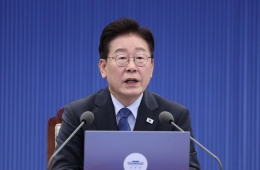
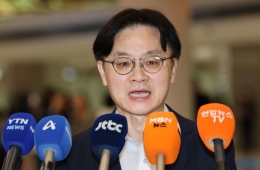
Policy Chief Kim Yongbeom is giving a briefing on April 27 at the Blue House Chuncheon Hall regarding the meeting held that day between President Lee Jae-myung and Demis Hassabis, CEO of Google DeepMind. 2026.4.27 Yonhap News Agency
View original imageIn his third entry of the "Structure of Finance Series" posted on Facebook that day, Kim emphasized the need to reconnect fragmented markets and fill neglected gaps in order to change the structure of cruel finance. This article is the final part of his three-day critique of Korea's financial structure, following "Why Is Korean Finance So Cruel?" on the 1st and "Who Created the Financial Crisis?" on the 2nd.
Kim first reflected on the reactions to his previous two articles, stating, "I saw countless words exchanged—there was criticism, ridicule, surprise, and empathy." He added, "I, too, was someone who managed crises and executed public funds from the center of this system," and acknowledged that "these criticisms are also directed at me." He clarified the purpose of his writing, reiterating, "It is not to destroy the credit order or irresponsibly advocate for debt forgiveness." Instead, he stated, "I want us to look at how the current order operates and what segments are being abandoned in the process. Rather than resorting to the excuse that 'there is no other choice,' this is an attempt to trace the uncomfortable roots of why such fundamental questions keep recurring."
Kim described the reality of Korean finance, saying, "Individual lives and risks are as continuous as a flowing river, but finance divides them into segments." He continued, "In the gaps that form between these segments, many people fall into deep valleys." He stressed, "While welfare and public low-income finance try hard to fill these gaps, ultimately, it is a matter of redesigning the system so that the stalled engine of finance runs again."
"The Structure Where Banks See Avoidance as a Rational Choice Must Change"
Kim identified the restructuring of banks' "avoidance structure" as the first solution. He argued, "We must change the structure where banks believe avoidance is a rational choice." He emphasized that if financial institutions shy away from segments such as mid- to low-credit borrowers, fearing the risks, the void will ultimately be filled by illegal private lenders and despair.
To address this, Kim proposed realigning loan portfolios so that household lending does not remain confined to the safe greenhouse of high-credit borrowers. He said, "We need to change the rules of the game so that growth is difficult without serving certain segments." He added, "Only then will banks take action. Instead of seeking grounds for rejection, they will begin to think about how to finely separate and select 'outlier risks.'"
He further emphasized, "When banks begin to grapple with these issues as their own, real financial resilience capable of overcoming 'staircase crises' will emerge. That is the core of finance."
"Outdated Credit Evaluation Frameworks Must Be Expanded... Cherry-Picking Is Not the Mission of Internet Banks"

As a second solution, Kim proposed revamping the credit evaluation system, advocating for boldly broadening the outdated frameworks. He said, "A lack of financial history does not mean a lack of repayment ability," noting that "people are already generating numerous signals of their daily lives through consumption, bill payments, and platform activities." He pointed out that financial companies do not forgo using this wealth of useful data due to a lack of technology, but rather because "the existing methods are already profitable enough, so they do not feel a pressing need to change."
Kim placed particular emphasis on the responsibility of internet banks. "We must assign this task to internet banks in earnest and require them to clearly demonstrate the outcomes they generate with their data," he said. He added, "In finance, the gravest responsibility stems not from regulation but from the obligations attached to a license." He further stated, "'Cherry-picking' is not the mission of internet banks," meaning these banks should not limit themselves to lending only to relatively creditworthy customers.
"The Role of Financial Institutions for Low-Income Groups Must Be Redefined... Evaluation Should Be Based on Outcomes, Not Structure"
As a third solution, Kim called for a fundamental redefinition of the role of financial institutions serving low-income groups. He pointed out that while such institutions have long received tax exemptions and various forms of support, in reality, the structure has shifted toward increased deposits at central federations rather than loans to members. "Funds are not flowing to those who need them. The problem lies in the underlying premise," he said.
Kim noted that although traditional low-income financial institutions have operated based on "familiar relationships," the reality has changed. "Labor is fluid, incomes are dispersed, and people are scattered," he observed, adding, "A significant gap has emerged between the traditional model based on relationships and the current reality of mobility and atomization."
Therefore, he argued, what is needed is not simply expanding support, but adjusting the model itself. Kim proposed, "We must design incentives for existing institutions to adopt new approaches, or allow new types of low-income financial entities that operate on the premise of liquidity." He stressed, "Institutions must be evaluated based on outcomes, not form." He added, "We should assess and provide opportunities based on who solves these challenges more creatively and less discriminatorily."
"Have Financial Regulators Not Strengthened the Entrenched Interests Inside the Fortress Under the Pretext of Soundness?"

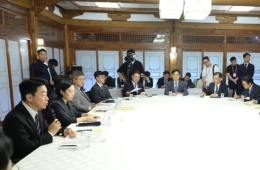
Eokwon Lee, Chairman of the Financial Services Commission (second from right), and Yongbyung Cho, Chairman of the Korea Federation of Banks, along with other heads of major commercial banks, are attending the "5th Productive Finance Great Transformation Meeting" held at the Bankers' Hall in Jung-gu, Seoul on April 16, 2026. Photo by Jinhyung Kang
View original imageKim likened the current financial structure to a "massive fortress." He criticized the sad reality of Korean finance, where high-credit borrowers enjoy low interest rates within the fortress, while outside its walls, in what he called the "outer ten-mile zone," the financially excluded are densely concentrated, exposing a solid dual structure.
On the need to reform the role of financial regulators, he said, "We must now look far beyond the fortress walls and rediscover the mission of finance there." Kim noted, "So far, the authorities have regarded soundness management and systemic crisis prevention as their supreme mission," but even consumer protection has focused only on compensation after damage occurs.
He went on to say, "We must ask ourselves honestly: Have the authorities hidden behind the shield of 'soundness,' ultimately serving to further entrench vested interests inside the fortress? Have they been so preoccupied with raising the fortress walls that they neglected structural contradictions?"
"Inclusive Finance Is Not a Slogan But Structural Design... Continuous Risks Require Continuous Responses"
Kim stressed that credit order is not created by exclusion alone, but also through more precise differentiation and understanding. "This is not about indiscriminately expanding the money supply," he said. "Rather, it is about more accurately assessing those whom institutional finance has so far failed to consider. This is the direction that will strengthen the credit system."
Hot Picks Today
!["Don't Use Chinese-Made Products": One U.S. Warning Triggers a 5 Trillion Won Jackpot for Korean Batteries [Weekend Money]](https://cwcontent.asiae.co.kr/asiaresize/93/2025121709393659037_1765931975.jpg) "Don't Use Chinese-Made Products": One U.S. Warning Triggers a 5 Trillion Won Jackpot for Korean Batteries [Weekend Money]
"Don't Use Chinese-Made Products": One U.S. Warning Triggers a 5 Trillion Won Jackpot for Korean Batteries [Weekend Money]
- "Dividend Payouts of 40 Million Won Before Their First Birthday"...'Baby Shareholders' Put Ordinary Workers at a Disadvantage
- Order Volume Surges by 9,000%...How Generation Z in China Finds Fulfillment With Just 20,000 KRW [China.zip]
- "Planning a Trip to Japan?"... Accelerating Yen Strength [Weekend Money]
- '12 Billion Bottles of Surplus' – Enough for the World to Drink for 3 Years... Wasn't MZ Just Trending Recently?
Regarding existing efforts such as bank contributions to low-income financial products and the provision of mid-interest rate products through fiscal support, Kim argued, "Inclusive finance is not a separate slogan or program, but something that must be found by restructuring financial systems to respond continuously to ongoing risks and reconnecting the broken segments." He concluded, "This is the starting point for moving beyond an era of cruel finance toward a more connected financial system."
© The Asia Business Daily. All rights reserved. Unauthorized AI training and use prohibited.