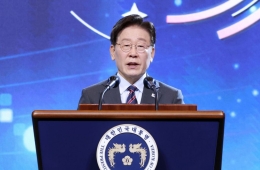
Takaichi Signals Step-by-Step Constitutional Revision, Prioritizing "Emergency Clause" and "Electoral Districts"
Sankei Interview Marks 79th Constitution Anniversary
Key Issue of "Explicitly Stating the Self-Defense Forces" Pushed Down the Priority List
Japanese Prime Minister Sanae Takaichi has stated that among the constitutional amendment items pursued by the ruling Liberal Democratic Party (LDP), she will prioritize discussions on "eliminating electoral district mergers" and "introducing an emergency clause." This is interpreted as a strategy to incrementally proceed with constitutional revision, starting with items that are relatively easier to gain opposition party and public consent on, rather than the most contentious issue, "explicitly stating the Self-Defense Forces in the Constitution."

On May 3, to mark the 79th anniversary of Japan's Constitution, Prime Minister Takaichi gave an interview with the right-leaning daily Sankei Shimbun. Regarding the LDP's four major constitutional amendment items—explicitly stating the Self-Defense Forces, introducing an emergency clause, eliminating electoral district mergers, and enhancing education—she said, "If we proceed with the discussions one by one in a realistic manner, eliminating electoral district mergers and introducing an emergency clause are pressing matters." She drew a clear line by adding, "I do not have the naive idea that all themes should proceed at the same pace."
In particular, regarding the abolition of the "merged districts" system, where less-populated prefectures are grouped together for elections, she expressed a strong desire to introduce the proposal and hold a national referendum before the House of Councillors election scheduled for the year after next. Based on this, Sankei Shimbun projected that there is a high likelihood a constitutional amendment bill will be proposed during the regular Diet session next year. In addition, she stressed that the introduction of an emergency clause is also essential to enable a swift national response in the event of a major disaster or terrorist attack.
However, even the introduction of the emergency clause, which Prime Minister Takaichi has stated she will prioritize, faces hurdles within the party. Sankei Shimbun pointed out that if a clause is introduced to allow for an extension of the House of Representatives (Lower House) term during emergencies, there are concerns that the role of the House of Councillors (Upper House), which is currently tasked with acting in place of the Lower House in the event of dissolution, could be diminished. As a result, there is growing caution among LDP Upper House members regarding the introduction of this clause.
Regarding the amendment of Article 9 of the Japanese Peace Constitution (explicitly stating the Self-Defense Forces), which forms the foundation of the constitution, she once again emphasized its importance but maintained a somewhat cautious stance. Currently, the LDP seeks to explicitly state the existence of the Self-Defense Forces while keeping Paragraph 2 of Article 9, but the coalition partner Japan Innovation Party is calling for the deletion of Paragraph 2 and the establishment of a national defense force, with no unified position even within the party itself.
Hot Picks Today
 "It's Not Time to Sell, Buy More During Sharp Declines"... Advice as the Market Shakes
- "Don't Show Screens Even If Your Baby Cries"...Why Warnings for Children Under Two Have Been Issued
- The Foreseen 'Paichai High School' Controversy... 90% of Teachers Say "Far-Right Hate Speech in Schools Is Serious"
- With Just 200 Million Won, Customize Appearance and Personality as You Wish... Companion Robot Orders Surpass 10,000 Units
- "Why Did You Call Me to the World Cup!" Jens-Hong Myung-bo Assault Video Surpasses 10 Million Views... Revealed as AI
An aide close to the Prime Minister said, "It is not that Prime Minister Takaichi regrets pursuing the amendment of Article 9, but she believes that eliminating electoral district mergers and introducing an emergency clause are more realistic for reaching agreement with other parties."
© The Asia Business Daily. All rights reserved. Unauthorized AI training and use prohibited.