"I Was an Accomplice to the Cruel Financial System"...Confession of Blue House Policy Chief Kim Yongbeom
"The most desperate pay the highest interest... It's a structural, not personal, problem"
Kim recalls: "At first, I thought President Lee's questions showed a lack of understanding of the basics of credit"
"Credit scores are mere reflections of the past... An invisible hierarchy created by finance"
"It's not about ignoring risk... We must ask whether the classification is truly fair and precise"
"Even after the 2008 financial crisis, finance lacked fundamental reflection... It became even more closed-off"
Kim Yongbeom, policy chief at the Blue House and a widely recognized expert in economic and financial policy, has publicly reflected on the credit evaluation and interest rate structure in finance—areas he had long considered self-evident. Having previously served as First Vice Minister of Economy and Finance and Vice Chairman of the Financial Services Commission, he revisited the operating principles of a financial system that uniformly determines interest rates based on individual credit scores. He confessed, "I am someone who has designed, operated, and justified this cruel system. In that sense, I am clearly an accomplice." He added that this confession is a desperate attempt, born out of intense self-reflection, to somehow bring about change.

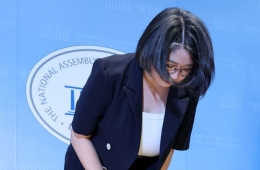
Kim Yongbeom, policy chief, is giving a briefing on the meeting between President Lee Jae-myung and Demis Hassabis, CEO of Google DeepMind, held on the 27th at the Chunchoo-kwan of the Blue House. From left: Kim Woochang, National AI Policy Secretary, Policy Chief Kim Yongbeom, and sign language interpreter Park Jiyeon. April 27, 2026. Photo by Yonhap News Agency
View original imageKim began his post by writing, "This piece starts from that cowardly realization." On May 1, he posted on Facebook an article titled "Why Is Korean Finance So Cruel?: The Imperfect Science of Credit Scores," in which he asked, "Why do the most affluent people get to enjoy the lowest interest rates, while those in the most desperate situations have to pay the highest costs for money?" He pointed out, "This question is not about individuals, but about the structure."
This observation echoes a fundamental question about the financial system that President Lee Jae-myung has repeatedly raised. Through senior staff meetings, cabinet meetings, and town hall gatherings, President Lee has asked, "Why do the most affluent people enjoy low interest rates, while those in the most desperate situations pay the highest interest? Shouldn't it be the other way around?"
In response, Kim confessed that at first he regarded President Lee's question as "one that misunderstands the basics of credit." He said, "Giving lower interest rates to those proven capable of repayment—that is the ABC of finance and an unshakeable order, or so I believed." However, over time, he came to realize that this question "pierces the very core of the assumptions we have always taken for granted." He recalled asking himself, "Whom does finance really protect? By what standards are we measuring human value?"
"The Fundamental Limits of Credit Evaluation in Finance...The Invisible Hierarchy Designed by Finance"

President Lee Jae-myung is speaking at the Senior Secretary Meeting held at the Blue House on April 30, 2026. Photo by Yonhap News Agency
View original imageIn this article, Kim focused on the limitations of credit evaluation systems. He explained that finance begins with "some people having surplus funds and others needing money," and that finance is the bridge connecting the two. The fundamental question for lenders, he said, was originally a simple one: "Is this person going to pay the money back?"
However, he pointed out that when only a person's credit remains and there is no collateral, finance begins to analyze a person's life. It considers income, debt, occupation, financial transaction history, and records of past delinquencies, and then compresses this complex life into a single number: the credit score. "This invention seemed rather brilliant," Kim said. "The attempt to quantify an uncertain future seems rational, and, in reality, those with higher scores generally do repay their debts better."
Kim stressed that the tragedy of the financial system begins at this point. "The claim that credit scores measure repayment ability is only half true," he said. "The grades are strictly backward-looking." He continued, "Lives that have followed a stable path are given preferential treatment, while those who have endured rough storms are mercilessly penalized." He cited examples such as the differences between salaried and self-employed individuals, the disadvantages faced by those with little financial history, and life events such as unemployment, illness, or divorce, stating, "Credit scores do not predict the future. They are merely a refined summary of one's past."
He went on to point out that "this number becomes an absolute god in the real world—it determines the success or failure of loans, sets the level of interest rates, and dictates a person's economic trajectory." He described this as "not a score, but a structure—an invisible hierarchy designed by finance." He emphasized, "The financial system is willing to sacrifice individual grievances for the 'correct average.' Under the banner of efficiency, individual circumstances are not even considered."
Kim made it clear that this reflection is not simply about lowering interest rates. "This is not an argument for sympathy, nor is it an irresponsible call to ignore risk," he said. "Risk is real, and there must be a price tag attached to it." However, he argued, "The real issue is whether the classification of risk is truly fair and precise. People do not pay higher interest rates because they are inherently riskier; it is because the system we created groups them into 'high-risk categories.'"
"Even After the 2008 Financial Crisis, No Fundamental Reflection in Finance"...Only More Isolation, Polarization Persists

Paek Jongmin, policy chief (left), and Kim Jeonggwan, Minister of Industry, are conversing before the cabinet meeting held at the Blue House on March 10, 2026. Photo by Yonhap News
View original imageHe also pointed out that the sophistication of financial models can actually increase systemic risk. "The more sophisticated the models become, the more precarious the system gets," Kim said. "As finance grows more reliant on numbers, it lends money more aggressively and builds even higher leverage."
He cited the 2008 global financial crisis as an example. The belief was that financial risk would be safer if it could be split and mixed in various ways, but when housing prices fell all at once, the models collapsed. "It was not individual people who created the disaster," Kim said. "It was the structure—an edifice of greed built from the raw materials of their credit."
Kim criticized the financial sector for building higher barriers rather than engaging in fundamental reflection after the financial crisis. "Having experienced an unprecedented shock, one would have expected fundamental reflection and innovation, but finance instead built even stricter and more closed fortresses," he said. "There was more paperwork, the scores became even more intricate, and the thresholds were raised. It was a shift toward shifting systemic failures onto individuals."
Hot Picks Today
!["Don't Use Chinese-Made Products": One U.S. Warning Triggers a 5 Trillion Won Jackpot for Korean Batteries [Weekend Money]](https://cwcontent.asiae.co.kr/asiaresize/93/2025121709393659037_1765931975.jpg) "Don't Use Chinese-Made Products": One U.S. Warning Triggers a 5 Trillion Won Jackpot for Korean Batteries [Weekend Money]
"Don't Use Chinese-Made Products": One U.S. Warning Triggers a 5 Trillion Won Jackpot for Korean Batteries [Weekend Money]
- "Dividend Payouts of 40 Million Won Before Their First Birthday"...'Baby Shareholders' Put Ordinary Workers at a Disadvantage
- "I'll Take the Perfect Travel Shot for You"... Thailand's 'Paid Friend' Service Gains Popularity at 40,000 Won per Hour
- "Planning a Trip to Japan?"... Accelerating Yen Strength [Weekend Money]
- '12 Billion Bottles of Surplus' – Enough for the World to Drink for 3 Years... Wasn't MZ Just Trending Recently?
As a result, he criticized, financial polarization has barely improved. "Those within the walls enjoy even stronger protection, but those at the margins remain adrift, unable to find a way in," Kim said. "Who created the crisis? And why is it that only individuals are forced to shoulder the burden and are pushed out of the market?" Kim stated that, starting from this question, he plans to share a series of articles addressing "the standards of credit and how the market operates," as well as "the possibility of redesigning financial structures."
© The Asia Business Daily. All rights reserved. Unauthorized AI training and use prohibited.