"What Should I Eat? Cooking at Home Is a Hassle... 10,000~20,000 Won 'Hotel-Level Catering' Spreads in Ultra-Luxury Apartments [Luxury World]"
Started in Seongsu-dong in 2017, Now a Basic Option for New Apartments
Meal Prices Reach 10,000–20,000 Won, Featuring Hotel-Level Chefs and Collaborations with Renowned Restaurants
Group dining, once reminiscent of company cafeterias and school lunchrooms, has now established itself as a 'premium service' in luxury apartment complexes. These days, the sight of 'purchasing meals at home' is no longer unfamiliar.

According to industry sources on April 26, major food service companies such as CJ Freshway, Samsung Welstory, and Gourmet Galleria are expanding their apartment dining service businesses. CJ Freshway currently operates services at Raemian One Bailey, Raemian One Pentas, Raemian Leaders One, and Brighton Yeouido. Samsung Welstory is running similar services at Gaepo Xi Residence, Raemian Bless Tige, and Yongsan Central Park. Gourmet Galleria is also responsible for residents' meals in key complexes such as Trimage Seoul, Gaepo Raemian Forest, and Gaepo DH Xi.
Launched in Seongsu-dong in 2017, Now a Standard Apartment Feature
Food and beverage services within luxury apartment communities were first introduced at Trimage in Seongsu-dong, Seoul, in 2017, and have since spread, especially among high-end complexes in Gangnam and Seocho. Recently, this trend has expanded beyond the capital region to metropolitan cities across the country, becoming a 'basic option' in newly built apartments. In particular, for complexes supplied since 2020, it is increasingly common for dining halls and cafes to be incorporated as essential community facilities from the design stage.
The selection process for operating companies also differs from traditional food service. Like corporate and office catering, it still involves competitive presentations and tasting evaluations, but now also includes resident voting. Bidding criteria are not limited to price; they comprehensively reflect menu quality, service standards, operational references, and brand trust. Especially in high-end complexes, the ability to offer a superior menu and service at the same price is a key competitive factor.
The average meal price in luxury apartments in the Gangnam area is between 10,000 and 20,000 won, which is significantly higher than typical office catering (6,000 to 8,000 won). However, apartment food services face limitations in operational efficiency due to smaller user bases and greater fluctuations in demand.
Instead, the menu and service levels are closer to those of restaurants. Chefs and managers with hotel backgrounds are stationed on-site, offering a wide range of cuisines, including Korean, Western, Chinese, and Japanese. Special menus in collaboration with popular local eateries, kids' menus, healthy options, and trendy dishes are also part of the offerings.
The user profile varies depending on the characteristics of each complex. In the Gangnam area, the main customers are dual-income couples in their 30s and 40s and the senior demographic. Dual-income households often use the service for dinner solutions, while seniors utilize it as an everyday dining option. Complexes with a higher proportion of seniors see more stable usage rates, whereas those with more office workers tend to have lower weekday daytime usage and higher weekend demand. The average usage rate per household is reported to be around 20% to 30%.
!["What Should I Eat? Cooking at Home Is a Hassle... 10,000~20,000 Won 'Hotel-Level Catering' Spreads in Ultra-Luxury Apartments [Luxury World]"](http://www.asiae.co.kr/news/img_view.htm?img=2026042015372932936_1776667049.jpg)
Profitability Still Lags, Companies Focus on Differentiation
However, profitability remains limited. This is because the number of diners is small and resident expectations are high, making operational conditions challenging. There have been cases where companies entered the market with low bids but withdrew midway. Nevertheless, companies continue to enter the market due to its growth potential.
The industry estimates the current market size for apartment food service at approximately 30 to 40 billion won. According to an industry insider, "As the corporate catering market has become saturated, military catering and apartment catering are drawing attention as new growth engines," adding, "The apartment market is still in its infancy but is showing annual growth rates of over 20%." The experience of operating luxury apartment services itself is also cited as a valuable reference for future business expansion.
CJ Freshway is expanding its apartment dining service business based on its operational expertise accumulated in industrial and office catering. At Raemian One Bailey, chefs and managers with hotel backgrounds are stationed, and the company has introduced the industry’s first 100% direct employment system to improve service quality. The menu consists of two sections: Korean cuisine and specialty dishes, offering restaurant-level options such as grill dishes, soups, teppanyaki, and Chinese noodle dishes. Additionally, the company differentiates itself by introducing special menu items in collaboration with restaurant brands such as 'Eomjine Cockle Bibimbap' and 'Samwon Garden.' Their competitive edge also comes from sourcing ingredients through contract cultivation and direct delivery from production regions.
Gourmet Galleria is a business specializing in apartment community food services, having established a consulting-based model that participates from the early design stage. Projects take one to three years from contract to opening, including restaurant layout and operations, and the company is expanding its business through collaboration with construction companies.
Gourmet Galleria also caters to family units and a wide range of age groups by simultaneously offering healthy, kids', and trendy menus. They further differentiate themselves by providing experiential content such as cooking classes and tuna filleting shows. The company is also pursuing a strategy to expand restaurant menus into apartment dining services by launching the premium deli brand 'Table'.
Hot Picks Today
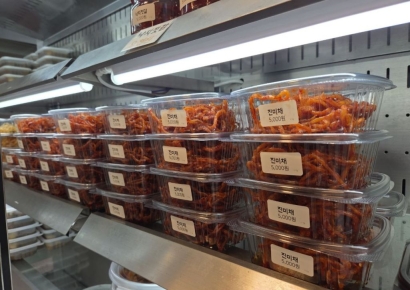 "Auntie, When Will Dried Shredded Squid Return as a Side Dish?"...Once Vanished from Restaurants, Now Making a Comeback
- "Saved Up for Overseas Trips, but When Can We Use Them?"... Korean Air Mileage Surpasses 3 Trillion Won
- "They Thought They Hit the Jackpot: Thieves Steal Nvidia-Branded Trailer, Flee After Discovering Only Sand Inside"
- Resident in Cardiac Arrest After Fire in Eunpyeong Multi-Family Residence on Chuseok
- Already 1,000 Examined, Stirring Up Protest: "Why Go to the Army When We Said No?" Students Rally in the Streets
An industry insider commented, "In the past, apartments were simply residential spaces, but now they are evolving into platforms for living and consumption. With the addition of food and beverage services alongside fitness centers and swimming pools, apartments are transforming into integrated lifestyle complexes."
© The Asia Business Daily. All rights reserved. Unauthorized AI training and use prohibited.