Government to Approve 9 Trillion Won in EDCF by 2028... Focus Shifts from "Quantitative Growth" to "Qualitative Enhancement"
Average Annual Approval Target Set at 3 Trillion Won Through 2028
Focusing on "Strengthening Core Competencies" Amid Global ODA Contraction
The government is shifting the paradigm of managing the External Economic Cooperation Fund (EDCF) from "quantitative expansion" to "qualitative enhancement." Over the next three years, the volume of new approvals has been adjusted downward by more than 5 trillion won compared to the previous plan. Instead, the government plans to elevate projects by designating artificial intelligence (AI) and K-culture as new growth engines. In addition, it aims to strengthen the fund's sustainability by breaking from the longstanding low-interest-rate policy and implementing an "interest rate hike."
Approval Volume Adjusted to 9 Trillion Won Over Three Years... Cancellation and Reinvestment of Long-Term Delayed Projects

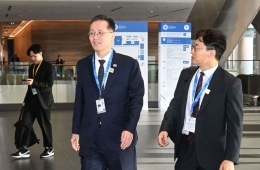
On the 13th, Koo Yoonchul, Deputy Prime Minister and Minister of Strategy and Finance, presided over the External Economic Cooperation Fund (EDCF) Fund Management Committee. Ministry of Strategy and Finance.
View original imageOn the 13th, the Ministry of Strategy and Finance, led by Deputy Prime Minister and Minister Koo Yoonchul, convened the EDCF Fund Management Committee and approved the "2026-2028 EDCF Medium-Term Management Plan," which centers on these changes. The most significant change lies in the adjustment of new approval (commitment) targets. The previous "2025-2027 plan" had set a three-year approval target of 14.1 trillion won (an annual average of 4.7 trillion won), but the new plan reduces this to a total of 9 trillion won for three years (an annual average of 3 trillion won).
This move is not simply about reducing scale; it reflects the government's intention to manage the "total amount executed" by selecting projects with a high likelihood of actual implementation. The government plans to boldly cancel approvals for projects in which Korean companies have lost the opportunity to participate or those that have been delayed for extended periods due to circumstances in recipient countries, and reinvest the resources secured from these cancellations into new core areas. The list of canceled projects will be released on the EDCF website to enhance transparency.
Following the reduction in the approval volume, the previous goal of expanding Korea's official development assistance (ODA) volume to "world's top 10" has also been scaled back. The goal has been reset to "maintaining the current position (13th) until 2030." This decision comprehensively takes into account the limited domestic fiscal situation and the trend of aid reduction by major donor countries such as Germany and the United States, despite growing calls from the international community for greater contributions. According to the Ministry of Strategy and Finance, provisional data show that ODA performance for the top four countries—Germany, the United States, the United Kingdom, and Japan—declined year-on-year last year.
AI and Culture Added as Key Focus Areas... Low-Interest Policy Overhaul Also Announced

In addition to the existing focus areas of green, digital, and supply chains, AI and culture have now been newly designated as strategic sectors. In the field of AI, the government will launch "signature projects" that apply Korea's technological prowess to fields with clear demand in developing countries, aiming to present exemplary cases. In the culture sector, support will be provided for constructing large-scale facilities with high symbolic and ripple effects, and grants will be linked to ODA to help spread K-culture globally. Furthermore, the government intends to expand EDCF support to countries with high potential for strategic resources, such as critical minerals, thereby contributing to the security of supply chains. Regionally, while maintaining its focus on Asia, the government will prioritize support for key partner countries in Africa and Latin America, following the principle of selective and focused cooperation.
Hot Picks Today
 "I Ate It Often Because It Tasted Good"... This Eating Habit Linked to 40% Higher Odds of Asymptomatic Cerebrovascular Damage
- "She's 7..." President Lee Left Speechless, Posthumously Awards Medal to Firefighter Killed in the Line of Duty
- [AI Revolution] Buzzvil's Strategy for Increasing App Dwell Time in the AI Era
- "We've gone this far to save on lunch"... Where office workers are flocking instead of restaurants
- "Can They Really Be This Sweet?"... The Story Behind Convenience Store Honey Sweet Potatoes [Foodie X-Files]
Unlike previous years, the latest plan significantly reinforces the section on "enhancing fund management efficiency." In particular, measures will be taken to improve the fund's financial soundness. The government will overhaul the current low-interest policy—currently at 0.01% to 2.5%—and pursue interest rate hikes in line with levels set by other donor nations and international ODA standards. The long-term aim is to minimize the need for additional fiscal injections. In addition, the system for public recirculation has been strengthened, including measures such as remitting a portion of profits generated by EDCF support to the Strategic Export Finance Fund as a cooperative contribution.
© The Asia Business Daily. All rights reserved. Unauthorized AI training and use prohibited.
!["Please, Just Take Them Off" - They Made It All the Way to Bed... Then Fecal Bacteria Struck [Deep Scroll]](https://cwcontent.asiae.co.kr/asiaresize/307/2026101610053063338_1792112730.png)