'MPC Unanimously Freezes Base Rate... Significant Upward Revision of Inflation Forecast Expected in May (Comprehensive)'
April 10: Bank of Korea MPC Meeting on Monetary Policy Direction
High Oil Prices, Exchange Rate Volatility, and Inflation Concerns Following Iran War
Market Now Expects a Rate Hike Within the Year
Possibility of Continued Tensions After
At the final Monetary Policy Committee (MPC) meeting before the end of Lee Chang-yong’s term as Governor of the Bank of Korea, the benchmark interest rate was kept unchanged at 2.50% per annum. The decision to hold the rate was unanimous. As a result, this marks the seventh consecutive rate freeze, following decisions in July, August, October, and November of last year, as well as in January and February of this year. Several factors influenced this decision, including the surge in international oil prices after the war between the United States, Israel, and Iran, the won-dollar exchange rate fluctuating above 1,500 won, and concerns about inflation. The MPC is expected to raise its forecast for this year’s consumer price inflation by a significant margin compared to its previous estimate of 2.2% in next month’s economic outlook. The economic growth rate is also projected to be revised downward from the previous estimate of 2.0%.

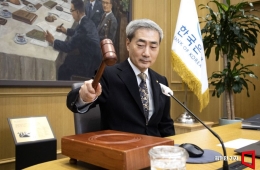
Lee Chang-yong, Governor of the Bank of Korea, is striking the gavel at the Monetary Policy Committee plenary session held on the 10th at the Bank of Korea headquarters in Jung-gu, Seoul.
View original imageExchange Rate Surpasses 1,500 Won Due to Iran War... Heightened Caution, Seventh Consecutive Rate Freeze
On April 10, the Bank of Korea’s MPC unanimously decided to maintain the benchmark interest rate at its current level (2.50%) during the policy direction meeting held at the Bank’s headquarters in Jung-gu, Seoul. This decision was in line with market expectations. In a recent survey conducted by The Asia Business Daily, all 13 expert respondents predicted a rate freeze for this month, with 12 anticipating a unanimous decision. In its statement on the direction of monetary policy, the MPC said, “With upward pressure on prices and downward pressure on growth both increasing due to the Middle East war, and volatility in financial and foreign exchange markets expanding significantly, we believe it is appropriate to maintain the current policy rate level and continue to monitor developments and spillover effects, especially given the high degree of uncertainty related to the ongoing Middle East situation.”
This month’s rate freeze was effectively anticipated. This is due to soaring oil prices caused by the Iran war, the strengthening of risk aversion sentiment, and ongoing market volatility threatening financial stability. The won-dollar exchange rate, which surpassed 1,500 won, surged to 1,530.1 won as of the weekly closing on March 31 and remained at a high level. On April 8, news broke that the United States and Iran would enter negotiations after a two-week ceasefire, prompting a sharp drop of 33.6 won to 1,470.6 won. However, by the next day (April 9), it had risen again to 1,482.5 won, before stabilizing in the mid-1,470 won range on this day, highlighting the continued high volatility. Analysts say that ongoing market uncertainty is driven by the expectation that future negotiations, including the reopening of the Strait of Hormuz, will not proceed smoothly.

On the 10th, an employee is monitoring the stock market and exchange rates in the dealing room at the Hana Bank headquarters in Jung-gu, Seoul.
View original imageMPC: “Inflation Rate Will Rise to Mid-to-High 2% Range”... February Forecast to Be Significantly Surpassed
Heightened vigilance over inflation also supported the decision to hold rates. The MPC stated, “While upward pressure on inflation will significantly increase due to higher international oil prices, government price stabilization measures will partially offset this, and the inflation rate is expected to rise to the mid-to-high 2% range. We expect this year’s consumer price inflation to significantly exceed our February forecast of 2.2%.” The core inflation rate is also forecast to be somewhat higher than the earlier projection of 2.1%.
Although the March consumer price inflation rate (2.2%) was broadly in line with expectations, a cautious tone prevailed in this month’s monetary policy as authorities assessed the strength of the recent supply shock. Kim Jungsik, Professor Emeritus of Economics at Yonsei University, commented, “Even if the war ends as it is, the conflict could persist for quite a long time. Iran has neither surrendered nor been conquered, so tensions could continue, making a significant drop in international oil prices or exchange rates unlikely.” Kim Seongsu, an analyst at Hanwha Investment & Securities, also raised his inflation forecast from 2.1% to 2.4%, stating, “Even if the war ends, it will take time for supply chains and infrastructure to return to normal operation.”
Concerns also remain regarding the housing market and household debt. Although the pace of home price increases has slowed recently, prices are still on the rise, and the duration of the slowdown has not been long enough to warrant relief. According to the Korea Real Estate Board’s weekly apartment price trends for the first week of April (as of April 6), apartment sales prices in Seoul rose by an average of 0.10% compared to the previous week. After a seven-week slowdown since the first week of February, Seoul apartment prices dropped to an increase of 0.05%, then expanded to 0.12% over the past two weeks, before narrowing again after three weeks. The Real Estate Board explained, “There is a mix of regions where transactions have slowed due to a wait-and-see attitude and others, such as those near subway stations, large complexes, and redevelopment sites, where prices are rising, leading to an overall increase in Seoul.”

Expectations for a Rate Hike Within the Year Grow... Inflationary Pressure Outweighs Growth Concerns
In the market, expectations for a rate hike within the year have become increasingly prominent. The backdrop to these expectations is concern about inflation. Professor Kim analyzed, “There is a possibility of a slight rate increase in the second half of the year. The inflation rate is expected to rise to the mid-to-high 2% range, and if the exchange rate rises, capital outflows could occur, increasing the likelihood of a rate hike.” Shin Hyun-song, the nominee for Governor of the Bank of Korea, who is known for a strong focus on financial stability, is also seen as potentially raising rates. Professor Seok Byeong-hoon of Ewha Womans University also said that, based on the possibility of the inflation rate reaching the high 2% range, “The rate will either remain unchanged or be raised once this year.”
The MPC also signaled a downward revision to its growth outlook. Despite strong semiconductor exports and the supplementary budget, growth has slowed more than expected due to rising energy prices and supply disruptions. However, the market expects that the widening of inflationary pressure will have a more significant impact on the domestic macroeconomy than concerns over slowing growth.
Hot Picks Today
 Despite "Insufficient Balance" Notices, They Board Anyway... Reports of Foreign Fare Evasion Mounting
- "If It Helps My Child's Studies, It's Worth Every Penny"... U.S. Parents Open Their Wallets for $10,000 Tests
- [Exclusive] "We Came for a KRW 140,000 Trip": Following Chinese Tourists in Korea Uncovers a 'Suspicious' Tour
- "I'm paying to stay, and you want me to do the laundry and dishes too?" ... Airbnb bans excessive cleaning demands
- "Baek Jongwon Had Been Quiet, Then Hit It Big"... Waits in the 100s in U.S. Despite KRW 46,000 Pork Belly
Kang Minjoo, Senior Economist at ING Bank, said, “A slight rate hike could take place around July this year to guard against a recession caused by inflation.” Professor Kim also pointed out, “Rather than sharply lowering the growth rate, efforts will be made to defend growth through fiscal policy measures such as a second or additional supplementary budget.” Professor Seok similarly predicted, “The economic outlook in May will likely see this year’s growth rate revised downward from the previous 2.0%, but the supplementary budget will help offset a 0.1–0.2 percentage point decline, thereby reducing the extent of the slowdown.”
© The Asia Business Daily. All rights reserved. Unauthorized AI training and use prohibited.