Rather Than Buying Ultra-High-Priced Apartments Over 10 Billion Won, More Opt for Monthly Rents Over 10 Million Won
Only Three Apartment Sales Over 10 Billion Won in Q1
Down 73% Year-on-Year
High-End Monthly Rentals Over 10 Million Won Increase
Property Tax Burden and Money Moving to Stocks Drive the Shift

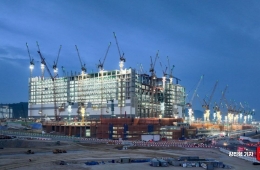
A panoramic view of Nine One Hannam in Hannam-dong, Yongsan-gu, Seoul. Photo by Yonhap News Agency
View original imageThe number of ultra-high-priced apartment sales worth 10 billion won (KRW 10 billion) or more has dropped sharply so far this year. There has been a clear preference for monthly rentals over purchases due to the burden of property holding taxes. The shift of funds from real estate to the stock market—often referred to as the "money move" phenomenon—has further contributed to a trend of turning to rentals rather than sales.
According to the Ministry of Land, Infrastructure and Transport's real transaction price disclosure system on April 9, there were only three apartment sales worth 10 billion won or more in Seoul during the first quarter of this year. This represents a 73% decrease compared to the 11 transactions during the same period last year.
In the first quarter of this year, two transactions were recorded for a 244㎡ exclusive unit at Nine One Hannam in Hannam-dong, Yongsan-gu, at 15.65 billion won and 14.04 billion won, respectively. Another transaction involved a 183㎡ exclusive unit at Shinhyundai 11th Complex in Apgujeong-dong, Gangnam-gu, which sold for 11 billion won. In the first quarter of last year, there were deals exceeding 10 billion won at several locations, including Hannam The Hill in Hannam-dong, Raemian One Bailey in Banpo-dong, Seocho-gu, Acro River Park in Banpo-dong, and Acro Seoul Forest in Seongsu-dong 1-ga, Seongdong-gu. This year, not only has the number of transactions decreased, but ultra-high-priced sales were limited to just two complexes: Nine One Hannam and Shinhyundai 11th Complex.
Prices have also fallen. For example, the 244㎡ exclusive unit at Nine One Hannam fetched a record high of 16.7 billion won in August last year, but this year, transactions have occurred in the range of 14 billion to 15 billion won.
The tightening of mortgage loan regulations since the real estate measures announced on June 27 last year has also had an impact. Of the 44 high-priced home sales worth 10 billion won or more last year, 30 transactions (68%) occurred by June. As mortgage regulations became stricter, transactions in the high-priced housing market declined. The "money move" from real estate to financial products, a policy promoted by the current administration, has also contributed to the decrease in high-priced apartment transactions.
While ultra-high-priced apartment sales declined, monthly rental contracts increased somewhat. The number of apartment monthly rental contracts with a monthly rent of 10 million won or more reached 64 in the first quarter, up about 31% from the same period last year. Of these 64 contracts, 10 were renewals (four using the renewal request right), an increase of three compared to last year. Among the renewed contracts, the monthly rent increased in eight cases, while it decreased in only one case.

Particularly notable is the sharp increase in contracts for apartments with a monthly rent of 20 million won or more, which represent the top 0.04% of all monthly rental transactions. There were 14 such contracts in the first quarter, marking a 2.8-fold increase compared to a year earlier. The highest was a 198㎡ exclusive unit at Acro Seoul Forest, which was rented for a deposit of 500 million won and a monthly rent of 29 million won. As the luxury apartment complex Four Zehs Hangang in Gwangjang-dong, Gwangjin-gu began move-ins in August last year, a number of high-priced monthly rental deals have been made there, with five contracts for monthly rents of 20 million won or more concluded in the first quarter alone. The main groups driving demand for these high-priced monthly rentals are identified as wealthy individuals holding virtual assets, high-ranking executives of foreign companies, and celebrities. Monthly rentals do not incur tax burdens and do not require spending massive amounts such as 10 billion won or more. Rather than investing in real estate, these individuals are opting for alternative investments.
Hot Picks Today
 "I Went for the Cheap Coffee, but Now I Feel Uneasy"... Major Coffee Franchises Cited for Violations One After Another
- “No Room Available Despite Advance Reservation”… Lodging Industry’s 'Contract Breaches by Businesses' Surpass Last Year’s Annual Total in Just 8 Months
- In Korea, Studying Medicine Is in High Demand, but in China, It's Shunned: "Why Become a Doctor When You Can’t Make Money?"
- "50 Million Won for Weekly Encounters"... Man in His 60s Sentenced for Deceiving Woman in Her 20s with Forged 1.4 Billion Won Account
- "After Spending 170,000 Won on Hanwoo, This Is What I Got": Why Webtoon Artist Kim Gyusam Decided to Give Cash Instead

Yoon Sumin, a real estate specialist at NH Nonghyup Bank, said, "As prices kept rising, people were sitting on large real estate holdings, but now the tax burden is increasing," and added, "Although the supply of high-priced homes continues, the high costs involved are prompting a shift toward alternative income-generating investments, such as financial products."
© The Asia Business Daily. All rights reserved. Unauthorized AI training and use prohibited.