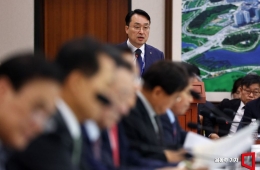
Prosecution Fails to Recover Chun Doo-hwan's Yeonhui-dong Residence... Supreme Court: "Claim Expires Upon Death"
Supreme Court Confirms Dismissal Without Further Review
Maintains Ruling: "Claim to Collect Fines Expired After Chun Doo-hwan's Death"

The prosecution's attempt to recover unpaid fines from the late former President Chun Doo-hwan by transferring ownership of his house in Yeonhui-dong, Seodaemun-gu, Seoul has ultimately failed. The court has finalized its decision that, since Chun has passed away, the claim to collect the fine has itself expired and can no longer be enforced.
According to the legal community on April 3, the First Division of the Supreme Court (Presiding Justice Seo Kyunghwan) confirmed the lower court's decision to dismiss the lawsuit without further review the previous day, in a case where the government filed for a transfer of ownership registration of the Yeonhui-dong residence against Mrs. Lee, former secretary Lee Taeksoo, and eldest son Jae-guk, who are the registered owners of the property.
Dismissing a case without further review is a procedure in which the Supreme Court rejects an appeal without a full hearing if it finds no legal error in the appellate court's ruling, except in criminal cases. This is the final decision in a legal battle that began four years and six months ago in October 2021, when the prosecution filed suit arguing that the main house in Yeonhui-dong appeared to be Chun's property held under borrowed names.
Previously, in April 2021, the Supreme Court ruled that "there is insufficient legal basis to view the main house under Mrs. Lee's name and the garden under Mr. Lee's name as property subject to forfeiture," and ordered the seizure to be lifted.
However, at the time, the court added that "if the main house and garden are indeed assets held under borrowed names by the defendant (Chun Doo-hwan), the government can file a subrogation lawsuit to restore the ownership under the defendant's name and then enforce the forfeiture judgment." Following this, in October of the same year, the prosecution filed a lawsuit to transfer the ownership of the main house and garden to Chun in order to enforce the unpaid fines. Chun Doo-hwan died a month later.
Hot Picks Today
 "Jealous of Koreans" - Now a Must-Do on Every Trip... The Place Where Foreigners Spent KRW 229.8 Billion
- [Exclusive] Piling medicines into a basket and setting them on the counter: "Ready to check out?" ... Misuse concerns mount, but the government remains in the dark.
- "'No! Dad, Run!'... Father Moved by 5-Year-Old Son Who Shielded Him from Ghost at Korean Folk Village"
- "I thought getting into a big company was the goal"... The 'position' only 1 in 121 employees reaches
- "Please Let Me Go Home"... Customers Trapped in Department Store Parking Lot for 5 Hours Vent Their Anger
In February 2024, the court of first instance ruled that "the claim to collect the fine based on the judgment has expired due to Chun Doo-hwan's death," and added that "in principle, liabilities arising from various criminal judgments are not subject to inheritance." The government appealed, but both the appellate court and the Supreme Court upheld the same decision.
© The Asia Business Daily. All rights reserved. Unauthorized AI training and use prohibited.

!["Please, Just Take Them Off" - They Made It All the Way to Bed... Then Fecal Bacteria Struck [Deep Scroll]](https://cwcontent.asiae.co.kr/asiaresize/307/2026101610053063338_1792112730.png)