[Interview] Stanford's Gi-Wook Shin: "Trump Could Present Opportunities for Korean Manufacturing... Economic Cooperation with Japan and the EU Must Be Strengthened"
An Era Where Security and the Economy Move Together
Korea's Critical Role in Manufacturing
Skepticism Over State-Led China Surpassing the U.S.
A 'Triple Alliance' Needed Among Korea, Japan, and the EU
"The Donald Trump administration in the United States could present opportunities for Korean manufacturing. This is because the economy and security now go hand in hand. Korea needs to strengthen economic cooperation with Japan and the European Union (EU) while maintaining its alliance with the United States."
Gi-Wook Shin, Professor at Stanford University, made this statement in an interview with The Asia Business Daily near Jongno-gu, Seoul, on April 1. Professor Shin is a professor of Sociology and a tenured professor specializing in Korean Studies at Stanford University, and served as director of the Walter H. Shorenstein Asia-Pacific Research Center (APARC) for 20 years. In 2023, he established the Stanford Next Asia Policy Lab, a policy think tank, and has focused his research on talent development, nationalism and racism, and the crisis and reform of democracy.
Professor Shin explained that the era of 'America for security, China for the economy' has passed, and now security and the economy move together.

He emphasized that it is time to move beyond the old frameworks and further segment the areas of security and the economy when formulating diplomatic strategies. In particular, he advised that Korea—which has strengths in manufacturing sectors such as semiconductors and shipbuilding—should leverage these advantages in negotiations with the United States.
The following is a Q&A with Professor Shin.
-U.S. President Donald Trump has declared an end to the war. How long do you expect the Middle East situation to last?
▲It does not seem like it will last long, but the situation changes by the day. I believe the main reason for this war initiated by Trump was to prevent Iran from acquiring nuclear weapons or missiles. In addition, Israel also played a role in encouraging this move. Now that President Trump has achieved his objectives to some extent, it seems he will look to wrap things up and withdraw.
-The recent rise of China's manufacturing sector poses a major threat to the Korean economy. There are claims that the recent attack on Iran was targeted at China. What is your view?
▲Through its 10-year mid- to long-term manufacturing powerhouse strategy 'Made in China 2025' announced in 2015, China has significantly strengthened its manufacturing base. In fact, China has caught up with almost all aspects of Korean manufacturing. By keeping China in check under the pretext of national security, Trump has slowed China's growth, buying time for Korean semiconductor companies. Recently, such as in this case, economic and security issues are increasingly intertwined.
-Could China surpass the United States?
▲Despite this, China still lags behind the United States in terms of world-leading technology. Although President Trump is problematic in many ways, China's limitations are clear. All so-called global platform companies are based in the United States. While China's challenge is fierce, the U.S. is market-driven, whereas China is state-driven. State-led growth has obvious limitations. Up to a certain point, it enables rapid growth and may seem very effective, but I believe there are clear limits to surpassing the United States. I have often seen successful Chinese entrepreneurs who do not have much faith in their own country. China's domestic demand, driven by state leadership, will boost economic growth, but I am skeptical that this alone will allow China to surpass the U.S.

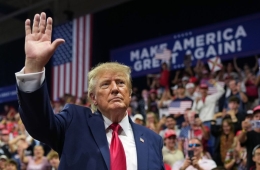
U.S. President Donald Trump clenched his fist after delivering a special keynote speech at the '2025 Asia-Pacific Economic Cooperation CEO Summit (APEC CEO SUMMIT)' held at the Gyeongju Arts Center in Gyeongbuk on October 29 last year. 2025.10.29 Photo by Kang Jinhyung
View original image-Tariffs have been a challenge. What kind of economic cooperation is possible between the United States and Korea?
▲From a manufacturing perspective, Korea is an extremely important country to the United States. In fact, Europe faces considerable difficulties in manufacturing. From the U.S. perspective, President Trump's push for a revival of domestic manufacturing is not wrong in terms of direction—although the approach is overly aggressive. Since the U.S. currently lacks the necessary workforce and infrastructure, companies like Hyundai Motor and TSMC have no choice but to establish a presence there. For the U.S. to reestablish its manufacturing sector, it needs partners, and I believe Korea is the most suitable. Japan would be next in line. There are concerns that Korea might gradually lose its manufacturing base, but since the U.S. would also struggle without Korea, maintaining a mutually complementary relationship should allow for strong cooperation. In Silicon Valley, as AI companies engage in a 'chicken game,' ultimately only one or two companies will survive, but the share prices of Samsung Electronics and SK hynix are rising, aren't they? In Silicon Valley, there's even talk that memory is now a seller's market.
-You have argued that Korea should strengthen economic cooperation with Japan and the EU.
▲I would suggest forming a 'triple alliance' among Korea, Japan, and EU countries. All are democracies and U.S. allies, yet all are suffering most from tariff issues. In addition, they share similarities in terms of declining populations and the crisis of democracy, so they should be able to share perspectives with one another. SK Group Chairman Chey Tae-won, for example, has even proposed forming an 'economic community' with Japan and the EU, which I think is a great idea. From a security perspective as well, Korea should cooperate with Japan and the EU.
-Why do innovative companies continue to emerge from the United States?
▲Despite political populism like Trumpism, the world's leading companies continue to emerge from the U.S. NVIDIA is a recent example, but companies like Google, Amazon, and Meta keep coming up. Europeans often make a self-deprecating remark: "America does innovation, China does emulation, and Europe only does regulation." We need to reflect on that. While Korea's cultural industries like K-pop and cosmetics are booming, I believe the economy is ultimately held up by manufacturing companies such as Samsung, SK hynix, and Hyundai Motor.

President Lee Jae-myung and Japanese Prime Minister Sanae Takaichi are taking a commemorative photo at Horyu-ji Temple, a representative cultural heritage site in Nara Prefecture, Japan, on January 14. Photo by Yonhap News Agency
View original image-You have often spoken about the prominence of Indian talent. How should Korea foster talent going forward?
▲There is an abundance of Indian leaders at global big tech companies such as Google and Microsoft (MS) CEO roles. They went to universities in the U.S. and then established themselves in Silicon Valley. Now, as Chinese influence wanes in Silicon Valley, India is rising. People refer to 'Bengaluru startups,' and the number of unicorns (unlisted startups valued at over 1 trillion won) in India is now the third largest after the United States and China. Korean talents also need to pursue STEM fields. Moreover, in the era of AI, when the labor market is rapidly changing, I argue for the establishment of a Ministry of Human Resources. Just two years ago, majoring in computer science in college meant finding a job was easy. Now, even Stanford graduates sometimes struggle to find employment because of AI. It's a difficult problem. I believe a control tower is needed to predict and discuss the future direction of the workforce, including carving out parts of the Ministry of Education and the Ministry of Employment and Labor.
Hot Picks Today
![[Breaking] After photos dispelled death rumors... Unification Ministry: "Kim Jong Un arrives in Dandong today via New Yalu River Bridge on China visit"](https://cwcontent.asiae.co.kr/asiaresize/93/2026102408431572707_1792798995.jpg) [Breaking] After photos dispelled death rumors... Unification Ministry: "Kim Jong Un arrives in Dandong today via New Yalu River Bridge on China visit"
[Breaking] After photos dispelled death rumors... Unification Ministry: "Kim Jong Un arrives in Dandong today via New Yalu River Bridge on China visit"
- “We’ve Hit Bottom”: Samsung Electronics and SK hynix “Undervalued at Global Financial Crisis Levels” Set for W-Shaped Rebound - But When? [Weekend Money]
- "A Short Trip to Korea Isn't Enough; I Want to Live There for a Month"... Foreign Tourists Take Up Hiking and Yoga, Too
- "Justice Will Prevail"... Seoul Mayor's Office Holds Welcome Event for Acquitted Oh Sehoon
- "If This Airs, I'm Dead"... Why a Restaurant Refused to Let Jeon Hyunmoo's Show Film
-How do you view the Lee Jae-myung administration?
▲The Lee Jae-myung administration appears to be a pragmatic government. In some ways, it is similar to the MB administration. Beyond responsive, agile measures, it is important to set a big agenda. Without guiding principles, responding to situations one by one will eventually reach its limit.
© The Asia Business Daily. All rights reserved. Unauthorized AI training and use prohibited.




![[Breaking] Ministry of Unification: "Kim Jong Un visits China... arrives in Dandong today via New Yalu River Bridge"](https://cwcontent.asiae.co.kr/asiaresize/307/2026102408431572707_1792798995.jpg)