Trump's Posting of Iranian Bridge Explosion Video Reignites Oil Price Surge (Comprehensive)
Trump Pressures Iran for Swift End-of-Conflict Agreement
Iran Discusses Hormuz Transit Rules with Oman

On the 2nd (local time), U.S. President Donald Trump posted footage of the explosion of an Iranian bridge on his social networking service (SNS) Truth Social. Screenshot of Truth Social video
View original imageInternational oil prices surged after U.S. President Donald Trump posted footage of the U.S. military bombing a bridge in Iran. As expectations grew that the large-scale offensive President Trump announced in his recent address to the nation had begun, concerns over uncertainty in the global oil supply reemerged. However, news that Iran plans to establish transit rules in consultation with Oman, a country bordering the Strait of Hormuz, and that ministers from various countries had gathered to address the issue of the potential blockade, helped limit the price increase. Nevertheless, oil prices are expected to remain volatile until uncertainties surrounding U.S. policy toward Iran are resolved.
Trump Posts Footage of Iranian Bridge Explosion...Pressuring for a Deal

On the 2nd (local time), President Trump posted a video on his social media platform, Truth Social, showing the bombing of the B1 bridge near Karaj, west of Tehran, a key bridge in Iran. Along with the video, President Trump stated, "Iran's largest bridge has collapsed and can never be used again, and there is more to come," emphasizing, "Iran must agree before it's too late, before there is nothing left." The previous day, in an address to the nation, President Trump had warned of a "massive attack on Iran for two to three weeks," signaling an intensified offensive against Iran's infrastructure.
It has been reported that at least eight people were killed in the bridge explosion in Iran. According to Iran's Fars News Agency, "Eight people were killed and 95 injured in the B1 bridge bombing," adding, "At least two people died in the initial attack, and a second strike occurred while rescue workers were providing aid to the victims at the scene."
International oil prices, which had been declining in anticipation of a declaration to end the conflict from President Trump, soared across the board. On this day, West Texas Intermediate (WTI) crude oil for May delivery jumped 11.41% from the previous day to close at $111.54 per barrel. This marks the highest level in three years and ten months since June 2022, immediately following the outbreak of the war in Ukraine. Brent crude, the international oil price benchmark, also closed up 7.78% at $109.03 per barrel.
As international oil prices reignited their upward momentum, gasoline prices in the United States also rose sharply. According to the American Automobile Association (AAA), the average price of gasoline nationwide reached $4.081, a 36.1% increase from the previous month. The average price of diesel fuel also surged 46%, rising from $3.770 to $5.507.
Rebecca Babin, Senior Energy Trader at CIBC Private Wealth, told the Wall Street Journal (WSJ), "The market expected President Trump to make comments suggesting negotiations with Iran and a quick withdrawal, but his actual address to the nation did not reflect this," adding, "It appears more likely that the situation will escalate further rather than de-escalate."
Iran Limits Oil Price Gains...Discussing Hormuz Transit Rules

It was Iran that set the upper limit on the surge in oil prices that day. Iran announced it was in discussions with Oman to establish new transit rules for the Strait of Hormuz. On this day, Kazem Gharibabadi, Iran's Deputy Foreign Minister for Legal and International Affairs, said in an interview with Russia's Sputnik News, "Even in peacetime, ship movements through the Strait of Hormuz should be under the supervision of Iran and Oman, the littoral states," adding, "For this reason, we are working with Oman to draft new protocols."
He also stated that they are considering imposing transit fees on ships passing through the Strait of Hormuz. Deputy Minister Gharibabadi said, "This matter is still under review," adding, "It is too early to discuss the exact level of transit fees."
The international community also announced that it is actively seeking ways to reopen the Strait of Hormuz. On this day, under the auspices of the United Kingdom, a virtual conference was held with foreign ministers from over 40 countries around the world, including South Korea, to discuss the reopening of the Strait. UK Foreign Secretary Yvette Cooper emphasized at the meeting, "Today, we are focusing on diplomatic and international plans, including the collective mobilization of all forms of diplomatic and economic tools and pressure," adding, "Our partners today called for the immediate and unconditional reopening of the strait and respect for the basic principle of freedom of navigation."
The United Nations (UN) Security Council is scheduled to vote on a resolution to resume navigation in the Strait of Hormuz on the 3rd. The resolution, proposed by Bahrain and supported by other Gulf Arab countries and the United States, allows UN member states to use "all necessary defensive means" to protect merchant shipping. The original language permitting "all necessary means" was softened due to opposition from China and Russia, who objected to the use of force. China and Russia are both permanent members of the Security Council with veto power. French President Emmanuel Macron, during his state visit to South Korea, stated that military reopening of the Strait of Hormuz was "unrealistic," and warned that "not only would it take an enormous amount of time, but ships passing through the strait would be exposed to threats from the Islamic Revolutionary Guard Corps and the risk of ballistic missiles."
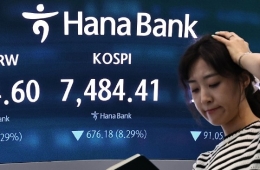
As a result, Asian stock markets showed an upward trend. As of 10:20 a.m., the Korea Composite Stock Price Index (KOSPI) had risen 3.11% compared to the previous session, while Japan's Nikkei 225 (up 1.36%) and TOPIX (up 1.05%) indices were also strong. Financial markets in Hong Kong, Taiwan, and Australia were closed for the day.
Hitoshi Asaoka, Chief Strategist at Asset Management One in Tokyo, told Bloomberg News, "Improved risk appetite among U.S. investors also influenced Asian stock markets," adding, "Even if oil prices do not fully return to previous levels, there is significant room for a rebound in terms of liquidity if they partially normalize."
Hot Picks Today
 Ballot Box Found in Trash... Peru Holds Runoff Amid 'Ballot Shortage Crisis'
- "Brothers, You've Been Waiting for News?"... Orphanage Library Built Thanks to 'Money Brag' by SK hynix Employee
- "Could It Happen to Me?"... Residents Continue Mountain Visits Despite Surge in Bear Attacks in Japan
- "A Mother's Quick Reflexes Save Child from BRT Bus Rushing onto Sidewalk"
- "Click! Gotta Post on SNS"... 'Small Luxury' for 20s and 30s Cools Down Amid High Inflation
However, since the Trump administration's military operations against Iran are expected to continue, oil price uncertainty is likely to persist. George Efstathopoulos, Portfolio Manager at Fidelity International, told CNBC, "President Trump's remarks about an offensive against Iran in his address to the nation have created long-term uncertainty," adding, "As investors who had hoped for a ceasefire shift back to risk aversion, oil price volatility will remain extreme until the uncertainty is resolved."
© The Asia Business Daily(www.asiae.co.kr). All rights reserved.




![[Breaking] President Lee Criticizes Election Commission: "No Excuse, Extremely Serious"](https://cwcontent.asiae.co.kr/asiaresize/307/2026060817232560108A.jpg)