Deputy Prime Minister Koo Yoon-chul: "Significant Reduction in Import Times for Paint and Other Products... Easing Supply Chain Bottlenecks"
Emergency Economic Headquarters and Economic Ministers' Meeting Held on April 3
Economic Impact of Middle East War Expands
Government Pursues Regulatory Rationalization
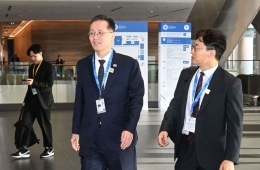
Deputy Prime Minister and Minister of Strategy and Finance Koo Yoon-chul stated on April 3, "For chemicals with supply concerns such as paint, we will apply special exceptions to the import registration process to significantly reduce the time required for imports."

Koo Yooncheol, Deputy Prime Minister and Minister of Strategy and Finance, is delivering opening remarks while presiding over the 'Emergency Economic Headquarters Meeting and Economic Relations Ministers' Meeting' held at the Government Seoul Office in Jongno-gu, Seoul, on April 3. Ministry of Strategy and Finance
View original imageOn the morning of April 3 at the Government Complex Seoul, Deputy Prime Minister Koo convened the Emergency Economic Headquarters Meeting and Economic Ministers' Meeting. He remarked, "The economic impact of the Middle East war is gradually expanding," and added, "By temporarily suspending certain regulations, we will swiftly resolve procedural challenges such as supply chain bottlenecks for key items."
He went on to say, "Like a helmsman steering through rough seas, I will do my utmost to overcome this crisis," and emphasized, "For supply chain and price-sensitive items heavily affected by the war, we will assign dedicated personnel to monitor each item daily." He continued, "By sharing information in real-time through a hotline among ministers, we will respond boldly and swiftly. In particular, depending on future supply and demand, we will actively consider additional measures for naphtha derivatives and petrochemical products."
To this end, the government plans to complete customs clearance for imported energy and raw materials before arrival and unloading. For companies importing goods from the Middle East, special exceptions will be applied to reduce increased freight costs incurred from using alternative shipping routes by providing customs duty reductions. In addition, the government will temporarily ease packaging labeling regulations to facilitate the use of alternative packaging materials for food, hygiene products, and pharmaceuticals. The approval and review period for alternative packaging materials will also be shortened through a fast-track process.
During the meeting, measures to improve the investment system for advanced strategic industries and rationalize hidden regulations imposed by public institutions at corporate sites were also discussed. Deputy Prime Minister Koo said, "For local investments, after review and approval by the Fair Trade Commission, we will pursue improvements to regulations on great-grandchild companies of general holding companies. To ensure rapid factory construction, we will also expand support to allow strategic industry special companies within industrial complexes to lease or dispose of land to third parties even before factory establishment."
Hot Picks Today
 "I Ate It Often Because It Tasted Good"... This Eating Habit Linked to 40% Higher Odds of Asymptomatic Cerebrovascular Damage
- "She's 7..." President Lee Left Speechless, Posthumously Awards Medal to Firefighter Killed in the Line of Duty
- Shinsegae, Hyundai, Lotte: Three Kingdoms of Department Stores... Who Makes the Most Money? [Weekend Money]
- "We've gone this far to save on lunch"... Where office workers are flocking instead of restaurants
- "Can They Really Be This Sweet?"... The Story Behind Convenience Store Honey Sweet Potatoes [Foodie X-Files]
The government also plans to reduce the payment period for sales proceeds to companies listed on state-run home shopping channels from 10 days after settlement to 2 days. In addition, the installation standards for liquefied hydrogen refueling facilities will be eased to match those for similar gaseous hydrogen refueling facilities. Through the identification and rationalization of hidden regulations within public institutions, the government aims to alleviate the regulatory burden on businesses.
© The Asia Business Daily. All rights reserved. Unauthorized AI training and use prohibited.


!["Please, Just Take Them Off" - They Made It All the Way to Bed... Then Fecal Bacteria Struck [Deep Scroll]](https://cwcontent.asiae.co.kr/asiaresize/307/2026101610053063338_1792112730.png)