Tax Audits Can Be Scheduled at Companies' Preferred Times... "Timing Selection System" Fully Implemented from April
Lim Kwanghyun, Commissioner of the National Tax Service, Attends Federation of Korean Industries Meeting
Unveils Tax Audit Innovation Plan
Starting this month, the "timing selection system" that allows companies to choose the timing of their tax audits will be fully implemented. The aim is to enhance companies’ predictability.
The National Tax Service announced that Kwanghyun Lim, Commissioner of the National Tax Service, attended a meeting hosted by the Korea Businessmen's Association on the 2nd and unveiled these innovative plans for tax audits.

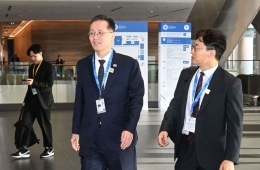
Kwanghyun Lim, Commissioner of the National Tax Service, attends a luncheon meeting hosted by the Korea Economic Association on the 2nd, announcing innovative tax audit measures including the timing selection system for regular tax audits. National Tax Service
View original imageAt the event, Commissioner Lim stated, "In line with the pro-business policy of the government based on the principle that corporate growth leads to economic growth, we will rationally redesign tax audits from the taxpayers’ perspective. In particular, for regular tax audits, which are similar to routine health checkups, taxpayers will be allowed to directly choose the timing of their audit."
Beginning in April, the National Tax Service will fully implement the timing selection system, which allows companies subject to regular tax audits to choose when the audit begins within a three-month window. Taxpayers selected for a regular audit will receive a notification and can select their preferred audit timing by month (first and second choice) within the three-month period. As before, they will receive an official advance notice at least 20 days before the actual audit begins.
An official from the National Tax Service explained, "The timing selection system for tax audits is a fundamental reevaluation of tax audit practices from the perspective of the taxpayer." The official added, "Companies can avoid audits during critical periods for their business operations, and when audits do occur, they will be able to focus solely on tax issues."
Additionally, the National Tax Service has designated and released a list of "key verification items" that have been subject to repeated taxation during audits. Specifically, the 10 items are: ▲Personal use of corporate credit cards ▲Omission of sales reports through personal accounts ▲Arbitrary abandonment of accounts receivable without just cause ▲Recording of fabricated payroll expenses ▲Improper tax credits for research and human resource development expenses ▲Omission of interest calculation on temporary payments and the like ▲Deducting expenses that should be capitalized as current expenses ▲Issuing or accepting tax invoices that do not match the facts ▲Errors in differentiating between taxable and VAT-exempt sales ▲Omission of VAT reporting for personal supply, among others.
Hot Picks Today
 "I Ate It Often Because It Tasted Good"... This Eating Habit Linked to 40% Higher Odds of Asymptomatic Cerebrovascular Damage
- "She's 7..." President Lee Left Speechless, Posthumously Awards Medal to Firefighter Killed in the Line of Duty
- Shinsegae, Hyundai, Lotte: Three Kingdoms of Department Stores... Who Makes the Most Money? [Weekend Money]
- "We've gone this far to save on lunch"... Where office workers are flocking instead of restaurants
- "Can They Really Be This Sweet?"... The Story Behind Convenience Store Honey Sweet Potatoes [Foodie X-Files]
The National Tax Service has also been minimizing the practice of prolonged on-site audits at company offices, a practice that previously often lasted several months, and, since last year, on-site presence is limited to cases where it is absolutely necessary. However, the agency will continue to strictly verify suspected tax evasion, which is the essential function of tax audits.
© The Asia Business Daily. All rights reserved. Unauthorized AI training and use prohibited.


!["Please, Just Take Them Off" - They Made It All the Way to Bed... Then Fecal Bacteria Struck [Deep Scroll]](https://cwcontent.asiae.co.kr/asiaresize/307/2026101610053063338_1792112730.png)