"Handle It Yourselves": Trump Distances U.S., Iran Eyes Transit Fees... No End in Sight for High Oil Prices [U.S.-Iran War]
Trump Stresses in National Address
"Countries Needing Hormuz
Should Defend It Themselves"
Despite Potential Violation of International Law
Iran Moves to Institutionalize Tolls
Even If U.S. Troops Withdraw from Iran
Hi
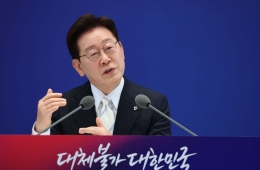
U.S. President Donald Trump announced plans for a large-scale offensive within the next two to three weeks and, regarding the closed Strait of Hormuz, emphasized that "the countries that need it should resolve the issue themselves," leading to a surge in international oil prices.

U.S. President Donald Trump is delivering a national address at 9 p.m. Eastern Time on the 1st. Photo by Reuters Yonhap News
View original imageDuring a national address that lasted over 20 minutes on April 1 (Eastern Time), President Trump stated, "U.S. oil imports barely come through the Strait of Hormuz—this was true in the past and will remain so in the future," adding, "Among all the countries that import oil through the strait, those nations should protect it themselves." He went on to say, "Many countries have not responded to requests to participate in the conflict," and added, "The Strait of Hormuz will inevitably open on its own."
Regarding negotiations with Iran's leadership, he said, "An agreement has not yet been reached." Previously, the United States was reportedly negotiating a ceasefire with Iran on the condition that the Strait of Hormuz be reopened. Citing three U.S. officials, the U.S. online media outlet Axios reported before the address that both countries were discussing a plan to exchange the reopening of the Strait of Hormuz for a ceasefire. Vice President J.D. Vance was also reported to have continued negotiations by contacting intermediary countries until recently.
President Trump's repeated criticism of allied nations that refused to participate, and his apparent deferral of responsibility regarding the normalization of the Strait of Hormuz, is expected to pose a threat to countries highly dependent on Middle Eastern crude oil, including Korea. The Strait of Hormuz is a key crude oil transportation route, accounting for about 20–30% of global oil shipments. As of last year, Korea imported 69.1% of its crude oil from the Middle East, and more than 95% of that was shipped through the Strait of Hormuz.
Iran, which holds control over the Strait of Hormuz, is moving to formalize the imposition of transit fees, even though such action may violate international law. On March 31, the Iranian parliamentary National Security Committee approved a measure to impose transit fees on vessels passing through the strait and to ban passage by U.S. and Israeli ships.
Domestic public opinion in Iran is also favorable toward the formalization of transit fees. On March 30, Hossein Lagfar, an Iranian university professor and economic analyst, stated in an interview with Tasnim News Agency that "Iran should fundamentally reconsider its economic policy in light of the wartime situation." While the specific transit fee amount has not been disclosed, Tasnim and other outlets estimate government revenue from these fees could exceed 100 billion dollars (about 150 trillion won) annually.
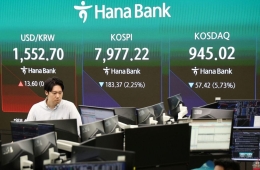
In the markets, there is speculation that high oil prices will persist even if U.S. forces withdraw from Iran. Before the war, Brent crude traded at around 60 to 63 dollars per barrel during periods of stability, but prevailing opinion suggests it will be difficult to return to those levels even if the war ends. As of 10:45 a.m. KST on April 2, June Brent crude futures were trading at 105.55 dollars, up 4.39% from the previous session’s close.

An India-flagged liquefied petroleum gas (LPG) carrier reportedly passed through the Strait of Hormuz on the 16th (local time). Photo by Reuters Yonhap News Agency
View original imageFawad Razaqzada, a market analyst at Forex.com, told The Wall Street Journal (WSJ), "Although there has been some adjustment, the fact that Brent crude is still holding above 100 dollars per barrel indicates that the market remains unconvinced." Capital Economics (CE) also projected in a client note that "Brent crude will remain at least above 80 dollars per barrel through the end of 2026," describing this as the most conservative scenario based solely on the disruption of Middle Eastern infrastructure due to airstrike damage.
Bloomberg Intelligence predicted that oil prices would remain elevated, citing China’s restrictions on oil exports. In reality, major Asian oil refiners such as Sinopec have reportedly begun reducing output. With domestic oil demand high, China is also reportedly considering importing U.S. liquefied natural gas (LNG). China, which has largely kept its distance from the Iran war, suddenly raised its level of mediation by announcing a "peace initiative" with Pakistan on March 31, seen in this context as a related move.
Security premiums, such as those related to shipping industry insurance, are also cited as significant burdens. According to the Korea Shipowners' Association, since the outbreak of war, war risk insurance premiums have surged by 1,100%, and low-sulfur fuel prices have risen by 227%. Many expect that these issues will be difficult to resolve in the short term.
Hot Picks Today
 Ballot Box Found in Trash... Peru Holds Runoff Amid 'Ballot Shortage Crisis'
- [Exclusive] "Why Is Only My Stock Not Rising?" The Reason Revealed... Suspicions of 'Stock Price Suppression' Mocking Government Policy [Wealth Succession] Intops②
- "Exactly the Same Early Voting Results in Songdo 1-dong and 2-dong?"... Uproar Over Ballot Counting
- "Brothers, You've Been Waiting for News?"... Orphanage Library Built Thanks to 'Money Brag' by SK hynix Employee
- "Click! Gotta Post on SNS"... 'Small Luxury' for 20s and 30s Cools Down Amid High Inflation
Meanwhile, there are also predictions that the prices of non-ferrous metals are unlikely to return to pre-war levels. On the London Metal Exchange (LME), the three-month aluminum contract closed at 3,523.80 dollars per ton the previous day, maintaining the 3,500-dollar level. This is the highest figure in more than four years since the early stages of the Russia-Ukraine war in March 2022. Production of helium, which is essential for semiconductor manufacturing, has also suffered major disruptions.
© The Asia Business Daily(www.asiae.co.kr). All rights reserved.

!["Money Pit: Unstoppable Price Gouging at Golf Courses [Green Fee Price Shock]"](https://cwcontent.asiae.co.kr/asiaresize/307/2026060809323390802_1780878752.png)