KOSPI Surges on Hopes of End to War... Oil Prices and Exchange Rates Remain Key Variables
United States and Iran Announce Intent to End War Simultaneously
KOSPI Buy-Side Circuit Breaker Triggered for Fifth Time This Year
High Oil Prices and Exchange Rate Remain Biggest Variables for the Market

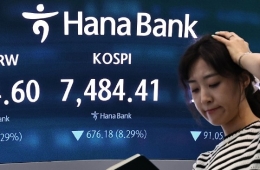
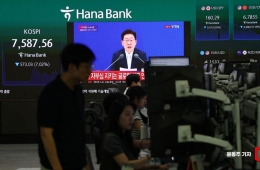
The KOSPI index started with a sharp rise of over 5% on renewed optimism, triggering a buy-side circuit breaker early in the session. The electronic board at the dealing room of Hana Bank head office in Jung-gu, Seoul, displayed the domestic stock market status. On the same day, the won-dollar exchange rate opened at 1508.5 won, down 21.6 won from the previous trading day. April 1, 2026, Photo by Kang Jin-hyung
View original imageThe South Korean stock market surged as both the United States and Iran simultaneously expressed their intention to end the war. As expectations for an end to the conflict grow, the outlook for a market recovery is also strengthening. However, even if the war ends quickly, a delay in normalizing the Strait of Hormuz and the continued high level of international oil prices could put pressure on the domestic stock market. The high exchange rate, which has surpassed 1,500 won, is also a key variable.
The United States and Iran Both Signal End to War... KOSPI Responds with a Sharp Rally
On April 1, the KOSPI opened at 5,330.04, up 5.49% from the previous trading day, and as of 9:50 a.m., was trading at 5,323.72, up 5.37%. The KOSDAQ was also trading at 1,103.83, up 4.89%.
As the KOSPI soared, a buy-side circuit breaker (temporary suspension of program buy orders) was triggered at around 9:07 a.m., soon after the market opened. The KOSPI circuit breaker is activated when the KOSPI 200 futures price rises by 5% or more from the reference price and remains at that level for one minute. This suspends the effectiveness of program buy orders for five minutes to cool down an overheated market. With repeated sharp fluctuations, the KOSPI buy-side circuit breaker has been triggered five times this year alone—the most since the 2008 global financial crisis.
The won-dollar exchange rate started at 1,508.5 won, down 21.6 won from the previous session, and has been fluctuating at a similar level. The previous day, the exchange rate had briefly exceeded 1,530 won, hitting its highest point since the financial crisis, but dropped sharply today.
The prospect that the war between the United States and Iran could end soon is pushing the index higher. U.S. President Donald Trump emphasized on March 31 (local time) that the timing for ending the war with Iran would be "within two to three weeks." Iranian President Masoud Pezeshkian also stated that Iran is ready to end the war if the United States and Israel do not launch any further attacks.
With both sides expressing their willingness to end the war, the U.S. Dow Jones Industrial Average rose by 2.49%, the Nasdaq by 3.83%, and the Philadelphia Semiconductor Index surged by 6.24%. The price of West Texas Intermediate (WTI) crude oil for May delivery closed at $101.38 per barrel, down $1.50 (1.46%) from the previous session. This was the first drop in oil prices in four trading days.
Kim Seokhwan, a researcher at Mirae Asset Securities, explained, "As both the United States and Iran, which had previously given mixed signals regarding the end of the war and negotiations, sent similar signals of resolution on the same day, the market appears to be reflecting expectations for the conclusion of the war more strongly than ever."

Samsung Electronics Surges Over 7%, Returns to 1.8 Million Won
Most of the top KOSPI stocks are posting sharp gains. As of 9:57 a.m., Samsung Electronics was up 7.66%, returning to the "1.8 million won" level, while SK Hynix also jumped 7.56%, reaching the "860,000 won" range.
Hyundai Motor rose 5.95%, reclaiming its position as the third-largest market cap company on the KOSPI just one day after dropping to fourth place. Hanwha Aerospace (up 3.24%), Doosan Enerbility (up 6.21%), Celltrion (up 2.18%), and LG Energy Solution (up 1.14%) were also strong performers. Securities stocks such as Mirae Asset Securities (up 4.38%) and Kiwoom Securities (up 3.53%) are also rising together. By industry, most sectors are climbing, including construction (up 8.61%), electronics (up 6.40%), and information technology (up 5.94%).
Institutional investors in the KOSPI have been net buyers of more than 590 billion won, driving the index higher, while retail investors and foreign investors have been net sellers by 530 billion won and 130 billion won, respectively. Foreign investors have been on a selling streak in the KOSPI market for 10 consecutive trading days.
With the United States and Iran expressing their intention to end the war, experts expect the domestic stock market to enter a recovery phase. Han Ji-young, a researcher at Kiwoom Securities, analyzed, "Given that the war risk has already been priced into the stock market throughout March and that both countries are increasingly willing to resolve the situation, the stock market is more likely to enter a recovery phase rather than experience further declines going forward."
Han also emphasized the need to pay attention to exchange rate volatility. He stated, "The background for last month's massive net selling of approximately 35 trillion won by foreign investors included not only the war and concerns over semiconductors, but also the burden of a rapidly rising exchange rate (to avoid foreign exchange losses). Since calming the surge in the exchange rate is one of the key conditions for foreign investors to stop net selling, changes in the exchange rate will be a major point of interest in determining the direction of foreign capital inflows and outflows."
Hot Picks Today
 Ballot Box Found in Trash... Peru Holds Runoff Amid 'Ballot Shortage Crisis'
- "Brothers, You've Been Waiting for News?"... Orphanage Library Built Thanks to 'Money Brag' by SK hynix Employee
- "Exactly the Same Early Voting Results in Songdo 1-dong and 2-dong?"... Uproar Over Ballot Counting
- "A Mother's Quick Reflexes Save Child from BRT Bus Rushing onto Sidewalk"
- "Click! Gotta Post on SNS"... 'Small Luxury' for 20s and 30s Cools Down Amid High Inflation
International oil prices are also expected to remain a major variable for the domestic stock market. Even if the war ends, if normalization of the Strait of Hormuz is not achieved, oil prices could remain high. Lee Kyungmin, a researcher at Daishin Securities, explained, "If the situation in the Strait of Hormuz remains unresolved and the United States withdraws, Iran's plans to control the strait and impose transit fees could remain a burden for the Asian region, which has a high dependency on energy supplies from the Gulf."
© The Asia Business Daily(www.asiae.co.kr). All rights reserved.