Industrial Production Up 2.5% in February on Semiconductor Boom... Largest Growth in Five Years and Eight Months (Comprehensive)
Ministry of Data and Statistics Releases February Industrial Activity Trends
Facility Investment Hits 11-Year High, Construction Reaches 28-Year Peak
Industrial production in February increased by 2.5% compared to the previous month, marking the largest rise in five years and eight months. The increase in semiconductor production, especially in the manufacturing sector, drove up overall output. Both facility investment and construction performance posted double-digit growth, buoyed by the effect of electric vehicle subsidies and the expansion of production facilities, resulting in broad improvement across the indicators. Consumption remained flat, showing that the recovery in spending is still limited. However, these figures do not yet reflect the impact of the Middle East crisis that erupted at the end of February.

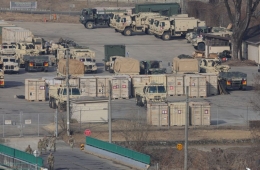
Following U.S. President Donald Trump's signing of a proclamation imposing a 25% tariff without exceptions on steel and aluminum products imported into the United States, and his announcement that tariffs on automobiles and semiconductors are also under consideration, export vehicles are waiting to be loaded at Pyeongtaek Port, Gyeonggi Province, on February 13, 2025. Photo by Kang Jinhyung
View original imageIndustrial Output Up 2.5% on Semiconductor and Construction Rebound... Largest Gain in 5 Years and 8 Months
According to the "February 2026 Industrial Activity Trends" released by the Ministry of Data and Statistics on March 31, the all-industry production index rose by 2.5% from the previous month. This is the largest increase since June 2020, a span of five years and eight months. After rising in November (0.7%) and December (1.2%) of last year, all-industry production fell in January this year (-0.9%) but rebounded in February.
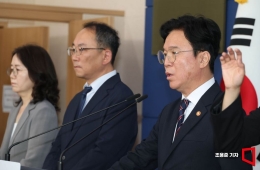
Manufacturing sector production increased by 5.4% month-on-month, the largest jump in five years and eight months since June 2020 (6.6%). By sector, semiconductor production surged by 28.2%, leading the overall growth. Non-metallic mineral production also increased by 15.3%. Lee Dowon, Director of Economic Trends Statistics at the Ministry of Data and Statistics, explained, "In semiconductors, not only high-bandwidth memory (HBM) but also general-purpose memory showed overall improvement in market conditions, and some plants are operating near maximum capacity." This indicates that the increase in semiconductor production reflects a recovery in the industry beyond just a base effect.
Service industry production increased by 0.5%. This was attributed to growth in wholesale and retail of machinery equipment and related goods, food and beverages (up 2.7%), and the professional, scientific, and technical sector including engineering R&D (up 3.3%). However, certain sectors such as the restaurant industry (-2.0%) declined, indicating that the overall recovery was still limited.
On the expenditure side, consumption remained flat (0.0%). Sales of semi-durable goods such as clothing (-5.4%) and durable goods such as telecommunications devices and computers (-1.5%) decreased, while sales of non-durable goods such as food and beverages increased by 2.6%. The Ministry of Economy and Finance assessed, "Despite the base effect of retail sales posting the highest growth in two years and eleven months in January (2.9%), the fact that sales remained flat in February shows that the momentum for consumption recovery continues."
Electric Vehicle and Construction Investment Surge... Facility Investment Hits 11-Year High, Construction at 28-Year Peak
Facility investment increased by 13.5% from the previous month, marking the largest gain in eleven years and three months since November 2014. Investment in transportation equipment such as automobiles rose by 40.4% due to the effect of electric vehicle subsidies, and machinery investment increased by 3.8%. Director Lee noted, "The early execution of electric vehicle subsidies and the expansion of investment by rental car companies significantly boosted transportation equipment investment. Semiconductor equipment investment is also continuing to grow, and investment in electrical equipment such as data centers expanded by 33.2%."
Construction performance, a leading indicator of the construction market, increased by 19.5% month-on-month due to higher construction of semiconductor factories, logistics centers, and apartments. This is the largest increase in 28 years and seven months since July 1997. Both building construction (up 17.1%) and civil engineering (up 25.7%) saw gains. Performance improved for both non-residential and residential buildings, as well as general civil engineering. The Ministry of Data and Statistics analyzed, "This reflects both a rebound from previous sluggishness and the impact of major projects such as the Yongin Semiconductor Cluster."
The coincident composite index, which reflects the current economic situation, rose by 0.8 points from the previous month, while the leading composite index rose by 0.6 points. The increase in the coincident index is the largest in fifteen years and one month. However, the government maintained a cautious stance in assessing economic recovery. Director Lee stated, "Although the indicators have improved significantly, several more months are needed to determine whether this is a temporary rebound or a sustained recovery."
Meanwhile, the impact of instability in the Middle East remains limited for now. Although the U.S.-Iran war escalated on February 28, its effects were scarcely reflected in the February indicators. The Ministry of Data and Statistics analyzed that if the war becomes prolonged, ripple effects could emerge, especially in oil refining and chemicals. Some effects may begin to show in March, with full impact likely from April onward.
Hot Picks Today
 "Why Is the Amount in My Account So Low?"... Why Pension Savings Subscribers Were Surprised
- "After Sleeping Well with Strangers"... Who Is the 24-Year-Old Woman Who Won 19 Million Won?
- "SK hynix to Hit 4.7 Million Won, Samsung 670,000 Won"... Why Nomura's Bold Forecast justifies it
- "Even Underwear Has to Be Cut Up with Scissors"... China Hit by Rise of "Trash Hunters" in an "If You're Slow, You're Out" Scramble
- "Photos of Kim Jong Un Released by North Korea Are a Deception"... Debate Over Death Rumors Continues
The government stated, "In order to minimize the impact of the Middle East war on our economy, we are mobilizing all policy tools including fiscal, tax, financial, and regulatory measures to ensure an emergency response. Follow-up measures are being swiftly implemented to stabilize energy prices and inflation, respond to supply chain disruptions, and support vulnerable sectors."
© The Asia Business Daily. All rights reserved. Unauthorized AI training and use prohibited.