"Safer, More Efficient Solid-State Batteries Set to Expand Beyond EVs Into Robotics and Space" [K-Industry, Future Designers]
(4) Jungbeom Lee, Project Leader at LG Energy Solution
Replacing Conventional Liquid Electrolyte and Separator Structures
with a Single Solid Electrolyte
Revolutionary Improvements in Safety and Durability
Focus on Completeness Over Speed
Expanding Electrification Beyond Electric Vehicles
Becoming a Key Driver for Energy Security
Solid-state batteries are emerging as a "game-changer" in the next-generation electric vehicle market. The competition surrounding technological maturity and commercialization timelines is also intensifying. In particular, sulfide-based solid-state batteries are being highlighted as a core technology that simultaneously achieves both safety and energy density, attracting significant attention within the industry.
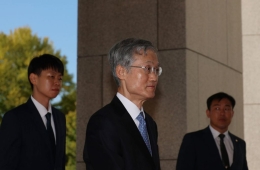
Jungbeom Lee, Senior Researcher at LG Energy Solution (Next-Generation Cell Sulfide Solid-State Battery Project Leader; pictured), who leads solid-state battery development at LG Energy Solution, discussed in a recent interview why solid-state batteries are considered "next-generation" and the challenges that must be addressed before mass production can be realized.
Lee, who studied lithium-ion battery electrode materials throughout his integrated undergraduate and graduate program at Seoul National University's Department of Chemical and Biological Engineering, joined LG Energy Solution in 2017 and has since been immersed in battery materials and cell design as a battery technology expert. Since 2020, he has focused on the development of sulfide-based solid-state batteries, conducting research spanning the entire process from cathode/anode design and solid electrolyte materials to cell structure development, thereby enhancing technological completeness. Since 2022, he has also participated in joint research with UC San Diego in the United States to verify solid-state battery technologies. He currently leads the related project, overseeing core research to secure mass production feasibility.

Jungbeom Lee, Senior Researcher (Next-Generation Cell Sulfide Solid-State Battery Project Leader). LG Energy Solution
View original imageHe identified the essence of solid-state batteries as "the change in electrolyte." While conventional lithium-ion batteries use liquid electrolytes and separators separately, solid-state batteries replace them with a single solid electrolyte. Lee stated, "This change alone can elevate the battery's stability and durability to an entirely new level."
Such technological progress does not simply end with improved battery performance. Securing a leadership position in solid-state batteries represents a turning point for Korea's battery industry, transforming it from a follower to a leader, and serves as a key driver in strengthening energy security as a national strategic asset. At the core of these changes lies the fundamental structural difference in the battery itself.
In fact, a solid electrolyte serves as both the pathway for ion movement and the separator. This structure inherently reduces issues such as leakage, gas generation, and fire hazards that occur with liquid electrolytes. He explained, "Conventional batteries face issues of increased internal pressure under high temperatures or long-term use, but solid-state batteries can fundamentally suppress such phenomena."
This structural change also leads to performance improvements. With the separator eliminated, more active material can be filled, and cooling or protective structures can be simplified, ultimately increasing energy density. He emphasized, "It's a structure that allows for more energy to be stored in the same size."
The choice of sulfide-based batteries is based on two pillars: "performance" and "processability." He identified the extremely high lithium-ion conductivity, which enables output levels comparable to conventional liquid electrolytes, as the biggest advantage. At the same time, the material's relatively soft nature allows for a larger contact area with the electrode, making it suitable for large-area manufacturing processes.
The development is progressing beyond mere "operation" to the "mass production" stage. The key is to stably reproduce the same performance in real manufacturing environments, and given the nature of batteries, the greatest challenge is minimizing quality variations during mass production.

Jungbeom Lee, Senior Researcher and Next-Generation Cell Sulfide Solid-State Battery Project Leader, LG Energy Solution
View original imageAnode-free solid-state batteries feature a structure where lithium metal is formed directly without anode material, giving them a critical competitive edge in terms of energy density scalability. As both safety and performance improve, cooling and protection structures can be simplified, and vehicle design flexibility increases. This is also expected to reduce charging frequency and maintenance costs by enabling longer driving ranges and battery life. However, securing interfacial stability and reducing manufacturing costs remain challenges, which are being addressed through surface coating and dry electrode processes.
The dry process is a technique of manufacturing electrodes without organic solvents, which simplifies the process, reduces environmental impact, and increases productivity. Lee projected that this technology will become an important factor in securing competitiveness in future mass production. The key indicators for sulfide-based solid-state batteries—ionic conductivity and interfacial stability—are also rapidly improving. He stated that world-class ionic conductivity has been achieved and that interfacial resistance is being continuously lowered through functional coatings.
The mass production strategy is focused more on "completeness" than "speed." He emphasized, "It is important to achieve a price point that the market can accept along with high performance," and that the focus is on introducing competitive products rather than rushing commercialization.
Hot Picks Today
 "Quit Job to Start Life in Canada, Now Forced to Return Home"… Language School Closure Leaves Korean Students Stranded
- 'Japan in Chaos' as Unprecedented Outbreak Spreads ... "Four Days Is Too Short," Yet Japan Remains Top Travel Pick
- [Exclusive] "Oh, Oh! Why Is the Seatback Like This?" Hyundai Ioniq 9 Recalled in Korea: 15,000 Units Due to Power Seat Entrapment Risk
- Trump Holds Three-Hour Negotiations With Iran on Day of 'Annihilation' Threat... Iranian Military Calls It 'Domestic Political Propaganda'
- Hanwoo Can't Even Dream of This... "Melts in Your Mouth" as Wagyu Hits It Big in U.S. Supermarkets and Fast-Food Chains
The impact of solid-state batteries extends beyond electric vehicles. Lee predicted, "Solid-state batteries are a core area in the race for technological leadership between nations," and anticipated that electrification will expand to a wide range of industries such as robotics, aviation, and space, beyond just electric vehicles.
© The Asia Business Daily. All rights reserved. Unauthorized AI training and use prohibited.