Democratic Party Gyeonggi Governor Main Primary Debate: Kim Dong-yeon and Han Jun-ho Grill Choo Mi-ae on Policy Issues
"Gyeonggi Needs Economic, Not Political, Leadership"
At the first joint debate of the Democratic Party’s main primary for Gyeonggi Province Governor, sharp scrutiny was directed at Assemblywoman Mi Ae Chu, who is known to be leading the preliminary primary. She was questioned on issues such as plans to strengthen the self-sufficiency functions of the 3rd phase new towns and solutions to the power supply problem at the Yongin Semiconductor Industrial Complex—issues currently facing Gyeonggi Province. Additionally, there were pointed remarks that “Gyeonggi needs economic leadership, not political leadership,” aimed as a check against Assemblywoman Chu.
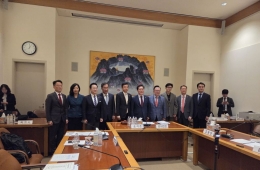
The Democratic Party candidates for Gyeonggi Province Governor participated in the main primary televised joint debate held on the 30th at MBC in Mapo-gu, Seoul.

(Suwon=Yonhap News) Reporter Hong Giwon = On the 30th, Democratic Party candidates for the Gyeonggi Province gubernatorial primary election at the 9th nationwide local elections shout "Fighting" at the 3rd Executive Committee meeting of the Democratic Party Gyeonggi Province Headquarters held at the Gyeonggi Provincial Assembly in Suwon, Gyeonggi Province. From left: Dongyeon Kim, Mi Ae Chu, Jun Ho Han. 2026.3.30 xanadu@yna.co.kr (End)
View original imageDuring the discussion segment on livelihood and economic issues, Assemblyman Jun Ho Han asked Assemblywoman Chu, “What is the most important factor for the success of Hanam Gyosan New Town, which is also in your constituency? Providing transportation measures before moving in is a basic requirement, but in the current state, is it feasible to attract businesses to the self-sufficiency land in Gyosan New Town?”
When Assemblywoman Chu responded by expressing interest in hearing Assemblyman Han’s alternative, he replied, “The governor holds the authority to reallocate the supply of industrial land in Gyeonggi Province. This should be used first, and through special provincial legislation, the self-sufficiency land should be converted into a form that can actually attract companies.”
Governor Dongyeon Kim also directly questioned Assemblywoman Chu, asking, “Why are you running for governor of Gyeonggi Province? Gyeonggi needs economic leadership, not political leadership.” In response, Assemblywoman Chu stated, “I have a deep interest in local autonomy. During the time of former party leader Kim Dae Jung, I served on the Public Administration and Security Committee and made numerous proposals concerning local governance. To promote the development of local autonomy, I even sponsored a bill to provide salaries for local council members.”
Governor Kim also pointed out that most of Assemblywoman Chu’s four pledges announced that day are already being implemented by Gyeonggi Province and criticized the lack of specific details. In reply, Assemblywoman Chu stated, “I will continue the good initiatives you have started and, through innovation in the era of artificial intelligence (AI), make things even smarter.”
Additionally, Assemblywoman Chu was intensively questioned by the other two candidates on how she would supply power to the Yongin Semiconductor Cluster and what is needed for the groundbreaking of the Great Train Express (GTX) Line C in the Seoul metropolitan area. This appears to be a strategic move, based on the assumption that Assemblywoman Chu, being the most recent to declare her candidacy for governor, may not be well-versed in regional issues and detailed policy matters in Gyeonggi.
As a result, on policy issues, Governor Kim and Assemblyman Han sometimes showed cooperation. Governor Kim asked Assemblyman Han to explain his “P10 Project” (aimed at creating ten Pangyo-like districts)—one of Han’s campaign pledges—and remarked, “Whether it’s the P10 you proposed or the Pangyo Plus 20 I proposed, it would be great if we could join forces and even attract investment together.”
However, in the second discussion round, Assemblyman Han took a critical stance toward Governor Kim, stating, “Due to your runs in the presidential and local elections, important positions such as the Deputy Governor for Economic Affairs and senior staff, who are responsible for the provincial administration, have repeatedly experienced resignations and reappointments.” Assemblyman Han also questioned Governor Kim’s compatibility with the Lee Jaemyung administration, asking, “Didn’t you previously oppose basic income as populism?”
Meanwhile, each candidate highlighted their strengths when explaining their reasons for running. Assemblywoman Chu stated, “Just as I completed prosecution reform, when Chu Mi Ae takes on administration, it will be different. I will create a strong and growing Gyeonggi Province, a fair Gyeonggi Province, and an AI-innovative Gyeonggi Province.”
Governor Kim appealed, “Being governor of Gyeonggi is not a position for fighting or struggle, but one for working and managing the economy and administration. Please judge who is the candidate that can transform Gyeonggi Province with the right economic vision and policies.”
Hot Picks Today
 "Expensive, Smelly and Scary"... What's Happened to the "Honeymooners' Paradise" Tourists Have Abandoned?
- Women Who Say "A Husband's Annual Salary of 100 Million Won Is a Given"... Matchmaking CEO: "They Talk About It Like It's Nothing"
- "Who Turned Up the Refrigerators?" Hackers Target 700 Supermarkets, Sparking Alarm... "A Blow to France's Food Security"
- "Not Twins, but the Same Person"... Chinese Man Holds 100th-Day Celebration and Wedding on the Same Day
- "I'll Give You 53.4 Billion Won to Keep Quiet"... Influencer Reveals Secret Deal; Musk Denies It
Assemblyman Han emphasized, “Practicality is ultimately the way to work. In my 52 years of life, I have worked in IT, finance, media, and the Blue House, and for six years in the National Assembly’s Land, Infrastructure and Transport Committee. I will bring the Lee Jaemyung administration’s pragmatism to full bloom in Gyeonggi Province.”
© The Asia Business Daily. All rights reserved. Unauthorized AI training and use prohibited.




![[Editorial] Don't Rest on Nuri's Success; Rally National Space Capabilities](https://cwcontent.asiae.co.kr/asiaresize/307/2026100807174054094_1791411459.jpg)
![[Editorial] Politics Must Not Waste the Time Bought by the Semiconductor Boom](https://cwstatic.asiae.co.kr/asiae_v3/com/noimg_thumb_en.jpg)