Chairman Kim Jongchol: "Youth SNS Issues Cannot Be Solved by Account Deletion Regulations Alone"
"Plans for a Differentiated Approach by Age and Developmental Stage"

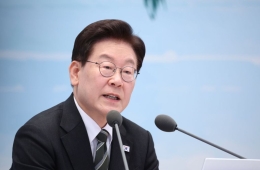
Kim Jongcheol, Chairman of the Broadcasting, Media and Communications Commission, is giving a greeting speech at the '100-Day Inauguration Press Conference' held on the 30th at the Government Gwacheon Building. Provided by the Broadcasting, Media and Communications Commission.
View original imageKim Jongchul, Chairman of the Broadcasting, Media and Communications Committee, commented on the ongoing controversy over youth social networking service (SNS) policies, stating, "We have confirmed that a regulatory-only approach—such as unilateral account deletions or outright bans—cannot solve the problem," adding, "We plan to adopt a differentiated approach based on age and developmental stage."
At the 100-Day Inauguration Press Conference held on the afternoon of the 30th at the Government Complex Gwacheon, Chairman Kim noted, "Last year, Australia banned SNS use for those under 16, and recently a US court issued an important ruling recognizing platform companies' responsibility for youth SNS addiction," and continued, "We will support discussions where various experts and stakeholders, along with the National Assembly, can come together to find solutions to the negative impacts."
Chairman Kim pointed out the limitations of a regulation-only policy—such as unilateral account deletions or bans—in resolving youth SNS issues. He said, "Looking at the example of the game shutdown system implemented in the past, we have learned that regulation cannot lead technological advancements," emphasizing that "policies allowing for both regulation and protection in a tailored, stage-by-stage manner are necessary."
He further stated, "On this matter, not only the youth, but all parents need to come together to develop effective and reasonable alternatives," reiterating, "We plan to approach the issue by age and developmental stage." He explained that the approach should differ between younger children and teenagers who possess a certain level of cognitive ability and experience.
Chairman Kim stressed, "We must not limit the issue to youth SNS concerns, but must also strive to normalize our society's overall media environment," adding, "Although such efforts take time and may have limited immediate effects, without media literacy education and a broad push to normalize the media environment, these problems cannot be solved."
On this day, Chairman Kim also called for cooperation among broadcasters regarding universal viewing rights. In reference to recent World Cup broadcasting rights negotiations, he said, "There is consensus to begin principled discussions on operating all broadcasting rights through a joint broadcasting model through 2032," and emphasized, "Broadcasting rights are an issue that goes beyond simple economic profit and loss—public viewing rights are a matter of public value." He added, "The committee will continue to provide a forum for dialogue and play a coordinating role," and, "In the long run, we hope to establish a cooperative model such as a 'Korea Consortium.'"

Kim Joungho, Chairman of the Broadcasting, Media and Communications Committee, is answering reporters' questions at the '100-Day Inauguration Press Conference' held on the 30th at the Government Complex Gwacheon. Provided by the Broadcasting, Media and Communications Committee.
View original imageIn addition, the Broadcasting, Media and Communications Committee plans to strengthen platform distribution responsibilities and actively pursue institutional improvements to enable faster blocking of illegal information with clear social harm, such as drugs and gambling.
Chairman Kim stated, "Deceptive acts such as algorithmic bias, filter bubbles, dark patterns, as well as false or manipulated information and digital sex crime content, are shaking the foundation of safety and trust in our society," and added, "Acts that undermine social trust by infringing on the dignity, value, and the right to pursue happiness guaranteed by the Constitution cannot be protected by freedom of expression, and we will respond more proactively to such acts."
Chairman Kim expressed regret that the formation of the committee has been delayed at a time when there are so many urgent issues surrounding broadcasting, media, and communications. He remarked, "It is unfortunate that there are limits to filling the gap (in committee formation)."
Regarding the establishment of the Korea Broadcasting, Media and Communications Promotion Agency, he stated, "Since a related bill was recently introduced in the National Assembly, we plan to actively support the legislative process to ensure a rational and effective system by thoroughly collecting opinions from all sectors of society."
As the primary government agency for media, the committee also plans to proactively lead a media sovereignty artificial intelligence transformation (AX) strategy suited to the AI era.
Chairman Kim explained, "To respond to the AI-based media environment, we are revising the user protection system and, internally, exploring ways to increase policy precision and speed by driving AI-based administrative innovation within the committee." He added that the committee will work closely with the fiscal authorities to actively reflect related support budgets so the adoption of AI in the media industry can proceed strategically.
Hot Picks Today
 "Didn't Save This Money to Leave to Our Kids?"... Retired Couples Spend $10,000 on a Single Trip
- "300,000 Won Grant" Shelved at Chuseok to Go to All Residents After All... This City Says It Will Pay Before Lunar New Year
- IAEA Director General Grossi to Miss Korea Nuclear Energy Ministerial Conference; Notice Comes Two Days Before Opening
- Friend Who Went Abroad Goes "Silent"... 617 South Koreans Out of Contact, What's Going On?
- "Stockpile 9 Liters of Bottled Water and Three Days' Worth of Food"... UK on Edge as Nationwide Emergency Preparedness Alert Issued
He went on to say, "We will ensure that improvements to outdated regulations—such as the transition in broadcast advertising regulation systems and the rationalization of programming regulations—result in tangible outcomes rather than remaining mere plans," and continued, "The more contentious an issue is among stakeholders, the more we will seek social consensus across ministries, rather than imposing unilateral solutions."
© The Asia Business Daily. All rights reserved. Unauthorized AI training and use prohibited.