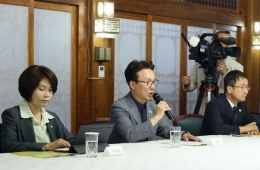
Han-jong Kim, Preliminary Candidate for Jangseong Governor, Pledges Creation of "Honam Region Second Innovation City" Connecting Northern Gwangju and Jeonnam

Han-jong Kim, preliminary candidate for Jangseong County Governor, has announced a major regional transformation initiative as a core campaign pledge, focusing on the creation of the "Honam Region Second Innovation City," which would connect the northern areas of Gwangju and Jeonnam through the relocation of public institutions and the development of advanced industries.
On March 30, Kim released a press statement declaring, "We plan to establish an innovation city by 2029 on a site of about 8.94 million square meters (approximately 2.71 million pyeong) spanning Wolchul-dong in Buk-gu and Bia-dong in Gwangsan-gu, Gwangju, as well as Nam-myeon and Jinwon-myeon in Jangseong, and Daejeon-myeon in Damyang."
The central concept is a metropolitan cooperative city model that integrates Gwangju, Jangseong, and Damyang into a single living and economic zone.
At the heart of this plan is the relocation of public institutions. Kim specifically designated the Ministry of Agriculture, Food and Rural Affairs as the top priority for relocation to Jangseong, with a strategy to build an "agricultural innovation cluster" that combines agricultural R&D, industry, distribution, and policy functions around this relocation.
Kim also proposed to establish a future-oriented agricultural hub by creating a smart agriculture development zone linked with the National Subtropical Demonstration Center and integrating with local food distribution networks.
In addition, Kim pledged to attract AI-based high-tech industries. By dispersing public institutions and coordinating with research institutes and companies, the plan aims to simultaneously expand industrial, residential, educational, and medical infrastructure to lay the groundwork for a self-sustaining city.
Kim emphasized the need for institutional reforms to ensure effective implementation. He plans to secure special provisions for the relocation of public institutions by amending the Gwangju-Jeonnam Regional Integration Special Act and to persuade the central government through collaboration with metropolitan governments and political circles.
The plan also includes measures to improve residential conditions. Infrastructure for housing, education, culture, medical care, and childcare will be expanded to accommodate incoming public sector employees, while initiatives such as relocating the Jeonchapo firing range will be pursued in parallel to enhance living conditions. The development of metropolitan transportation networks, including outer ring roads, will also proceed simultaneously.
In particular, if this pledge is realized, it is expected to revitalize the local economy through population growth and job creation resulting from the relocation of public institutions, and contribute to establishing a foundation for balanced national development by integrating administrative and industrial functions in northern Gwangju and Jeonnam.
Hot Picks Today
!["Don't Use Chinese-Made Products": One U.S. Warning Triggers a 5 Trillion Won Jackpot for Korean Batteries [Weekend Money]](https://cwcontent.asiae.co.kr/asiaresize/93/2025121709393659037_1765931975.jpg) "Don't Use Chinese-Made Products": One U.S. Warning Triggers a 5 Trillion Won Jackpot for Korean Batteries [Weekend Money]
"Don't Use Chinese-Made Products": One U.S. Warning Triggers a 5 Trillion Won Jackpot for Korean Batteries [Weekend Money]
- "Dividend Payouts of 40 Million Won Before Their First Birthday"...'Baby Shareholders' Put Ordinary Workers at a Disadvantage
- Mixing Leftover Hemp from Hemp Cloth into Film... Biodegradable Plastic's Remarkable Strength Boost [Reading Science]
- "Planning a Trip to Japan?"... Accelerating Yen Strength [Weekend Money]
- Foreign Tourists Leave in Tears Praising Seoul: "Wi-Fi So Fast, My Fingers Can't Keep Up" [K-holic]
Kim stated, "We will revitalize the local economy by attracting population inflow and creating jobs through the relocation of public institutions, and achieve tangible results in the administrative integration of Gwangju and Jeonnam. We will begin a new axis of balanced national development starting in Jangseong."
© The Asia Business Daily. All rights reserved. Unauthorized AI training and use prohibited.