"Choking March"... Ultrafine Dust Surges 31%, War-Related Factors Add to the Crisis
Combined Impact of Foreign Inflow, Stagnant Air, and Decreased Precipitation
Potential for Further Air Quality Deterioration Amid U.S.-Iran Conflict
In March of this year, the concentration of ultrafine dust in the Seoul metropolitan area has significantly worsened, causing increased inconvenience for citizens. While a complex combination of factors—such as stagnant air, inflow from abroad, and reduced precipitation—are at play, some analyses suggest that the aftermath of the U.S. and Israel's war with Iran could also have an impact.
On March 27, the National Institute of Environmental Research and relevant authorities announced that the concentration of ultrafine dust had reached 'bad' or 'very bad' levels in most regions nationwide in recent days. In particular, ultrafine dust advisories were issued for the Seoul metropolitan area, including Seoul, Gyeonggi, and Incheon. This advisory is issued when ultrafine dust concentrations of 75㎍/㎥ or higher persist for more than two hours.
In fact, air quality has deteriorated compared to last year. From March 1 to March 27, there were 21 days when at least one of Seoul's 25 districts recorded 'bad' or worse levels of ultrafine dust, a more than 31% increase compared to the same period last year, which had 16 such days.

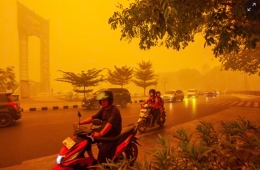
The city center of Seoul appearing hazy due to fine dust and ultrafine dust in March. Photo by Yonhap News
View original imageAs for the causes, the inflow of pollutants from abroad, especially from China, played a significant role. In particular, in mid-March, large-scale wildfires that broke out in the Liaoning Province area of China generated ultrafine dust, which was carried into Korea by northwesterly winds, pushing up the concentration levels.
In addition, an atmospheric stagnation phenomenon known as a "high-pressure dome" exacerbated the situation. With high pressure lingering over the Korean Peninsula, air circulation became sluggish, preventing pollutants from escaping and causing them to accumulate. As vertical convection weakened, a structure formed where pollutants became trapped in the lower atmosphere.
Reduced precipitation was also a contributing factor. In Seoul, there were only five days of rainfall this month, compared to eight days last year. Rain helps wash pollutants from the air, but with less precipitation, conditions favored the accumulation of fine dust.
External factors are also being cited as negative influences. Escalating tensions in the Strait of Hormuz and the prolonged conflict between the U.S. and Iran have increased instability in oil supply, prompting countries such as China and other Asian nations to consider expanding coal-fired power generation. Experts point out that this could lead to an increase in pollutant emissions and have a negative impact on domestic ultrafine dust concentrations.
Hot Picks Today
 "Jealous of Koreans" - Now a Must-Do on Every Trip... The Place Where Foreigners Spent KRW 229.8 Billion
- [Exclusive] Piling medicines into a basket and setting them on the counter: "Ready to check out?" ... Misuse concerns mount, but the government remains in the dark.
- "'No! Dad, Run!'... Father Moved by 5-Year-Old Son Who Shielded Him from Ghost at Korean Folk Village"
- "I thought getting into a big company was the goal"... The 'position' only 1 in 121 employees reaches
- "Please Let Me Go Home"... Customers Trapped in Department Store Parking Lot for 5 Hours Vent Their Anger
Poor air quality is expected to continue over the weekend. On March 28, a combination of foreign fine dust inflow and stagnant air is forecast to result in 'bad' levels in the Seoul metropolitan area, Chungcheong, and Yeongnam regions, with some areas possibly reaching the 'very bad' category in the morning. Although conditions are expected to improve somewhat on March 29, some regions are still likely to experience high concentrations.
© The Asia Business Daily. All rights reserved. Unauthorized AI training and use prohibited.


!["Please, Just Take Them Off" - They Made It All the Way to Bed... Then Fecal Bacteria Struck [Deep Scroll]](https://cwcontent.asiae.co.kr/asiaresize/307/2026101610053063338_1792112730.png)