"Climate Balance Already Lost"... WMO Warns of 'Irreversible Change' [Reading Science]
Worsening Greenhouse Gases, Oceans, and Glaciers Simultaneously
"Urgent Need for Both Emission Reduction and Adaptation"
An international organization has issued a warning that Earth's climate system has already lost its balance and entered a phase of structural change. As key indicators—including greenhouse gas concentrations, oceanic conditions, and glaciers—have all deteriorated simultaneously, experts now assess that the climate crisis is no longer a future risk but an "ongoing crisis" in the present.
According to the "State of the Global Climate 2025" report released by the World Meteorological Organization (WMO) on March 23, atmospheric carbon dioxide concentrations have reached their highest levels in two million years, while methane and nitrous oxide have also soared to their highest levels in 800,000 years.

The rise in temperatures is also pronounced. Each year from 2015 to 2025 has been recorded as the hottest year on record, and the average temperature in 2025 is 1.43 degrees Celsius higher than pre-industrial levels, ranking as the second or third hottest year ever observed.
The Oceans Have Absorbed the Heat... Intensifying Energy Imbalance
One of the most notable points in this report is the intensification of Earth's "energy imbalance."
Due to greenhouse gases, the energy entering Earth is not able to escape and is being trapped, causing the entire climate system to heat up. About 91% of this excess energy is stored in the oceans, and ocean warming is accelerating rapidly.
Over the past 20 years, the rate of ocean warming has more than doubled compared to previous periods, and ocean heat content has reached the highest levels since observations began. The energy accumulated during this period is approximately 18 times the annual energy consumption of humanity.
These changes are directly linked to rising sea levels. Since 1993, the global average sea level has risen by about 11 centimeters, and ocean acidification continues to worsen.

Reference photo to aid understanding of the article. SOS system representing the El Niño phenomenon displayed at the National Daegu Science Museum. Photo by Yonhap News
View original imageGlacier Collapse & Disaster Proliferation... "A Crisis That Is Already Here"
Glacier mass loss has continued at record-breaking rates, and the areas of Arctic and Antarctic sea ice are nearing their lowest levels ever observed. This leads to a decrease in the reflection of solar energy, further accelerating additional warming.
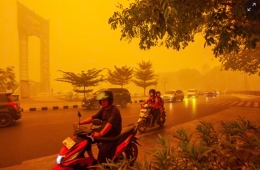
At the same time, extreme weather events such as heatwaves, wildfires, floods, and tropical storms are increasing in both frequency and intensity. These disasters are increasingly manifesting as "compound events," where multiple disasters are interconnected and occur simultaneously.
Professor Sangwook Ye, Department of Climate and Energy Systems Engineering at Ewha Womans University, stated, "Abnormal signals are appearing simultaneously across the entire climate system, including oceans, glaciers, and temperatures," adding, "This suggests that structural changes are occurring beyond mere natural variability."
Andrew King, Professor at the University of Melbourne in Australia, warned, "As greenhouse gas emissions continue, Earth is moving toward a hotter and more dangerous state," and cautioned, "The longer we delay our response, the greater the burden will be for future generations."
Hot Picks Today
 "I Don't Want to Marry a Salaried Man"... Women Flock to 'This Place' to Find Husbands Amid the AI Boom
- "I thought getting into a big company was the goal"... The 'position' only 1 in 121 employees reaches
- "Jealous of Koreans" - Now a Must-Do on Every Trip... The Place Where Foreigners Spent KRW 229.8 Billion
- "'No! Dad, Run!'... Father Moved by 5-Year-Old Son Who Shielded Him from Ghost at Korean Folk Village"
- "Please Let Me Go Home"... Customers Trapped in Department Store Parking Lot for 5 Hours Vent Their Anger
The report emphasized that adaptation strategies to respond to climate disasters must be implemented in parallel with efforts to reduce greenhouse gas emissions. The climate crisis is no longer just an environmental issue but a structural risk affecting the entire social and economic system. If action is delayed, the scale of damage is expected to grow exponentially.
© The Asia Business Daily. All rights reserved. Unauthorized AI training and use prohibited.


!["Please, Just Take Them Off" - They Made It All the Way to Bed... Then Fecal Bacteria Struck [Deep Scroll]](https://cwcontent.asiae.co.kr/asiaresize/307/2026101610053063338_1792112730.png)