KOSPI Plunges Over 6% Amid Escalating Middle East War and Surging Interest Rates
Trump Warns to "Devastate Iran's Power Plants"
Iran Threatens to "Blockade the Strait of Hormuz" in Standoff
Rising Inflation Fears Drive Up U.S. Treasury Yields

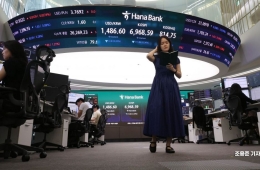
On the 23rd, amid fears of an escalation in the Middle East war, the KOSPI index opened at 5580.15, down 201.05 points from the previous trading day. The electronic board at the Hana Bank dealing room in Jung-gu, Seoul, displayed the current status of the domestic stock market and exchange rates. On the same day, the won-dollar exchange rate started trading at 1,504.9 won, up 4.3 won from the previous day. Photo by Jinhyung Kang, March 23, 2026.
View original imageAs signs emerge that the war between the United States and Iran may escalate and concerns about a possible U.S. base interest rate hike arise, the Korean stock market plummeted on March 23.
On this day, the KOSPI opened at 5580.15, down 3.48% from the previous trading day, and continued to fall, trading at 5414.55 as of 9:56 a.m., down 6.34%. At the same time, the KOSDAQ was also trading at 1104.09, down 4.94%.
Due to the sharp decline in the KOSPI, a sell-sidecar was triggered at 9:18 a.m. The sell-sidecar is activated when the KOSPI200 futures price drops by 5% or more from the reference price and remains at that level for one minute.
As the stock market plunged and foreign investors made massive net sales of Korean stocks, the won-dollar exchange rate surpassed 1,510 won. This is the highest level in 17 years since March 2009, during the global financial crisis. On this day, foreign investors recorded net sales of more than 1.16 trillion won in the KOSPI market.
It is assessed that the Korean stock market is being affected by both the increasing likelihood of a prolonged Middle East war between the United States, Israel, and Iran, and the possibility of a base interest rate hike as a result of the war's impact.
Over the weekend, U.S. President Donald Trump warned Iran that if it did not open the Strait of Hormuz within 48 hours, he would attack and "devastate" Iran's power plants. In response, the Iranian military stated that if the U.S. threat is carried out, it would blockade the Strait of Hormuz until the power plants are rebuilt.
Christopher Waller, a Federal Reserve Governor known as a "dove," stated that the prolonged Middle East conflict and higher oil prices are heightening inflation concerns, leading him to abandon his previous stance on rate cuts and adopt a more cautious approach. This announcement caused a sharp rise in government bond yields and sent shockwaves through the market.
Hot Picks Today
 "I Might End Up Paying My Entire Salary Just for Interest"... Annual Per-Person Interest Could Reach 6.73 Million Won, 'Yeongkeul-jok' Lament
- "Biggest 'Supply Cliff' in 70 Years of Memory History Approaching... Now Is the Time to Buy Samsung Electronics" [Click eStock]
- "I'd Rather Earn Daily Interest Than Face a Crash"... Investors Fleeing the Stock Market Seek Refuge in Parking-Type ETFs [Personal Finance Trends]
- [Breaking] Former Minister Cho Myungkyun Given Suspended Prison Sentence Over 'Moon Administration Blacklist' Confirmed
- "Earned $100,000 at 18": Young Americans Flock to Skilled Trades Like Plumbing, Undeterred by AI
Ji-Young Han, a researcher at Kiwoom Securities, analyzed, "If U.S. Treasury yields continue to rise, the discount rate burden could increase across the global stock market," adding, "There is growing technical concern that the New York Stock Exchange is breaking below the 200-day moving average for the first time since early March last year, signaling a potential breakdown of the long-term trend."
© The Asia Business Daily. All rights reserved. Unauthorized AI training and use prohibited.