IMF: "Downside Risks to Economy Growing"...Koo Yoonchul Vows "All Measures Including Extra Budget"
Meeting with First Deputy Managing Director Dan Katz... Discussion on Middle East Situation
"Prolonged Crisis Could Negatively Affect Inflation"
The International Monetary Fund (IMF) has assessed that downside risks to the global economy have increased as a result of the ongoing war in the Middle East. Deputy Prime Minister and Minister of Finance and Economy Koo Yoonchul stated, "We will mobilize all available policy tools, including the swift formulation of an extra budget, to minimize the impact on people's livelihoods."

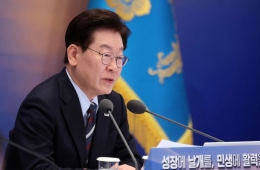
Deputy Prime Minister and Minister of Finance and Economy Koo Yoon-cheol is meeting with Dan Katz, First Deputy Managing Director of the International Monetary Fund (IMF), at the Government Seoul Office in Jongno-gu, Seoul, on the 19th. Ministry of Finance and Economy
View original imageOn the 19th, at the Government Complex Seoul, Deputy Prime Minister Koo held a meeting with Dan Katz, First Deputy Managing Director of the IMF, where they engaged in wide-ranging discussions on the global economic impact of the recent situation in the Middle East, Korea's policy responses, and avenues for cooperation between Korea and the IMF.
Deputy Managing Director Katz noted, "The recent situation in the Middle East has heightened volatility in energy prices and financial markets, increasing downside risks to the global economy." He added, "If the crisis persists, there is concern that it could negatively affect the global economic growth trajectory and inflation." The IMF plans to monitor related developments and reflect them in the World Economic Outlook (WEO) to be released in April.
Deputy Prime Minister Koo diagnosed the current situation as one where external uncertainties surrounding the Korean economy have risen significantly. He continued, "The government has activated an emergency response system across all ministries regarding the Middle East situation and is closely monitoring trends in energy supply, as well as in the financial and real sectors of the economy." Deputy Prime Minister Koo emphasized that the government will use all available policy measures—including the petroleum product price ceiling, swift formulation of an extra budget, and fiscal, financial, and industrial tools—to minimize the impact on the Korean economy and the livelihoods of its people.

Deputy Prime Minister and Minister of Strategy and Finance Koo Yoon-chul is shaking hands with Dan Katz, First Deputy Managing Director of the International Monetary Fund (IMF), at the Government Seoul Complex in Jongno-gu, Seoul on the 19th. Ministry of Strategy and Finance
View original imageDeputy Managing Director Katz assessed that the Korean economy has responded well to both domestic and external shocks so far. He stated, "We highly appreciate the government's swift policy responses to recent increases in market volatility and impacts on the real economy."
Hot Picks Today
 "Please Pay Me at Least 3 Million Won a Month": More Than Half of Young People Today Prioritize "Working Conditions" Over Company Size
- Selling Like Crazy Every Year... 30-Year-Old Hetbahn Takes on a New Challenge: Tastes Better Than "Mom's Home Cooking" [On-Site Report]
- "It's so popular you can't get it": 'Legendary liquor' returns after 11 years, causing a stir... 'Newtro' craze takes over convenience stores [How We Shop Today]
- "Hey, Lady, Teach Your Kids to Behave!" ... 300,000 Won in Cash and a Bodily Injury Claim Demanded Over Child's Door Ding
- Beachgoer Finds 'Plastic' That Turns Out to Be Perfume Ingredient Worth More Than Twice as Much as Gold
Meanwhile, Deputy Managing Director Katz expressed his gratitude for Korea's active contributions to IMF capacity development initiatives for vulnerable and low-income countries, and requested that mutual cooperation be further strengthened in the future. In response, Deputy Prime Minister Koo pledged to continue expanding Korea's contributions to capacity development initiatives across diverse fields, including AI and digital technology.
© The Asia Business Daily. All rights reserved. Unauthorized AI training and use prohibited.




![[Market ING] KOSPI Seeks Rebound in Superweek Packed with Corporate Earnings and FOMC](https://cwcontent.asiae.co.kr/asiaresize/307/2026102514484873155_1792907327.jpg)