Early Termination of Yoon Administration's "4th Inter-Korean Basic Plan"... Shift to "Recognition of North Korean Regime + Two States in Peaceful Coexistence"
The First Plenary Meeting of the Committee for the Development of Inter-Korean Relations
The government has decided to terminate the "4th Basic Plan for the Development of Inter-Korean Relations," which was established during the Yoon Suk-yeol administration, ahead of schedule, and has presented "peaceful coexistence" and "joint growth" as its new vision. The previous reference to "denuclearization" has been replaced, and "a Korean Peninsula free of war and nuclear weapons" is now included as one of the three main objectives.

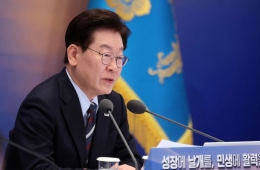
Jeong Dongyoung, Minister of Unification, is speaking at the plenary meeting of the Committee for the Development of Inter-Korean Relations held at the Government Complex Seoul in Jongno-gu, Seoul on March 19, 2026. Photo by Yonhap News
View original imageOn March 19, Jeong Dongyoung, Minister of Unification, presided over the plenary meeting of the Committee for the Development of Inter-Korean Relations at the Government Seoul Office and deliberated on the "5th Basic Plan for the Development of Inter-Korean Relations." This fifth basic plan will be in effect from this year through 2030, covering most of President Lee Jaemyung's term. After a review by the Cabinet, the plan will be finalized, reported to the National Assembly, and released to the public.
In his opening remarks, Minister Jeong stated, "Looking back at inter-Korean relations over the past 20 years, they have been left in ruins," and sharply pointed out, "It's painful, but we must acknowledge the failure of Korean politics." This appears to refer to the deterioration of inter-Korean relations during the Yoon Suk-yeol administration, which ultimately led North Korea to declare the South an "enemy state" in December 2023.
Minister Jeong emphasized, "The peace coexistence policy of the Lee Jaemyung administration stands on two pillars: eliminating the negative legacy of adversarial confrontation and achieving self-reliant national defense by reclaiming wartime operational control." He added, "We will pursue a peace policy—peace without the need to fight, genuine peaceful coexistence—centered on self-reliance."
Since 2008, the government has established mid- to long-term North Korea policies in five-year increments, starting with the first basic plan. It is the first time that a basic plan created by the previous administration has been terminated early. In accordance with the revised Inter-Korean Relations Development Act of 2024, an evaluation of the previous basic plan will also be conducted. Lee Jongjoo, policy chief of the Ministry of Unification, explained, "The government's direction for Korean Peninsula policy has undergone a complete transformation, necessitating the early establishment of a new basic plan," and added, "Following legal consultation, we are launching a new basic plan this year that aligns with the theme of 'peaceful coexistence.'"
The fifth basic plan is the first to be formulated after North Korea classified inter-Korean relations as those of "two hostile states." Unlike the previous fourth basic plan, which focused on denuclearization and resolving the North Korean nuclear issue, the new plan redefines inter-Korean relations as "two states peacefully coexisting while aspiring toward unification." Rather than responding in kind to North Korea's hostile stance, the emphasis is on "reconciliation and cooperation." To this end, the government has set forth three main principles: respecting the North Korean regime, not pursuing unification by absorption, and refraining from hostile acts.
The government will also work to institutionalize "peaceful coexistence" between the two Koreas. It has begun drafting the "Act on the Promotion of Peaceful Unification." Plans are also in place to promote social dialogue to increase public participation in North Korea policy, including inter-Korean exchanges and cooperation and unification education.
Hot Picks Today
 "Please Pay Me at Least 3 Million Won a Month": More Than Half of Young People Today Prioritize "Working Conditions" Over Company Size
- Selling Like Crazy Every Year... 30-Year-Old Hetbahn Takes on a New Challenge: Tastes Better Than "Mom's Home Cooking" [On-Site Report]
- "It's so popular you can't get it": 'Legendary liquor' returns after 11 years, causing a stir... 'Newtro' craze takes over convenience stores [How We Shop Today]
- "Hey, Lady, Teach Your Kids to Behave!" ... 300,000 Won in Cash and a Bodily Injury Claim Demanded Over Child's Door Ding
- Beachgoer Finds 'Plastic' That Turns Out to Be Perfume Ingredient Worth More Than Twice as Much as Gold
Meanwhile, as a follow-up to the 9th Party Congress, North Korea has announced that the first session of the Supreme People's Assembly, its equivalent to the South Korean National Assembly, will be held on March 22. North Korea has stated that this session will address the issue of "constitutional amendments," raising attention as to whether the designation of "two hostile states" will be explicitly stipulated in the North Korean constitution.
© The Asia Business Daily. All rights reserved. Unauthorized AI training and use prohibited.




![[Market ING] KOSPI Seeks Rebound in Superweek Packed with Corporate Earnings and FOMC](https://cwcontent.asiae.co.kr/asiaresize/307/2026102514484873155_1792907327.jpg)