"Heart Interpretation That Took 9 Minutes Now Done in 1 Minute with AI"...Inside the AX Innovation at National University Hospitals
Sharing Leading Models in Public Healthcare AI: Zero Medication Errors and Korean Healthcare LLMs
Ministry of Health and Welfare Aims to Bridge Regional Gaps with 'Public Medical AI Expressway'
On the second floor of the Special Examination Department at Seoul National University Bundang Hospital in Seongnam, Gyeonggi Province, on March 17, medical staff displayed a patient's echocardiogram on a monitor, and AI-based echocardiography analysis software instantly measured 81 cardiac indices. A task that would typically take a specialist 8 to 9 minutes to interpret was completed in just 1 minute. The AI also automatically provided strain analysis, a measurement of myocardial deformation that was previously impossible to obtain without expensive equipment or a dedicated workstation.
Professor Yoon Yeonyi of the Cardiology Department at Seoul National University Bundang Hospital explained, "Because the heart has a complex structure and is constantly moving, both acquiring images and measuring various indices require a high degree of skill and time. The AI solution automatically categorizes dozens of echo images, and immediately calculates the required measurements based on the categorized images. This greatly reduces the time needed for echocardiography and interpretation, enabling us to examine about 30% more patients than usual." The hospital stated that after validating the software over the past year, the Percent Correct Classification (PCC) matched the specialist’s reading at a rate of 0.95, demonstrating sufficient safety.

Professor Yoon Yeonyi, Department of Cardiology, Seoul National University Bundang Hospital (left), is explaining to Jeong Eungyeong, Minister of Health and Welfare, the process of measuring a patient's echocardiographic indicators and interpreting images using AI-based echocardiography analysis software. Seoul National University Bundang Hospital.
View original imageIn another examination room, a pilot run of the ‘AI Scribe’ system was underway, which records doctor-patient conversations in real time and summarizes key points. Instead of manually entering each symptom and response into the computer during consultations, the AI automatically organizes the medical record. Professor Kim Jungeun of the Family Medicine Department at Seoul National University Bundang Hospital said, "Instead of typing up medical records, I can make direct eye contact and have deeper conversations with patients. Both the quality of care and patient satisfaction have improved." This technology is expected not only to alleviate administrative burdens but also to evolve to the point of suggesting diagnosis codes and prescriptions, thereby supporting clinical decision-making.
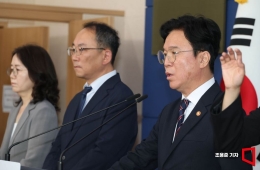
On this day at Seoul National University Bundang Hospital, Minister of Health and Welfare Jeong Eunkyung held a policy meeting to promote the expansion of public medical artificial intelligence (AX) with key regional medical institution leaders, including Kim Youngtae, President of Seoul National University Hospital; Song Junghan, President of Seoul National University Bundang Hospital; Yang Dongheon, President of Kyungpook National University Hospital; and Kim Inhee, Vice President for Medical Affairs at Jeonbuk National University Hospital. They shared examples of AI innovation in clinical settings.
At Seoul National University Bundang Hospital, AI is also playing a role in medication management, considered the frontline of patient safety. The hospital's Closed-Loop Medication Administration (CLMA) system uses RFID and barcodes to cross-check physicians’ prescriptions and actual medication administration in real time. According to 10 years of log analysis, potential medication errors, which previously reached 1.22% before the system was introduced, have dropped to just 0.0002% at the actual administration stage.
Seoul National University Hospital has released KMed.ai, a proprietary medical-specialized large language model (LLM) co-developed with Naver. The model assists clinicians by summarizing vast quantities of medical records and providing real-time clinical recommendations based on complex health insurance criteria and the latest research papers. Lee Hyungchul, Deputy Director of the Healthcare AI Research Division at Seoul National University Hospital, said, "In last year’s national medical licensing exam, KMed.ai scored 96.4 points, and more recently, 98 points, demonstrating highly sophisticated medical judgment. We possess one of the world's top-tier medical-specialized models."
Kyungpook National University Hospital has established a smart emergency transport system that connects 19 emergency medical institutions and fire departments in the Daegu and Gyeongbuk regions through its ‘AI-based Medical Innovation Center.’ Leveraging high-performance GPU infrastructure, the system predicts cardiac arrest risk among ER patients early and classifies their severity in real time to connect them with the optimal hospital, safeguarding the golden hour. Jeonbuk National University Hospital has introduced Doctor Pencil, a generative AI agent, freeing medical staff from the burden of filling out complex forms and increasing face-to-face time with patients. Additionally, its stroke diagnosis support technology helps facilitate rapid decision-making during emergencies.
Participants agreed that for the AI transformation (AX) of public healthcare to spread to other regions and to primary and secondary medical institutions, data must be organically shared and connected between institutions, going beyond the digitalization of individual hospitals. They also requested government support for computing resources such as GPUs and the cost of software maintenance, in order to sustain medical AI innovation.
Professor Jeong Sungmoon, head of the AI-based Medical Innovation Center at Kyungpook National University Hospital, said, "For regional hub hospitals to provide high-level medical services stably, it is essential to connect data between hospitals and to secure high-performance infrastructure such as GPUs that can process large-scale data. If the government supports software subscription and maintenance costs, along with a management system to continuously update and advance algorithms, it will be a significant boost to establishing a regionally self-sufficient smart public healthcare system."

On the 17th, at the 'Policy Meeting for the Expansion of Public Medical Artificial Intelligence' held at Seoul National University Bundang Hospital in Seongnam-si, Gyeonggi-do, Eun-Kyung Jung, Minister of Health and Welfare, is speaking. Ministry of Health and Welfare.
View original imageTo spread these innovation models from national university hospitals nationwide, the government has launched the ‘AI Primary Healthcare Task Force’ headed by the Second Vice Minister and plans to finalize and announce the ‘AI Primary Healthcare Strategy’ within the first half of this year. The goal is to build a 'Public Medical AI Expressway' that will dramatically strengthen the linkage of care among primary, secondary, and tertiary medical institutions using AI technology, thereby addressing regional disparities in healthcare, filling essential and public healthcare gaps, and allowing people across the country to access the necessary level of medical services wherever they are.
Hot Picks Today
 "Why Is the Amount in My Account So Low?"... Why Pension Savings Subscribers Were Surprised
- "I wanted her to feel my passionate love"... Wife collapses after husband's overly tight hug, diagnosed with broken ribs
- "Shocking Recording"... Comedian Who Sent a 'Straw' to Choo Mia Sends Jang Donghyuk a 'Drinking Cup'
- "After Sleeping Well with Strangers"... Who Is the 24-Year-Old Woman Who Won 19 Million Won?
- "Don't Come Back; the Net's a Fortress" 'Bukangi' Ends Monthlong Stay in Busan, Leaves Channel After 33 Days
Minister of Health and Welfare Jeong Eunkyung emphasized, "Although there are concerns about legal liability for misdiagnosis by AI, physicians will always make the final decision, and AI will be managed safely as a support tool. We will actively incorporate the tasks discussed at this meeting, such as establishing an AI cooperation system, financial support, and regulatory relaxation, to fully support national university hospitals so that they can serve as the forward base for AX."
© The Asia Business Daily. All rights reserved. Unauthorized AI training and use prohibited.