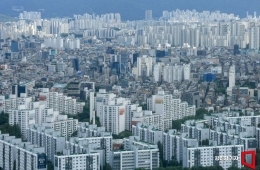
Seoul Home Prices Jump 9.8% While Sejong Plunges 24% [2026 Officially Assessed Prices]
Officially Assessed Apartment Prices in 2026
Housing Price Trends Over the Past Four Years:
Widening Gap Between Seoul and Other Regions
Daegu and Daejeon See Nearly 20% Declines
Median Price Falls Even in Seoul,
With Increases Limited to Affluent Districts Like Gangnam
This year, the officially assessed prices of apartment complexes nationwide have risen by more than 9% compared to last year, but most regions outside of Seoul have not recovered the sharp decline in housing prices from 2022. In particular, the recent increase in housing prices has been concentrated mainly in specific areas such as the Gangnam district of Seoul, further widening the gap between Seoul and other regions.
According to the officially assessed prices for apartment complexes released this year by the Ministry of Land, Infrastructure and Transport on March 17, the officially assessed prices for apartments, row houses, and multiplex homes have increased by an average of 9.16%. This is the largest increase in the past five years, following a 17.20% rise in 2022.
![Seoul Home Prices Jump 9.8% While Sejong Plunges 24% [2026 Officially Assessed Prices]](http://www.asiae.co.kr/news/img_view.htm?img=2026031710405378218_1773711652.jpg)
However, the average price over the past four years has actually decreased by 4.83%, dropping from 304.46 million won to 285.925 million won. This is due to the sharp 18.63% drop in the officially assessed prices in 2023, following the housing market crash in 2022.
During this period, only three out of the 17 metropolitan cities and provinces saw a rise in average prices: Seoul, North Jeolla, and Gangwon.
The average price in Seoul jumped by 9.83%, rising from 605.572 million won to 665.073 million won. Despite the sharp decline in 2023, the market rebounded strongly, not only recovering its losses but also reaching an all-time high. Gangwon and North Jeolla also experienced increases of 3.39% and 1.88%, respectively, offsetting their previous declines.
The largest drop occurred in Sejong City. The average price, which was 402.958 million won in 2022, fell by 24.70% to 303.446 million won this year. Daegu and Daejeon also recorded declines of 20.31% and 19.25%, respectively, over this period.
Gyeonggi Province (-11.78%) and Incheon (-13.59%), both part of the greater Seoul metropolitan area, also remain below their 2022 average price levels.
However, even in Seoul, the median price fell during this period. The median price refers to the value that lies at the exact midpoint when home prices are arranged in order. This year, the median price is 401 million won, down 9.48% from 443 million won in 2022.
The fact that the average price of apartment complexes in Seoul has risen while the median price has fallen is attributed to the price increases being limited mainly to high-end properties in affluent areas such as Gangnam and the Hangang Belt.
The only regions where the median price increased were North Chungcheong (up 1.98%), North Jeolla (up 1.60%), and Gangwon (up 0.90%). All other metropolitan areas and provinces saw declines in their median prices. Sejong and Daegu, which experienced drops in average prices of over 20%, also saw their median prices fall by 26.96% and 24.60%, respectively.
Hot Picks Today
 24-Year-Old Wins Sleep Contest, Takes Home 19 Million Won After Sleeping Soundly Alongside Strangers
- "My Portfolio Was Deep in the Red, I Didn't Even Want to Look" Companies That Shone Amid October's Market Plunge
- "Even Underwear Has to Be Cut Up with Scissors"... China Hit by Rise of "Trash Hunters" in an "If You're Slow, You're Out" Scramble
- "Be Careful If You See 'This' on Your Front Door"... Post Office Changes Notice Format
- "Photos of Kim Jong Un Released by North Korea Are a Deception"... Debate Over Death Rumors Continues
The gap in average prices between regions has also widened. The average price gap between Seoul and North Gyeongsang, which was 5.58 times in 2022, narrowed to 5.10 times the following year but has since expanded, reaching 6.38 times this year.
© The Asia Business Daily. All rights reserved. Unauthorized AI training and use prohibited.