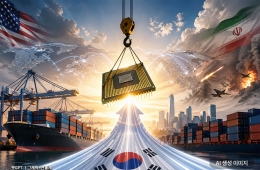
Trump Requests South Korean Warship Dispatch... Blue House: "Close US-Korea Communication, Careful Review"
Trump Names South Korea, China, and Japan on Truth Social
Blue House: "Closely Monitoring Middle East Developments... Exploring Ways to Ensure Safety of Supply Routes"
Blue House: "Freedom of Navigation in Maritime Routes Is Protected by Interna
On March 15, the Blue House announced that it is maintaining close communication with the United States and is carefully considering its response after U.S. President Donald Trump raised the need for the dispatch of naval vessels to the Strait of Hormuz, including by major countries such as South Korea, through Truth Social.

On December 29, 2025, President Lee Jae-myung commuted to the Blue House, marking the official reopening of the Blue House era after 3 years and 7 months. On this day, the phoenix flag was hoisted at the Blue House in Seoul. Photo by Jo Yongjun
View original imageA Blue House official stated on the same day, "We are paying attention to President Trump's comments on social media and will continue close communication between South Korea and the United States, reviewing the matter carefully before making a decision."
The Blue House also reiterated its position that the safety of international maritime transport routes and freedom of navigation are protected under international law. The official said, "The safety of international maritime transport routes and freedom of navigation align with the interests of all countries and are protected under international law," adding, "We hope that the global maritime logistics network will be normalized as soon as possible."
The official further explained, "While closely monitoring the situation in the Middle East and the trends of related countries, we are comprehensively considering and seeking various measures to protect our citizens and secure the safety of energy transport routes." The Strait of Hormuz is a critical passageway for global crude oil and liquefied natural gas shipments, accounting for about one-fifth of the world's oil and LNG cargo volume during normal times.
This statement from the Blue House came after President Trump stated the previous day on Truth Social that countries receiving oil via the Strait of Hormuz should take responsibility for the route. President Trump specifically named China, France, Japan, South Korea, and the United Kingdom, saying that countries affected by Iran's attempts to blockade the strait should send naval vessels together with the United States to keep the strait open and secure. This is the first time that President Trump has called on third countries, rather than Israel, to participate in military operations against Iran during a war with Iran. He also issued a hardline message, indicating that the United States would continue attacking Iran's coastline and sink Iranian ships and vessels.

Japan has adopted a cautious stance for now. Takayuki Kobayashi, Policy Research Council Chair of the Liberal Democratic Party, appeared on NHK and did not rule out the possibility of dispatching naval vessels, but noted that "the legal threshold is very high." Given that Japan relies on Middle Eastern oil for about 90% of its imports, the government is prioritizing immediate measures to mitigate energy shocks, such as releasing reserves through cooperation with the International Energy Agency (IEA), rather than a military response. Japan plans to release approximately 80 million barrels of private and national oil reserves starting on March 16.
Hot Picks Today
!["Don't Use Chinese-Made Products": One U.S. Warning Triggers a 5 Trillion Won Jackpot for Korean Batteries [Weekend Money]](https://cwcontent.asiae.co.kr/asiaresize/93/2025121709393659037_1765931975.jpg) "Don't Use Chinese-Made Products": One U.S. Warning Triggers a 5 Trillion Won Jackpot for Korean Batteries [Weekend Money]
"Don't Use Chinese-Made Products": One U.S. Warning Triggers a 5 Trillion Won Jackpot for Korean Batteries [Weekend Money]
- "Dividend Payouts of 40 Million Won Before Their First Birthday"...'Baby Shareholders' Put Ordinary Workers at a Disadvantage
- Foreign Tourists Leave in Tears Praising Seoul: "Wi-Fi So Fast, My Fingers Can't Keep Up" [K-holic]
- Gold-Plated Door Handles and All... The World’s Only Car Sets Cadillac’s All-Time Record at 1.8 Billion Won
- 'How Bad Was the Mistreatment'... Boss Tearfully Asks for Understanding and Generosity
China has not issued an official response to President Trump's request for the dispatch of naval vessels, but regarding the recent situation in the Middle East, it has emphasized the importance of a ceasefire and regional stability. On March 9, Chinese Foreign Minister Wang Yi called for an early ceasefire in the Gulf region and stated that the sovereignty, security, and territorial integrity of Gulf countries should be fully respected. On March 11, a spokesperson for the Chinese Foreign Ministry said that China does not agree with attacks on Gulf countries and condemned indiscriminate attacks targeting civilians and non-military facilities.
© The Asia Business Daily. All rights reserved. Unauthorized AI training and use prohibited.