Display Industry Faces 'Double Whammy' of Memory Prices and War... Samsung, LG Also Express Concerns Over Profitability
Rising Prices of Memory Semiconductors and Crude Oil
"Closely Monitoring the Situation... Second Half Expected to Be Challenging"
The heads of Korea's leading display companies have expressed concerns over rising memory semiconductor prices and the potential prolongation of the US-Iran war. They diagnosed that increased cost burdens during a period of investment in new businesses and business structure improvement could lead to deteriorating profitability.
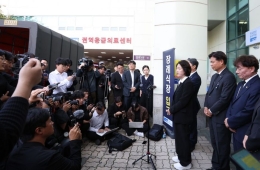
Lee Chung, President and CEO of Samsung Display, responded to reporters' questions on the 12th at Lotte Hotel Jamsil, Songpa-gu, Seoul, before the '2026 Korea Display Industry Association Annual General Meeting.' He said, "The situation is not favorable due to the increase in memory prices, and with inflation caused by the war, things are becoming even more difficult. Even if the first half of this year continues the momentum from last year, I expect the market conditions to become more challenging in the second half."

Lee Chung, President and CEO of Samsung Display, is responding to questions from reporters on the 12th at Lotte Hotel Jamsil, Songpa-gu, Seoul, before the '2026 Korea Display Industry Association Annual General Meeting'. Photo by Kim Jinyeong
View original imageHe added, "When crude oil prices rise, not only logistics costs but also the prices of most raw materials, such as film made from petroleum, go up. If the crisis in the Middle East is prolonged, the cost burden will become extremely significant. Honestly, there seems to be no way to overcome this. It is important to work with our partners to consider measures such as innovating our cost structure and strengthening our competitiveness."
Chuldong Jung, President and CEO of LG Display, also stated, "There is no immediate impact, but we are closely monitoring the situation in case the war drags on." He continued, "Set prices are rising due to higher memory costs, and we are analyzing how this might affect us. Although there are concerns from customers about price reduction pressures and memory supply, so far we have managed to overcome these challenges without significant impact."
Both companies expressed confidence regarding entry into new businesses. Previously, Samsung Display announced plans for full-scale mass production when it shipped samples of its 8.6th generation OLED panels in January. The 8.6th generation OLED uses glass substrates that are about 2.25 times larger than those of the 6th generation, enabling the production of notebook screens without wasting leftover glass. It is considered a game changer as it significantly reduces costs while increasing production efficiency by more than double.
Lee said, "Internal preparations for the 8.6th generation OLED are progressing as planned, and I expect production to proceed smoothly. I believe that if another IT boom occurs and OLED's unique strengths are highlighted, it will create excellent business opportunities."

Chuldong Jung, President and CEO of LG Display, is responding to questions from reporters on the 12th before the '2026 Korea Display Industry Association General Assembly' held at Lotte Hotel Jamsil, Songpa-gu, Seoul. Photo by Jinyoung Kim
View original imageLG Display, on the other hand, remains cautious regarding investment in 8.6th generation OLED panels. The company believes there is still insufficient visible demand to warrant a decision, and external uncertainties are high, so it plans to monitor the market situation a bit longer.
Jung said, "We are studying various technologies such as foldable and glass interposer and considering the timing for commercialization. Currently, we are focusing on integrating virtual design (VD) and AI into our product development, and we plan to further strengthen this area." Recently, LG Display drew attention as the first in the industry to be invited to NVIDIA's annual developer conference, GTC 2026. Its Digital Twin Panel Solution (DPS), developed based on NVIDIA's AI platform, reportedly captured NVIDIA's interest.
Jung emphasized, "We are continuously strengthening the company's fundamentals and moving toward generating stable profitability. I believe we can achieve good results in the first half of this year as well."
Previously, in April of last year, LG Display focused on improving its business structure by withdrawing from its last large LCD TV panel production base in Guangzhou, China, to concentrate on profitable businesses. After recording an operating loss of 560.6 billion won in 2024, LG Display achieved an operating profit of 517 billion won last year, successfully returning to profit for the first time in four years.
Hot Picks Today
 "I Ate It Often Because It Tasted Good"... This Eating Habit Linked to 40% Higher Odds of Asymptomatic Cerebrovascular Damage
- “Dad Just Gave It to Us as a Gift”... Scratched a Lottery Ticket at a Family Gathering and Hit a 1 Billion Won Jackpot
- "Why on earth come to Korea and do this?" ... Chinese Man in Hanfu Says He'll Promote Chinese Culture at Gyeongbokgung
- "My Stomach Was in Knots All Night After Eating a Hamburger"... Woman's Surprise Diagnosis After Tests Came Back Normal
- "What Is That Disgusting Lump in the Water?"... Bizarre Organism Found in Bukhan River
In its business report released yesterday, LG Display stated, "To expand production capacity for differentiated and competitive products such as OLED, we made capital investments totaling about 1.4 trillion won last year. This year, we plan to increase our investment to the upper 2 trillion won range, expanding from the previous year."
© The Asia Business Daily. All rights reserved. Unauthorized AI training and use prohibited.

!["Please Take Them Off!" They Made It All the Way to the Bed... Then "80% of Fecal Bacteria" Struck [Deep Scroll]](https://cwcontent.asiae.co.kr/asiaresize/307/2026101610053063338_1792112730.png)