Social Grand Reform Committee Under Prime Minister Proposes "Gradual Constitutional Amendment, Complete Abolition of Prosecutorial Investigative Powers"
The Social Grand Reform Committee under the Office for Government Policy Coordination has identified "gradual constitutional amendment" and "complete abolition of prosecutorial investigative powers" as urgent action items.
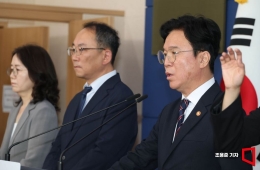
On the afternoon of March 10, the committee held a public briefing at the National Assembly Library and released a list of "urgent action items" containing these proposals. The action items are divided into four subcommittees—Political & Democratic, Economic & Livelihood, Social & Education & Human Rights, and Climate & Peace & History—comprising a total of 20 tasks.
The Political & Democratic subcommittee presented five tasks, including "constitutional amendment" and "complete abolition of prosecutorial investigative powers." The committee stated, "We propose a gradual constitutional amendment, taking into account the possibility of consensus, urgency, and the need for deliberation." It suggested prioritizing a "one-point constitutional amendment," such as "including the spirit of the May 18 Democratization Movement in the preamble," and gradually proceeding with more comprehensive and deliberative amendments, such as "rebuilding democratic constitutional order, expanding autonomy and decentralization, and expanding fundamental rights." In particular, the committee proposed that the "one-point constitutional amendment," which would serve as the first step in the gradual amendment process, should be pursued in conjunction with the nationwide local elections scheduled for June.
Regarding the government's prosecutorial reform initiative, the committee proposed the so-called "complete deprivation of prosecutorial investigative authority," which entails the full abolition of supplementary investigative and request rights. The committee argued, "The claims (by the prosecution) that the police lack investigative expertise or that there will be investigative gaps are not supported by objective evidence," and asserted, "Selective investigations and indictments by the prosecution have resulted in much greater and more serious public harm."
Other urgent action items proposed include a special law to investigate media control, reform of the local election system, and the relaxation of requirements for forming negotiating groups within the National Assembly (reducing the number of lawmakers required from 20 to 10).
The Economic & Livelihood subcommittee presented tasks such as "swift relief for victims of rental fraud," "establishing measures to prevent unfair practices by Coupang," "applying the Labor Standards Act to workplaces with fewer than five employees," "forming a public-private consultative body to manage imported agricultural products," and "abolishing the special judicial police system for street vendor crackdowns and transitioning to a consultative management system."
In other areas, tasks were identified such as "operating a task force to improve the system for workers outside industrial accident insurance coverage," "emergency measures to realize youth employment equality and rights protection," and "ensuring the safety of residents in border areas."
Hot Picks Today
 Short-Form Dramas Keep Popping Up... No Wonder: "1,519 Churned Out a Day"—Half of China's AI Tokens Go to Dramas
- [Exclusive] 'Korea's Largest' Business Card App Remember Hit by Data Leak... PIPC Probes Possible Hacking
- WHO Chief on First Korea Visit Since Taking Office: "AI Benefits for All Humanity"
- "Why Is the Amount in My Account So Low?"... Why Pension Savings Subscribers Were Surprised
- "I wanted her to feel my passionate love"... Wife collapses after husband's overly tight hug, diagnosed with broken ribs
The committee plans to discuss implementation measures for the proposed tasks in cooperation with the government and relevant agencies going forward.
© The Asia Business Daily. All rights reserved. Unauthorized AI training and use prohibited.