Pre-Feasibility for Population-Declining Regions to Focus Less on 'Economic Feasibility'... SOC Projects Under 100 Billion Won to Be Exempt
Economic Feasibility Weight Lowered by 5 Percentage Points for 89 Non-Metropolitan Areas
SOC Pre-Feasibility Threshold Raised from 50 Billion to 100 Billion Won
The government will undertake a comprehensive overhaul of the preliminary feasibility study (pre-feasibility) system for the first time in 27 years since its introduction in 1999, in response to the challenges of population decline and the risk of regional extinction. The main focus is to reduce the weighting of economic feasibility in the evaluation of projects in regions experiencing population decline and to increase the weighting for regional balance. In addition, the government will significantly raise the threshold for preliminary feasibility studies for social overhead capital (SOC) projects such as roads and railways, thereby increasing the scope for exemptions. The exemption pathway will also be widened for strategic investments aimed at stimulating regional growth.
Special Provisions for Regions Experiencing Population Decline: Lowering the 'Economic Feasibility' Bar and Emphasizing 'Regional Balance'

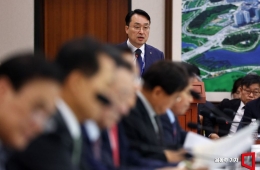
According to the Ministry of Economy and Budget, on March 10, Vice Minister Lim Kiguen, serving as Acting Minister, presided over the 3rd Fiscal Project Evaluation Committee meeting to discuss the 'Preliminary Feasibility Study System Reform Plan.' Under this plan, projects pursued in the 89 city, county, and district areas outside the Seoul metropolitan area that are experiencing population decline will face a significantly lower threshold for preliminary feasibility screening. The government plans to amend the relevant guidelines by May this year so that the changes can be immediately applied to the third round of project selections in 2025.
Currently, the evaluation weighting for projects in non-metropolitan regions experiencing population decline is 30-45% for economic feasibility and 30-40% for regional balanced development. Under the new plan, the weighting for economic feasibility will be lowered by 5 percentage points, while the weighting for regional balance will be increased by 5 percentage points, up to a maximum of 45%. Additionally, even within the metropolitan area, a new 'balanced growth evaluation' category (up to 5%) will be introduced for underdeveloped areas, and the weighting for economic feasibility will be reduced by 5 percentage points. The aim is to move beyond the dichotomous evaluation based solely on whether a region is inside or outside the metropolitan area and to genuinely reflect the unique characteristics of each region.
From 'Balanced Development' to 'Balanced Growth': Incorporating Qualitative Evaluation to Reflect Regional Potential
The approach of merely assessing regional underdevelopment will also change. The government will expand and reorganize the existing 'regional balanced development' category into 'regional balanced growth,' and will introduce qualitative evaluation criteria such as 'regional uniqueness' and 'future growth potential' in addition to quantitative indicators.
For example, in the case of cultural and tourism projects, the evaluation will now comprehensively consider how differentiated the region’s historical and cultural resources are, and whether continuous visitor demand can be generated through future international events or festivals. Furthermore, under the 'Balanced Growth Impact Assessment' system scheduled for introduction in 2027, projects receiving an 'excellent' rating will be given priority in the preliminary feasibility study selection. If sufficient prior feasibility studies have been conducted, exemption from the preliminary feasibility study may also be granted through a decision by the Cabinet.
SOC Pre-Feasibility Threshold Raised to 100 Billion Won: Replacement of Outdated Equipment Gets a 'Preliminary Feasibility Pass'
The efficiency of SOC and informatization projects will also be significantly improved. The threshold for SOC preliminary feasibility studies, which has remained at a total project cost of 50 billion won since the system’s introduction in 1999, will be raised to 100 billion won (with 50 billion won in national funding). Over the past decade, there have been 17 projects under 100 billion won that underwent preliminary feasibility studies, such as the 'installation of civil aviation facilities at Seosan military airfield' and 'construction of Heuksando Port.' Projects under 100 billion won accounted for 10.8% of all preliminary feasibility study cases over the past decade. In the future, these smaller-scale projects can be pursued solely based on review by the relevant ministries without requiring a preliminary feasibility study.
System reconstruction projects that simply replace outdated software (SW) or hardware (HW) will be newly designated as exempt from preliminary feasibility studies. This measure takes into account the practical difficulties of passing the preliminary feasibility study when it is hard to estimate additional benefits for projects that only involve equipment replacement without new function development. For informatization projects involving new technologies such as artificial intelligence (AI), a cost-effectiveness analysis (E/C) will be introduced, shortening the process from the current nine months to six months.
Hot Picks Today
 "I Should Enjoy It After Retirement": Prices Quadruple... Memberships Over 100 Million Won Popular, but Closures Mount
- "Jealous of Koreans" - Now a Must-Do on Every Trip... The Place Where Foreigners Spent KRW 229.8 Billion
- "I thought getting into a big company was the goal"... The 'position' only 1 in 121 employees reaches
- “The Strong Drink This” Goes Viral on Social Media... What China's Millennials and Gen Z Are Hooked on After Ditching Coffee and Milk Tea
- "Please Let Me Go Home"... Customers Trapped in Department Store Parking Lot for 5 Hours Vent Their Anger
Acting Minister Lim stated, "We have implemented the most significant reform to the preliminary feasibility study system since April 2019, reflecting the demands of the changing times," adding, "We will guide strategic fiscal investment by focusing on balanced growth investment and supporting key national agendas, and we aim to complete the follow-up procedures promptly so that the new system can be fully implemented by June."
© The Asia Business Daily. All rights reserved. Unauthorized AI training and use prohibited.