Blue House Announces "Petroleum Price Ceiling to Be Implemented This Week" Amid Soaring Oil Prices
Adjustment Every Two Weeks—First Time Since 1997
Foreign Exchange Tax Law Revisions and Korea-U.S. Strategic Investment Special Act to Be Discussed in National Assembly
Heads of Sub-Teams Under Joint Response Unit Upgraded from Grade 1 to Vice Minister Level
Economic Ministers' Meeting Converted to Emergency Economic Ministers' Meeting
'100 Trillion+ Alpha' Financial Market Response Further Expanded and Strengthened
The government has decided to implement a price ceiling system for petroleum products within this week to respond to the recent surge in oil prices originating from the Middle East. This marks the first time since 1997 that the government is reviving a price control measure, indicating its determination to directly curb the burden of high oil prices on ordinary citizens, separate from other measures to stabilize the foreign exchange and financial markets.

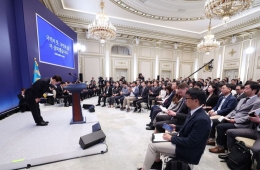
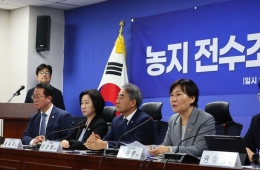
On March 9, Kim Yongbeom, policy chief at the presidential office, announced during a press briefing at the Chunchugwan that President Lee Jaemyung presided over an emergency economic review meeting focused on the Middle East situation and intensive discussions were held on stabilizing petroleum product prices. The meeting was attended by the Deputy Prime Minister for Economy and vice ministers from 11 government ministries. Deputy Prime Minister Koo Yooncheol reported on the real economic impact of the Middle East situation and cross-ministerial response plans; Minister of Trade, Industry and Energy Kim Jeonggwan presented measures for stabilizing the supply and prices of oil and gas; and Financial Services Commission Chairman Lee Eogwon gave an overview of market monitoring and response strategies.
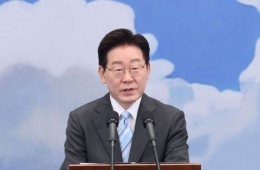
Kim stated, "We discussed detailed implementation plans for the price ceiling system to prevent abnormal pricing of petroleum products and ensure price predictability," adding, "The President also instructed us to push this forward as quickly as possible."
The government has clearly specified the timing for the implementation of the price ceiling. Kim explained, "We intend to put this into effect within this week at the latest. Although an official announcement process is required, we will proceed at maximum speed." He went on to say, "Basically, we are designing the system to be adjusted every two weeks. If we set the ceiling based on prices prior to recent developments, the initial ceiling price will be lower than the prices currently faced by consumers in the market." Even after the introduction of the ceiling, the government plans to adjust it every two weeks, rather than fix it for a long period, to buffer the shock from sharp price fluctuations.
To enhance the effectiveness of the price ceiling, the government will simultaneously inspect the entire refining and distribution process. Under the leadership of the Fair Trade Commission and the National Tax Service, they plan to investigate illegal activities such as collusion, tax evasion, and market manipulation, and will also conduct on-site inspections for refinery price surveys, tax audits, and the detection of counterfeit petroleum products. Kim stated, "Refineries will need to explain any sudden price hikes later, and we will examine these cases with the utmost rigor."
The government is taking a cautious stance regarding the release of oil from reserves. Currently, the nation has about 190 million barrels of oil stored, which is estimated to cover approximately 208 days according to International Energy Agency standards. However, considering the domestic demand from the petrochemical industry, the actual period for which the reserves could be used may be shorter. Therefore, the government plans to review a variety of scenarios, including the worst-case situation of a prolonged closure of the Strait of Hormuz.
To mitigate supply shocks, the government will prioritize exercising preferential purchase rights for jointly stored oil reserves with producing countries, convert production from Korea National Oil Corporation, and secure alternative supplies via strategic partners. In the case of gas, about 14% of the country's imports are sourced from the Middle East, and while there is a possibility of some disruptions to Qatari supplies, the government assesses that there is sufficient capacity to introduce alternative supplies, making the risk of immediate supply disruption low.
'100 Trillion+ Alpha' Financial Market Response Enhanced—Three Teams Under Joint Response Unit Upgraded from Grade 1 to Vice Minister Level

The government has also decided to strengthen its response to the increasingly volatile financial markets. Recent trends in key indicators such as stock prices and exchange rates have been excessively volatile compared to the fundamentals of the domestic economy, due to concerns about a prolonged Middle East crisis. In response, the government plans to swiftly execute a market stabilization program worth 100 trillion won as needed and is preparing additional expansion measures in advance if necessary. Kim stated, "Responding to market instability is the top priority. Basically, we have a 100 trillion won program at our disposal and can respond even to considerable shocks."
The government is also implementing measures to stabilize the foreign exchange market. Kim said, "To stabilize the foreign exchange market, we will actively cooperate with the National Assembly to expedite the passage of pending tax law amendments and special laws such as the Korea-U.S. Strategic Investment Special Act. We will also quickly establish a new framework for the National Pension Fund."
In addition, Kim stated, "To ensure thorough market management and block negative impacts on the real economy, we will upgrade the heads of the three sub-teams under the Middle East Situation Joint Response Unit from Grade 1 to Vice Minister level. We will also convert the Economic Ministers' Meeting, currently chaired by the Deputy Prime Minister for Economy, into an Emergency Economic Ministers' Meeting focused on the Middle East crisis, and conduct regular monitoring through President-led Emergency Economic Review Meetings."
Hot Picks Today
![[Exclusive] "Nvidia Researchers to Work in Yangjae"... LG Electronics to Establish 'Joint Robotics Development Base'](https://cwcontent.asiae.co.kr/asiaresize/93/2026092110452736212_1789955126.jpg) [Exclusive] "Nvidia Researchers to Work in Yangjae"... LG Electronics to Establish 'Joint Robotics Development Base'
[Exclusive] "Nvidia Researchers to Work in Yangjae"... LG Electronics to Establish 'Joint Robotics Development Base'
- "I’ll Take This, Please"... Buying the Last Lottery Ticket Brings a Jackpot
- "I Can't Believe There Are Such Kids These Days"... Middle School Students Help Elderly Man Collecting Scrap Paper All the Way to Junk Dealer
- "Contributing 9 Million Won Annually…430,000 Won per Month Steadily from Age 65" …The Power of the “Three-Tier Pension”
- "They Might Start Pitching Tents and Grilling Meat"... The 'Hammock Villain' Appears at Cheonggyecheon
The government has also made it clear that it intends to use this shock from the Middle East not just as an external variable, but as an opportunity to improve the structure of the Korean economy. Kim said, "The current Middle East situation is a crisis factor faced not only by us, but also by major competitors globally. As the President has emphasized, the government will make every possible effort to turn this crisis into an opportunity for the Korean economy." He added, "We ask the public to trust the government and focus on normal economic activities."
© The Asia Business Daily. All rights reserved. Unauthorized AI training and use prohibited.